
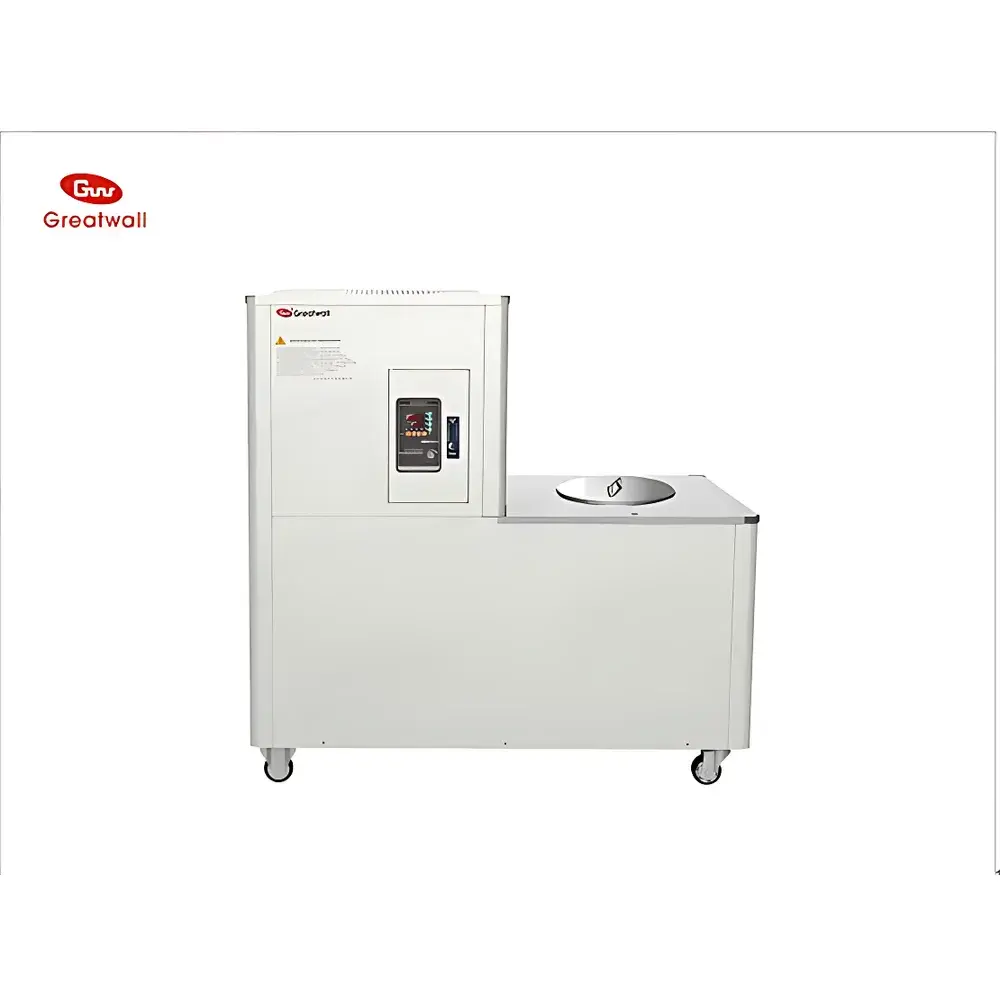
Great Wall DHJF-1030 Ultra-Low Temperature Circulating Cooling Bath
| Brand | The Great Wall |
|---|---|
| Origin | Henan, China |
| Manufacturer Type | Direct Manufacturer |
| Model | DHJF-1030 |
| Cooling Capacity | 620 W at −60 °C, 480 W at −80 °C, 200 W at −100 °C |
| Bath Volume | 30 L |
| Temperature Range | −100 °C to −60 °C |
| Temperature Stability | ±2 °C |
| Circulation Flow Rate | 20 L/min |
| Max. Pressure | 0.4 bar |
| Pump Power | 100 W |
| Total Power Consumption | 4 kW |
| Display | Digital LCD with 0.1 °C resolution |
| Refrigerant | Mixed refrigerant (R23/R13/R508B or equivalent) |
| Construction | 304 Stainless Steel bath & piping |
| External Port | 1/2″ NPT |
| Bath Dimensions | Ø400 × 235 mm |
| Footprint | 1160 W × 800 D × 1310 H mm |
| Weight | 180 kg |
| Ambient Operating Conditions | 5–35 °C, ≤70% RH, 3-phase 380 V / 50 Hz |
| Safety Protections | Phase sequence detection, overcurrent, overheating, delayed startup, thermal cutoff |
Overview
The Great Wall DHJF-1030 Ultra-Low Temperature Circulating Cooling Bath is an engineered solution for sustained, stable cryogenic temperature control in laboratory-scale chemical synthesis, low-temperature reaction monitoring, and material characterization applications. It operates on a single-stage compression cascade principle—utilizing a proprietary series-connected heat exchanger architecture—to achieve temperatures as low as −100 °C without requiring liquid nitrogen or multi-compressor systems. At its core, the unit integrates a hermetically sealed Panasonic scroll compressor, air-cooled finned-tube condenser with oxygen-free copper tubing, capillary tube expansion device, and a submerged coil-type evaporator housed directly within the 30 L 304 stainless steel reservoir. This configuration ensures mechanical robustness, minimal weld joints, and intrinsic safety during deep-cryogenic operation—particularly critical when handling thermally sensitive reagents or exothermic reactions below −80 °C.
Key Features
- Single-compressor cascade refrigeration system enabling −100 °C operation via serial heat exchange stages—eliminates complexity and reliability risks associated with dual-compressor designs.
- Submerged helical evaporator fully immersed in the bath fluid; structurally isolated from mechanical stress induced by cryogenic solidification of heat transfer media.
- Corrosion-resistant 304 stainless steel circulation loop and reservoir—compatible with common low-temperature heat transfer fluids including ethanol/methanol blends, ethylene glycol/water mixtures, and specialized silicone oils.
- Intelligent digital controller with high-resolution (0.1 °C) temperature display, intuitive keypad interface, and real-time operational status feedback.
- Comprehensive safety suite: phase-sequence monitoring, thermal cut-off relays, overcurrent protection, compressor delay start, and automatic shutdown upon abnormal temperature deviation or pressure anomaly.
- High-flow, low-noise shielded magnetic drive pump (100 W, 20 L/min @ 0.4 bar) optimized for consistent thermal homogeneity across external jacketed reactors or cold traps.
Sample Compatibility & Compliance
The DHJF-1030 is designed for integration with standard laboratory glassware up to 10 L capacity—including jacketed flasks, reactor vessels, and condensers—via its 1/2″ NPT external circulation port. Its 304 stainless steel wetted surfaces comply with general laboratory material compatibility requirements per ASTM E2913 (Standard Guide for Selection of Heat Transfer Fluids). While not certified to ISO/IEC 17025 or GLP-specific validation protocols out-of-the-box, the unit’s repeatable thermal stability (±2 °C across the full −100 °C to −60 °C range) supports method development aligned with USP “Thermal Analysis” and ASTM D3425 (Low-Temperature Flexibility Testing). Users implementing this system in regulated environments must perform IQ/OQ/PQ qualification per internal SOPs and FDA 21 CFR Part 11 requirements for electronic records.
Software & Data Management
The DHJF-1030 operates via embedded firmware with no external PC dependency. All operational parameters—including setpoint, actual bath temperature, compressor status, and fault codes—are logged locally on the LCD interface with timestamped event history accessible via menu navigation. While the unit does not feature Ethernet or USB connectivity, its analog output (0–10 V or 4–20 mA, optional upon request) enables integration into centralized LabVantage or DeltaV DCS platforms for trend logging and alarm forwarding. For audit-trail compliance, users are advised to pair the bath with third-party data acquisition hardware recording temperature vs. time at ≥1 Hz sampling rate, satisfying GLP documentation standards for thermal process verification.
Applications
- Catalytic hydrogenation and lithiation reactions requiring strict sub−80 °C thermal management.
- Low-temperature crystallization studies in pharmaceutical intermediate purification.
- Calibration of cryogenic sensors and reference thermometers per ISO 17025 traceability workflows.
- Condensation trapping in vacuum distillation setups operating below −90 °C.
- Material testing of polymer brittleness, elastomer hysteresis, or superconducting precursor stability under controlled thermal ramping.
- Support of FTIR or Raman spectroscopy cells requiring vibration-isolated, temperature-stabilized sample environments.
FAQ
Can the DHJF-1030 operate continuously at −100 °C with external circulation enabled?
No. Per manufacturer specification, external circulation must be disabled when bath temperature falls below −90 °C to prevent pump cavitation and thermal shock-induced seal failure.
What heat transfer fluids are recommended for use below −80 °C?
Ethanol/methanol blends (e.g., 60/40 v/v) or specialty low-viscosity silicone oils (e.g., DC-704) are validated for use. Aqueous glycols are prohibited below −40 °C due to freezing point limitations.
Is the unit compatible with 220 V single-phase power?
No. The DHJF-1030 requires three-phase 380 V / 50 Hz supply; voltage conversion or phase converters are not supported and void warranty.
Does the system include refrigerant charge documentation for EPA Section 608 compliance?
Yes—refrigerant type, mass, and charging procedure are provided in the technical manual; field service personnel must hold EPA-certified refrigerant handling credentials for maintenance.
What is the expected service interval for the scroll compressor?
Under continuous operation within ambient specifications (5–35 °C), the Panasonic compressor is rated for ≥30,000 hours MTBF; annual inspection of oil level and refrigerant pressure is recommended.



