
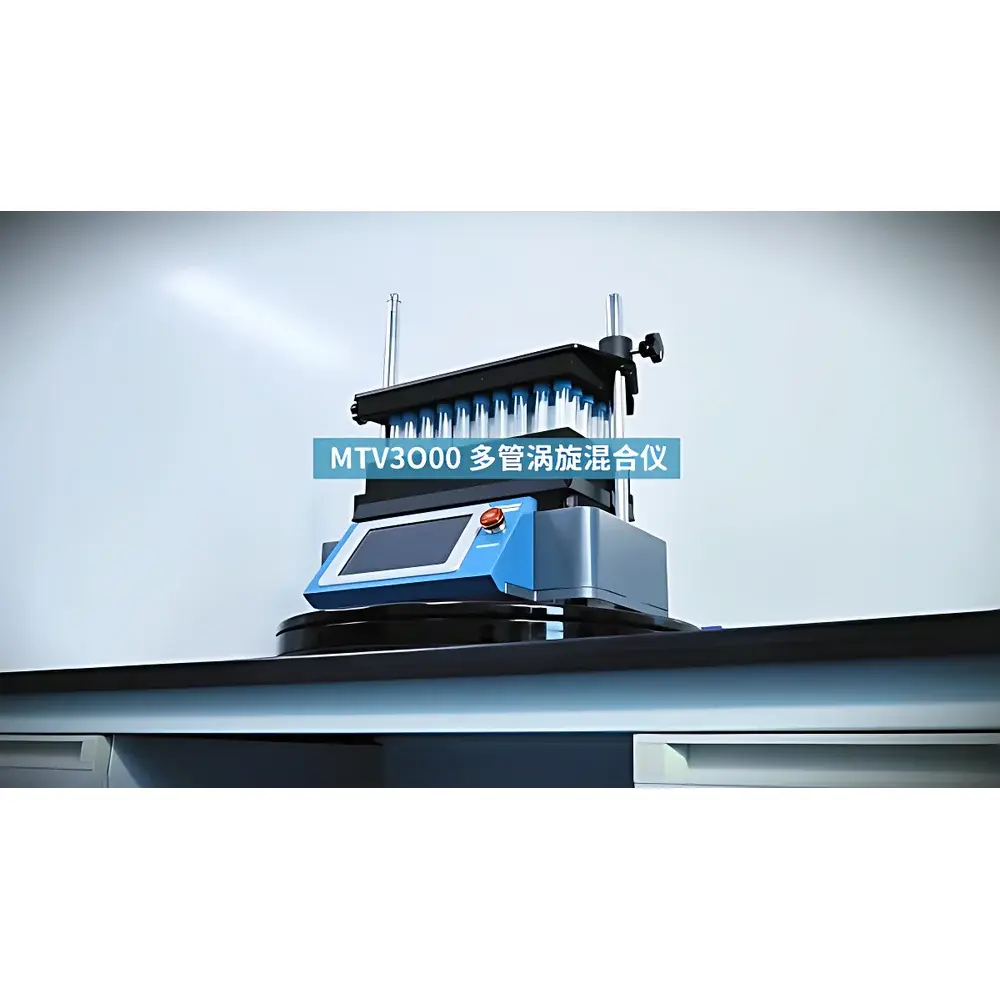
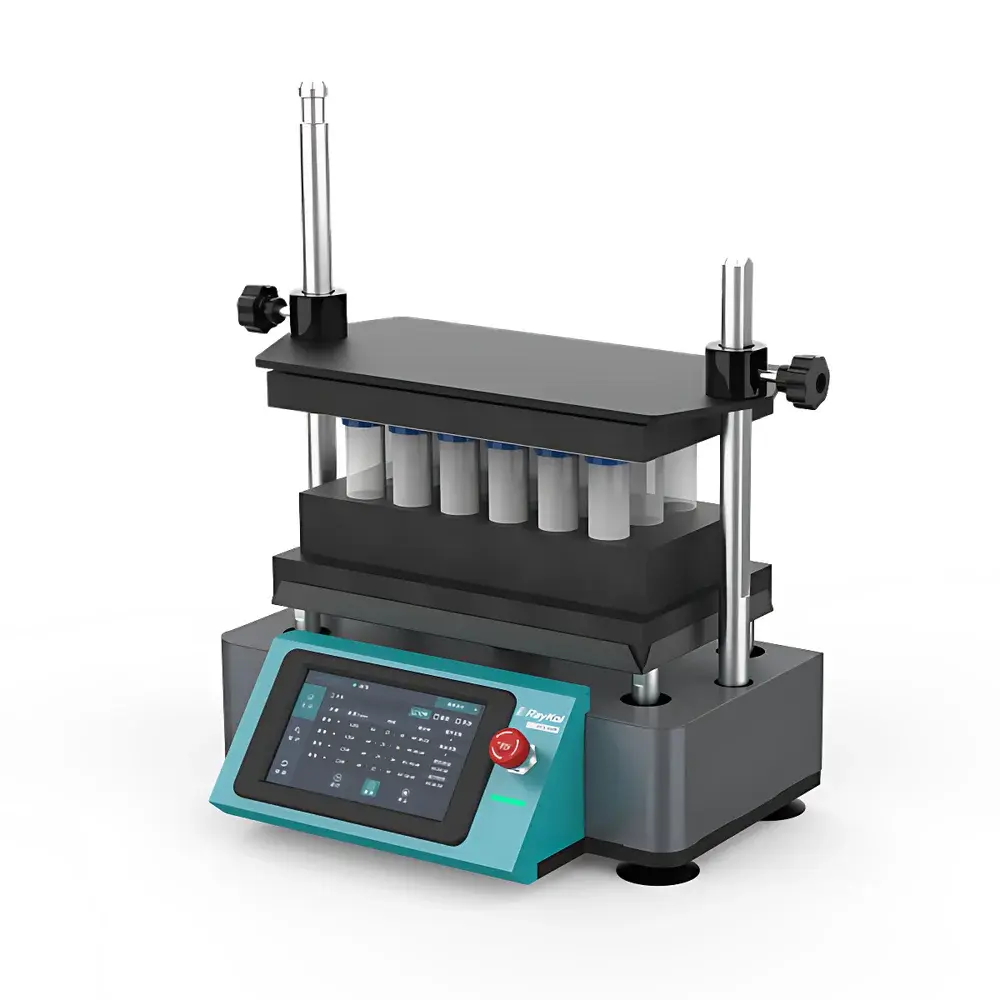
Raykol MTV3000 Multi-Tube Vortex Mixer
| Brand | Raykol |
|---|---|
| Model | MTV3000 |
| Origin | Fujian, China |
| Manufacturer | Raykol Group |
| Type | Benchtop Multi-Tube Vortex Mixer |
| Operating Mode | Continuous Orbital Oscillation |
| Speed Range | 200–3000 rpm |
| Motion Mechanism | Eccentric Drive |
| Amplitude | 3.6 mm |
| Sample Capacity | Up to 66 × 2 mL microcentrifuge tubes |
| Control Interface | 7-inch Full-Color Touchscreen Display |
| Programmability | Multi-step Method Editor (speed/time segments), Delayed Start, Cycle Repetition |
| Vibration Modes | 3 Predefined Oscillation Profiles (Standard, Gentle, Intense) |
| Rack Compatibility | Interchangeable Customizable Racks for 1.5/2.0 mL, 15 mL, 50 mL, and 100 mL Tubes |
| Compliance | Designed for GLP/GMP-aligned workflows |
Overview
The Raykol MTV3000 Multi-Tube Vortex Mixer is an engineered solution for high-throughput sample homogenization in regulated and research-intensive laboratory environments. Based on the principle of controlled eccentric orbital oscillation, the instrument generates reproducible, three-dimensional fluid agitation across multiple tubes simultaneously—enabling rapid dispersion, suspension reconstitution, and reagent mixing without cross-contamination. Unlike single-tube vortexers, the MTV3000 employs a rigid aluminum platform coupled with precision-machined eccentric drive mechanics to deliver consistent 3.6 mm amplitude motion across all positions, even at maximum speed (3000 rpm). Its architecture prioritizes mechanical stability under continuous operation, minimizing resonance-induced drift and ensuring uniform energy transfer regardless of tube fill volume or viscosity range (0.8–50 mPa·s typical). The device is purpose-built for laboratories performing routine extraction workflows—including QuEChERS-based pesticide residue analysis, nucleic acid isolation, and cell suspension preparation—where batch consistency, method traceability, and operator safety are critical.
Key Features
- High-capacity platform supporting up to 66 × 2 mL microcentrifuge tubes per run—optimized for parallel processing in QC, food safety, and pharmaceutical testing labs
- Eccentric drive system delivering stable, low-vibration orbital motion with ±0.5% speed accuracy across full 200–3000 rpm range
- 7-inch capacitive touchscreen interface with real-time parameter display (current speed, elapsed/remaining time, active method ID)
- Programmable multi-segment protocols: users define up to 5 sequential steps—each with independent speed, duration, and pause intervals—to replicate complex mixing sequences (e.g., initial gentle resuspension followed by vigorous homogenization)
- Three preset oscillation profiles calibrated for distinct sample types: Standard (balanced shear for general use), Gentle (low-energy mode for fragile cells or precipitated complexes), and Intense (high-shear mode for viscous matrices or aggregated pellets)
- Modular rack system compatible with standardized tube formats (1.5/2.0 mL, 15 mL, 50 mL, 100 mL); custom rack designs available upon request for non-standard containers
- Passive thermal management—no internal cooling/heating elements—ensuring compatibility with temperature-sensitive assays when operated within ambient lab conditions (15–30°C)
Sample Compatibility & Compliance
The MTV3000 accommodates common laboratory consumables including polypropylene and polyethylene microtubes, conical centrifuge tubes, and PCR strip tubes—provided wall thickness and dimensional tolerances meet ISO 7218:2017 specifications for microbiological sampling containers. It has been validated for use in workflows aligned with multiple international standards, including GB 23200 series (China National Food Safety Standards for pesticide residue analysis), USP Chromatography (for sample prep prior to LC-MS/MS), and AOAC Official Method 2007.01 (QuEChERS extraction). When deployed in GxP environments, the mixer’s programmable method storage and timestamped run logs support compliance with FDA 21 CFR Part 11 requirements when paired with a compliant electronic lab notebook (ELN) or laboratory information management system (LIMS) that enforces user authentication, audit trails, and electronic signatures.
Software & Data Management
The embedded firmware supports local storage of up to 100 user-defined methods, each containing complete parameter sets (speed, time, profile, segment count). All executed runs are logged with date/time stamp, operator ID (if configured via network integration), method name, and completion status. USB export enables CSV-formatted run history transfer for external review or quality assurance documentation. While the device does not include cloud connectivity or remote monitoring, its RS-232 port allows integration into centralized lab automation platforms for event-triggered logging or supervisory control. Firmware updates are performed via USB flash drive following IEC 62304 Class B software lifecycle controls.
Applications
- Food & Agricultural Testing: Homogenization of plant tissue extracts prior to GC-MS or LC-MS/MS analysis per GB 23200.113–2018 (208-pesticide multiresidue screening) and GB 23200.121–2021 (331-pesticide panel)
- Pharmaceutical Quality Control: Reconstitution of lyophilized reference standards and mixing of dissolution media per ChP 2020 General Chapter 2341 (Pesticide Residue Determination, Method V)
- Molecular Diagnostics: Uniform mixing of PCR master mixes, lysis buffers, and magnetic bead suspensions during DNA/RNA extraction workflows
- Veterinary Residue Analysis: Preparation of tissue homogenates for LC-MS/MS quantification per GB 31613.1–2021 (amprolium in bovine tissues) and GB 31656.11–2021 (tetracyclines in aquatic products)
- Toxicology Screening: Derivatization mixture agitation in biogenic amine analysis per GB 5009.208–2016
FAQ
What tube formats are supported out-of-the-box?
The standard configuration includes racks for 2 mL microcentrifuge tubes (up to 66 positions). Optional racks for 1.5 mL, 15 mL, 50 mL, and 100 mL tubes are available as accessories.
Is the MTV3000 suitable for use with volatile organic solvents?
Yes—provided tubes are securely capped and solvent compatibility with polypropylene or polyethylene is confirmed. The unit contains no internal seals or gaskets exposed to vapors.
Can run data be exported for regulatory submission?
Yes—via USB port in CSV format, including method name, start/end timestamps, speed settings, and operator ID (if enabled through network authentication).
Does the device meet electromagnetic compatibility (EMC) requirements for laboratory use?
It complies with IEC 61326-1:2012 for laboratory equipment (Group 1, Class A emissions; basic immunity per Table 2). CE marking is applied per EU Directive 2014/30/EU.
How is calibration verified?
Speed accuracy is factory-verified using NIST-traceable tachometry. Users may perform periodic verification using an external optical tachometer; no field calibration adjustment is required or supported.



