
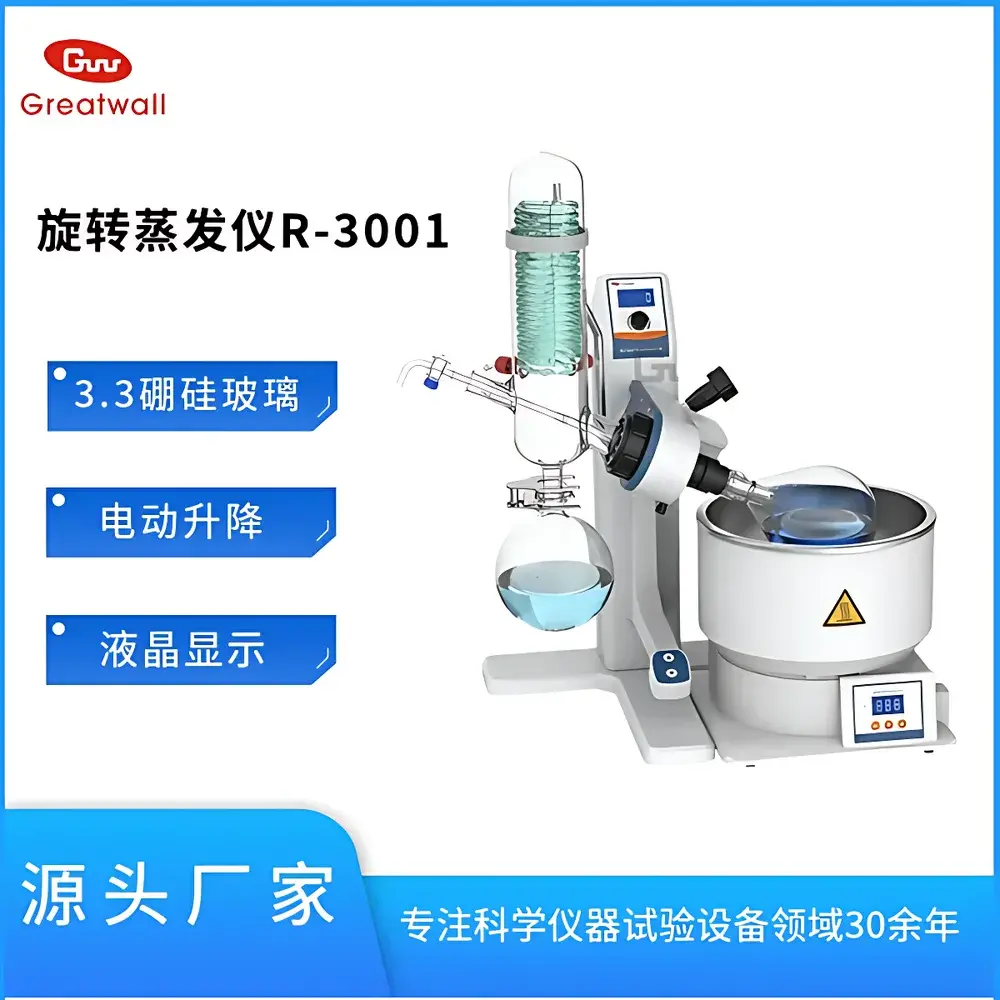
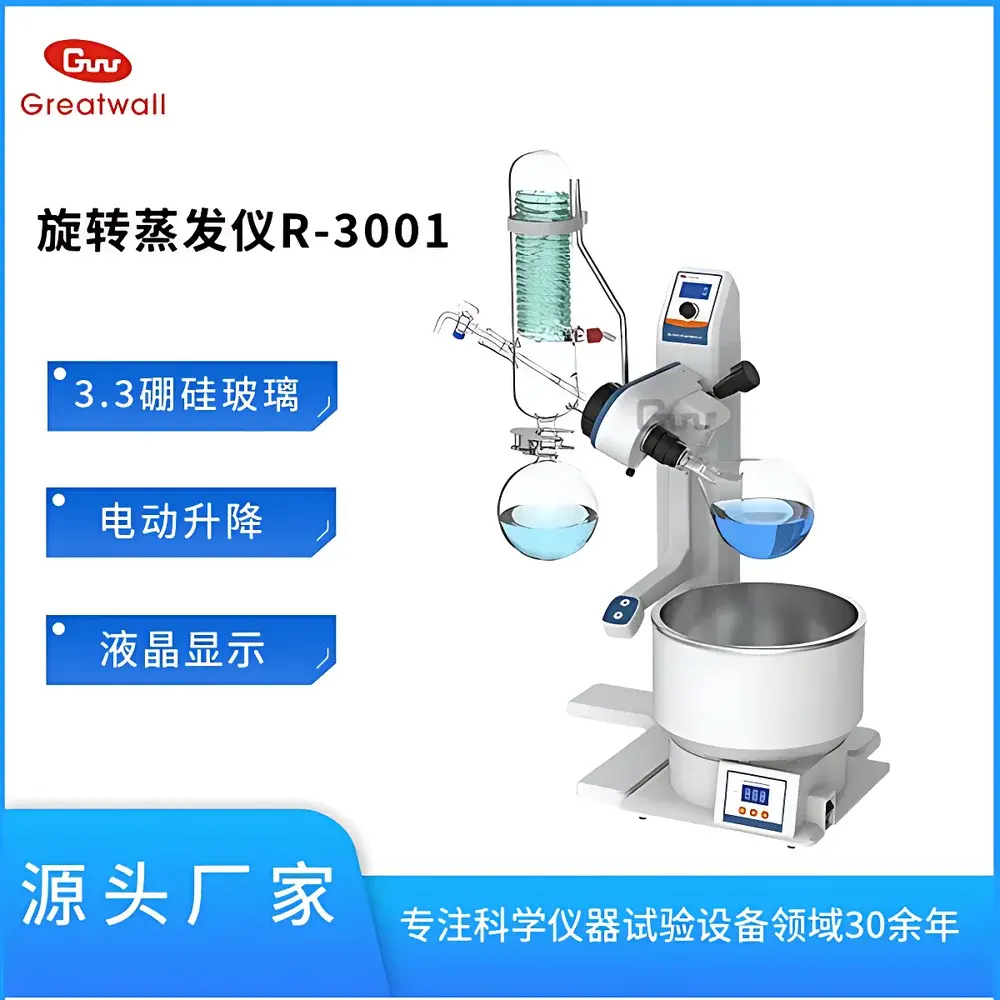
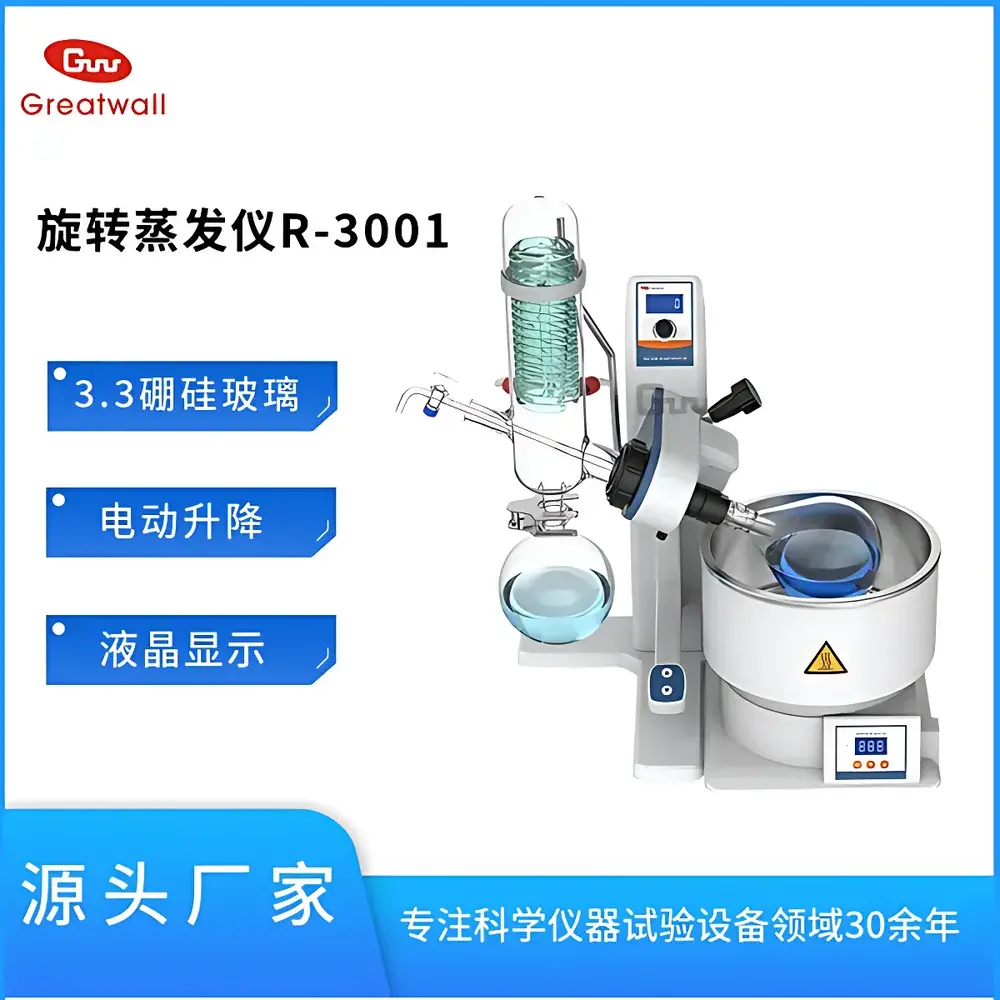
The Great Wall R-3001 Rotary Evaporator
| Brand | The Great Wall |
|---|---|
| Origin | Henan, China |
| Manufacturer Type | Direct Manufacturer |
| Model | R-3001 |
| Capacity | 1 L |
| Rotational Speed Range | 10–280 rpm |
| Bath Temperature Control Range | +5 to +95 °C |
| Condenser Area | 0.126 m² |
| Evaporation Rate (Water) | 23 mL/min |
| Sealing Leakage Rate | ≤ 0.33 kPa/min |
| Motor Power | 40 W |
| Lift Stroke | 150 mm |
| Display | LCD |
| Power Supply | 110 V / 60 Hz or 220–240 V / 50–60 Hz |
| Dimensions (W×D×H) | 620 × 400 × 700/850 mm |
| Weight | 10 kg |
| Sealing Material | PTFE-modified + FKM dual O-rings |
| Cold Trap Compatibility | Standard |
| Dry-Burn Protection | Yes |
| Bath Heating Method | Bottom heating |
| Rotation Angle Adjustment | Knob-controlled immersion angle |
| Bottle Ejection | Push-button axial lock release |
Overview
The Great Wall R-3001 Rotary Evaporator is an engineered solution for efficient, reproducible solvent removal and concentration under reduced pressure in research, quality control, and pilot-scale purification workflows. Based on the fundamental principle of rotary evaporation—where simultaneous rotation, vacuum application, and controlled bath heating reduce the boiling point of solvents while increasing surface area and heat transfer—the R-3001 delivers consistent performance across organic synthesis, natural product isolation, pharmaceutical formulation development, and analytical sample preparation. Its modular architecture separates the heating bath from the main evaporator unit, enabling flexible integration with vacuum pumps, chillers, and cold traps. Constructed entirely with Class-A borosilicate 3.3 glass components (including 1 L rotating flask and 1 L collection flask), the system ensures high thermal shock resistance, chemical inertness against acids, bases, and common organic solvents, and optical clarity for real-time process monitoring.
Key Features
- High-precision PID temperature control of the water/oil bath (±0.5 °C stability over +5 to +95 °C range) ensures repeatable distillation profiles and minimizes thermal degradation of thermolabile compounds.
- Dual-path reflux condenser with 0.126 m² effective cooling surface area maximizes condensation efficiency, especially during high-throughput evaporation of low-boiling solvents such as diethyl ether, dichloromethane, or acetone.
- PTFE-modified + fluorocarbon (FKM) dual-seal design at all critical joints guarantees long-term vacuum integrity (<0.33 kPa/min leakage rate), supporting operation down to ≤5 mbar without seal fatigue or swelling.
- Brushless DC motor with continuous 10–280 rpm speed regulation maintains stable rotational torque across load variations, eliminating slippage and ensuring uniform film formation on the flask interior wall.
- Motorized vertical lift mechanism (150 mm stroke) enables precise, vibration-damped positioning of the rotating flask relative to the condenser axis—critical for optimizing vapor path length and minimizing bumping.
- Detachable bath module with bottom-mounted heating element facilitates rapid cleaning, eliminates hot-spot accumulation, and incorporates automatic dry-burn cutoff to prevent heater damage during accidental empty-bath operation.
- Knob-adjustable flask immersion angle allows fine-tuning of solvent film thickness and residence time; push-button axial lock provides tool-free, one-handed flask removal after evaporation completion.
Sample Compatibility & Compliance
The R-3001 accommodates standard ISO-KF 25 and ISO-KF 35 ground-glass joints (rotating flask: 1 L, optional 500 mL; receiving flask: 1 L), compatible with widely adopted accessories including vacuum controllers (e.g., VACUUBRAND VRP 100), recirculating chillers (e.g., JULABO F25), and cold traps (e.g., LN₂ or dry-ice/methanol). All glassware complies with DIN ISO 3585 specifications for borosilicate 3.3 glass. While not certified to IEC 61010-1 or UL 61010B out-of-the-box, the system meets essential safety requirements for laboratory use under ambient conditions (5–40 °C, ≤70% RH) and supports GLP-compliant documentation when paired with validated vacuum and temperature logging systems. Its design aligns with common operational practices referenced in USP , ASTM E2654, and ISO 17025-accredited laboratories performing residual solvent analysis or extractables/leachables studies.
Software & Data Management
The R-3001 operates as a standalone instrument with embedded microcontroller-based logic. Temperature setpoint, actual bath temperature, and rotational speed are displayed simultaneously on a dual-line LCD interface. Though it does not feature native USB/Ethernet connectivity or proprietary software, its analog outputs (0–10 V or 4–20 mA optional upon request) support integration into centralized lab data acquisition systems (e.g., LabVIEW, DeltaV, or SCADA platforms) for time-stamped parameter logging. When deployed in regulated environments, users may implement external validation protocols—including IQ/OQ documentation, calibration traceability to NIST standards, and audit trails via third-party electronic lab notebooks (ELNs)—to satisfy FDA 21 CFR Part 11 requirements for electronic records and signatures.
Applications
- Concentration of crude reaction mixtures prior to chromatographic purification (e.g., post-Suzuki coupling workup).
- Removal of volatile solvents from polymer solutions, nanoparticle suspensions, or liposomal formulations without inducing aggregation.
- Preparative-scale solvent exchange in peptide synthesis (e.g., DMF → DCM transitions).
- Isolation of heat-sensitive phytochemicals (e.g., terpenoids, flavonoids) from botanical extracts using low-temperature, high-vacuum conditions.
- Routine QC testing of residual solvents in active pharmaceutical ingredients (APIs) per ICH Q3C guidelines.
- Distillation of fragrance oils and essential oil fractions under gentle thermal conditions to preserve volatile top notes.
FAQ
What vacuum level is recommended for optimal operation?
For most applications, a working vacuum range of 10–50 mbar is ideal; lower pressures (≤5 mbar) are suitable for high-boiling-point solvents but require enhanced condensation capacity and careful bumping control.
Can the R-3001 be used with corrosive solvents such as concentrated HCl or bromine solutions?
No—while borosilicate 3.3 glass resists mild acids and bases, prolonged exposure to strong oxidizers, halogens, or hydrofluoric acid will etch the glass surface and compromise structural integrity. Use only with chemically compatible solvents per Corning Pyrex® compatibility charts.
Is the heating bath compatible with silicone oil or ethylene glycol-based heat transfer fluids?
Yes—the stainless-steel bath vessel and bottom-heating element are rated for continuous operation up to 95 °C with non-aqueous heat transfer media; ensure fluid viscosity remains within pump-compatible limits if using external circulation.
Does the R-3001 include vacuum regulation capability?
No—vacuum control requires an external vacuum controller or manually adjustable needle valve; the unit includes only a vacuum gauge port (G1/4″ internal thread) for connection to third-party regulators.
What maintenance intervals are recommended for long-term reliability?
Inspect PTFE/FKM seals every 6 months or after 200 operating hours; clean condenser coils weekly with ethanol; verify bath temperature calibration annually using a traceable PT100 probe.



