
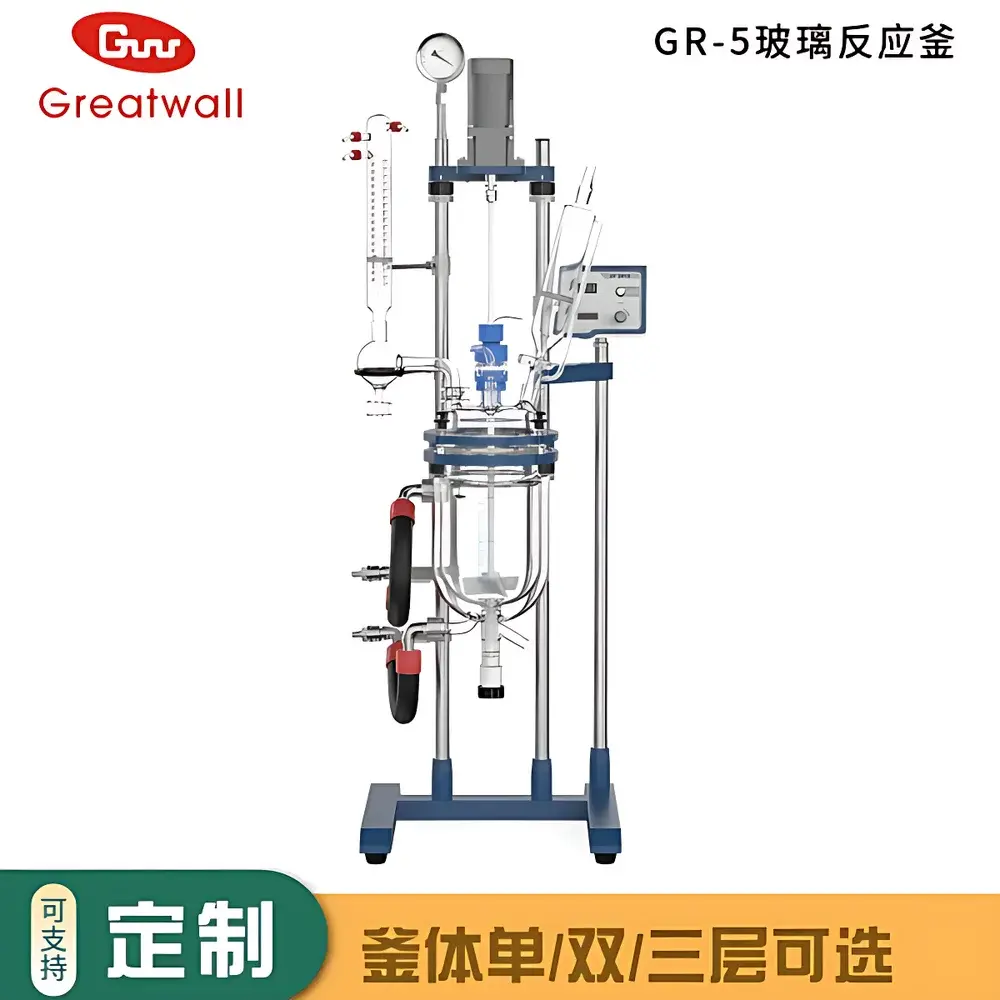
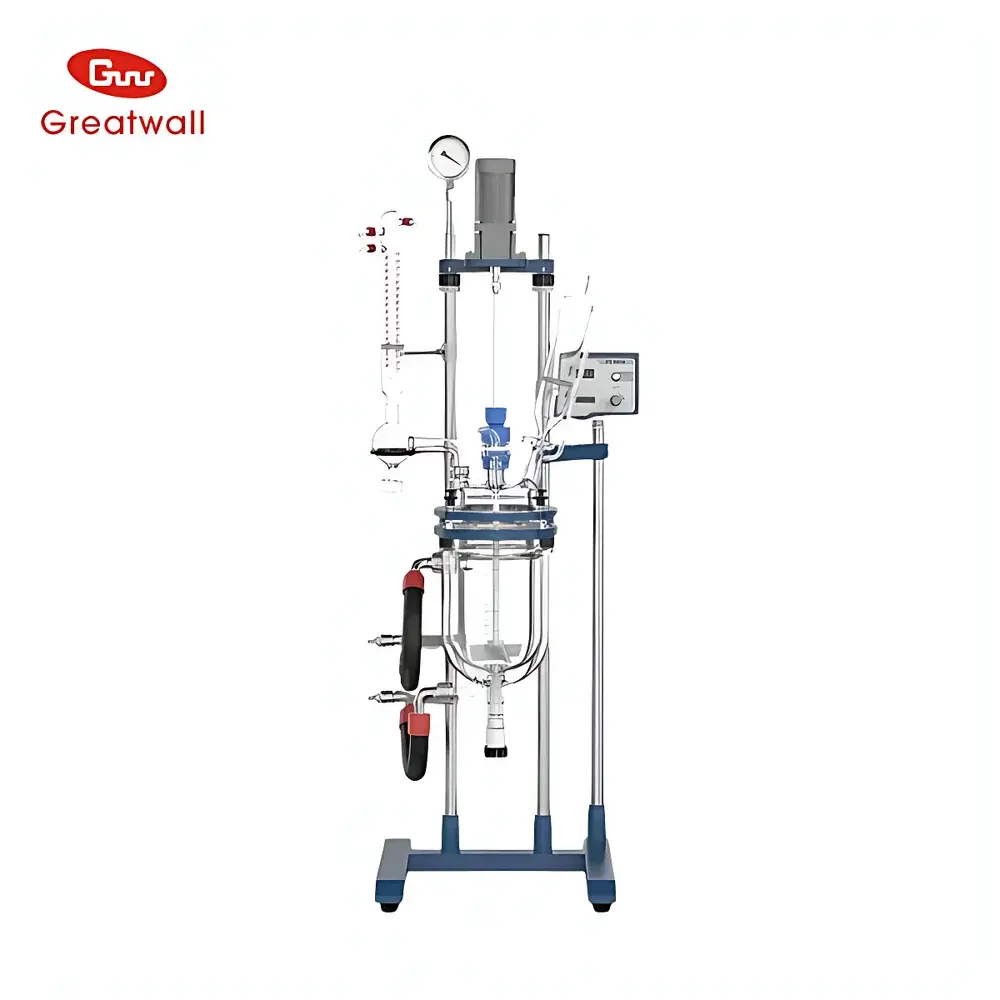
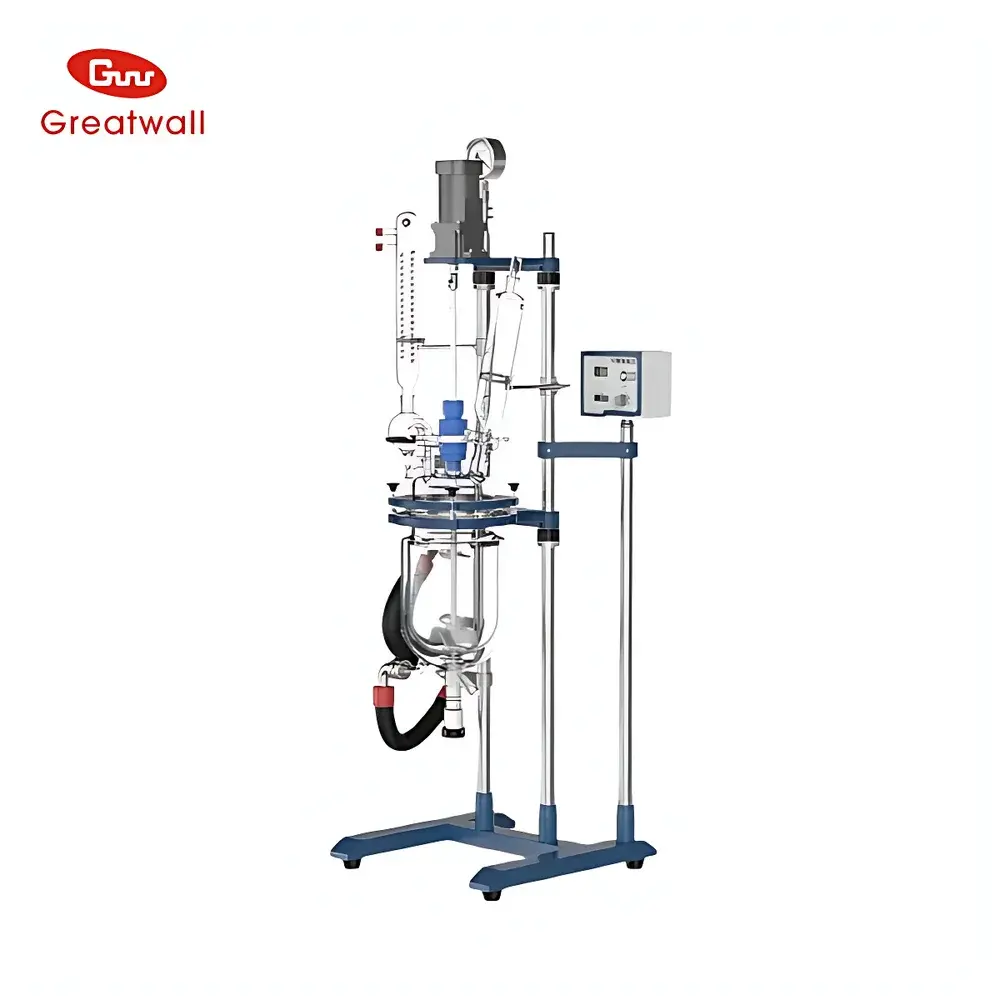
The Great Wall GR-5 Dual-Jacketed Variable-Speed Glass Reactor
| Brand | The Great Wall |
|---|---|
| Origin | Henan, China |
| Manufacturer Type | Direct Manufacturer |
| Origin Category | Domestic |
| Model | GR-5 |
| Instrument Classification | Jacketed Glass Reactor |
| Volume Class | Small-Scale |
| Vessel Material | Borosilicate Glass 3.3 |
| Operating Pressure | Low Pressure (Vacuum to Atmospheric) |
| Capacity | 5 L |
| Vacuum Level | 0.098 MPa (absolute) |
| Temperature Range | −80 °C to +200 °C |
| Jacket Pressure Rating | ≤ 0.03 MPa |
| Thermal Shock Resistance | 80 °C |
| Stirring Speed Range | 50–500 rpm |
| Speed Accuracy | ±1 rpm |
| Motor Power | 90 W |
| Drive Type | Three-Phase Asynchronous Motor with Frequency Converter Control |
| Sealing Type | Vacuum-Compatible Mechanical Seal |
| Stirrer Shaft & Blades | 06Cr19Ni10 Stainless Steel Core with PTFE Cladding |
| Stirrer Geometry | Single-Layer Four-Inclined-Blade Open Turbine |
| Condenser Surface Area | ~0.045 m² |
| Condenser Length | 435 mm |
| Standard Ground-Glass Joints | 29/32 and 50/50 |
| Bottom Valve Outlet Diameter | φ25 mm |
| Temperature Sensor | PT100, Digital Display, ±0.1 °C Accuracy |
| Frame Material | 06Cr19Ni10 Stainless Steel + Powder-Coated Carbon Steel + Anodized Aluminum |
| Overall Dimensions (W×D×H) | ~650 × 550 × 1600 mm |
| Net Weight | ~34 kg |
Overview
The Great Wall GR-5 Dual-Jacketed Variable-Speed Glass Reactor is an engineered laboratory-scale synthesis platform designed for controlled chemical reaction, distillation, concentration, and solvent recovery under vacuum or inert conditions. Its core architecture employs a double-walled borosilicate glass 3.3 vessel—comprising an inner reaction chamber and an outer thermal jacket—to enable precise, bidirectional temperature regulation via external circulating fluid (e.g., silicone oil, ethylene glycol/water mixtures, or cryogenic media). Unlike single-jacket systems, the dual-jacket configuration supports simultaneous process control and thermal insulation when operated with vacuum in the outer annulus (though the GR-5 implements only one functional jacket; the “dual-jacket” designation refers to its structural capacity for future thermal optimization pathways). The reactor operates within a pressure range of −0.1 MPa (gauge) to atmospheric, making it suitable for low-boiling-point reactions, vacuum distillations, and moisture- or oxygen-sensitive syntheses. All wetted glass components conform to DIN ISO 3585 specifications for borosilicate glass 3.3, ensuring high hydrolytic resistance (Class 1), thermal shock tolerance (ΔT = 80 °C), and long-term stability across −80 °C to +200 °C.
Key Features
- High-integrity vacuum-rated mechanical seal with PTFE-stabilized rotating assembly, rated for continuous operation at ≤0.098 MPa absolute pressure.
- Variable-speed stirring system powered by a 90 W three-phase asynchronous motor with frequency converter drive, delivering stable torque from 50 to 500 rpm (±1 rpm digital resolution).
- PTFE-clad stainless steel (06Cr19Ni10) stirrer shaft and four-inclined-blade open turbine impeller—optimized for radial flow, efficient mixing of heterogeneous phases, and minimal shear degradation of sensitive intermediates.
- Five standardized ground-glass ports (including one 50# central opening and two 29/32 side ports) support modular integration of condensers, dropping funnels, thermometers, gas inlets, and reflux accessories.
- Stainless steel frame with hybrid construction: load-bearing 06Cr19Ni10 elements, powder-coated carbon steel substructure, and anodized aluminum trim—engineered for corrosion resistance, structural rigidity, and ease of decontamination.
- Rc 3/4 threaded jacket inlet/outlet ports fitted with reinforced stainless steel insulated flexible hoses to eliminate thermal stress and prevent joint leakage during thermal cycling.
- Integrated PT100 temperature sensor with digital display (±0.1 °C accuracy) and independent readout—compatible with external PID controllers for closed-loop thermal management.
Sample Compatibility & Compliance
The GR-5 is compatible with a broad spectrum of organic, inorganic, and organometallic reaction systems—including Grignard formations, lithium–halogen exchanges, hydrogenations (with appropriate catalysts and gas handling), esterifications, and polymerizations. Its borosilicate glass 3.3 construction resists attack from most acids (except HF and hot concentrated phosphoric acid), alkalis (below pH 12 at elevated temperatures), and common organic solvents. The reactor meets fundamental design requirements outlined in ISO 15507 (laboratory glassware—mechanical and thermal performance) and aligns with general laboratory safety practices per IEC 61010-1. While not certified for explosion-proof use, its vacuum integrity and leak-tight sealing support safe operation under reduced pressure per ASTM E2913 (standard guide for vacuum system integrity testing). No CE, UL, or FDA 21 CFR Part 11 certification is claimed; users are responsible for validating suitability for GxP environments.
Software & Data Management
The GR-5 operates as a standalone analog-digital hybrid instrument: speed and temperature are monitored locally via LED displays, but no embedded microcontroller or data logging capability is included. For traceable process documentation, users may interface the PT100 output (2-wire or 3-wire configuration) and tachometer signal with external DAQ systems (e.g., National Instruments CompactDAQ, Keysight 34972A) compliant with GLP/GMP audit trail requirements. Optional third-party software packages—such as LabVIEW-based custom VI’s or MATLAB Instrument Control Toolbox scripts—can acquire, timestamp, and export real-time temperature/stirring profiles for regulatory submission. All glass joints follow ISO 2955/DIN 16909 standards, ensuring interchangeability with certified accessories from major vendors (e.g., Chemglass, Ace Glass, Kontes).
Applications
- Batch synthesis of fine chemicals and pharmaceutical intermediates under controlled thermal and vacuum conditions.
- Vacuum-assisted solvent removal and low-temperature concentration of heat-labile compounds (e.g., peptides, natural extracts).
- Reflux and fractional distillation setups using the integrated 435 mm air-cooled or water-jacketed condenser (0.045 m² effective surface area).
- Catalytic hydrogenation trials with H₂ sparging via side port, combined with precise temperature ramping and agitation control.
- Multi-step reaction sequences requiring sequential reagent addition through the 500 mL constant-pressure dropping funnel (29/32 joint).
- Material compatibility screening for new solvent systems or heterogeneous catalysts under reproducible shear and thermal profiles.
FAQ
What is the maximum allowable jacket pressure for the GR-5?
The outer jacket is rated for ≤ 0.03 MPa (gauge); exceeding this may compromise seal integrity or cause jacket deformation.
Can the GR-5 be used for exothermic reactions requiring rapid cooling?
Yes—when paired with a recirculating chiller capable of sub-zero outlet temperatures and sufficient flow rate (>2 L/min), the dual-jacket design enables rapid heat extraction with minimal thermal lag.
Is the bottom discharge valve fully drainable for quantitative transfer?
The φ25 mm PTFE-lined ball valve supports near-complete emptying; however, residual film adhesion on vertical glass surfaces is typical and must be accounted for in mass balance calculations.
Does the GR-5 include a built-in vacuum pump or refrigeration unit?
No—vacuum generation and thermal fluid circulation require externally connected equipment (e.g., diaphragm vacuum pump, immersion chiller, or heating/cooling circulator).
Are replacement glass components available as spare parts?
Yes—The Great Wall supplies certified borosilicate 3.3 replacements for the reactor body, lid, condenser, dropping funnel, and receiver flask, all with documented dimensional and thermal compliance certificates.



