
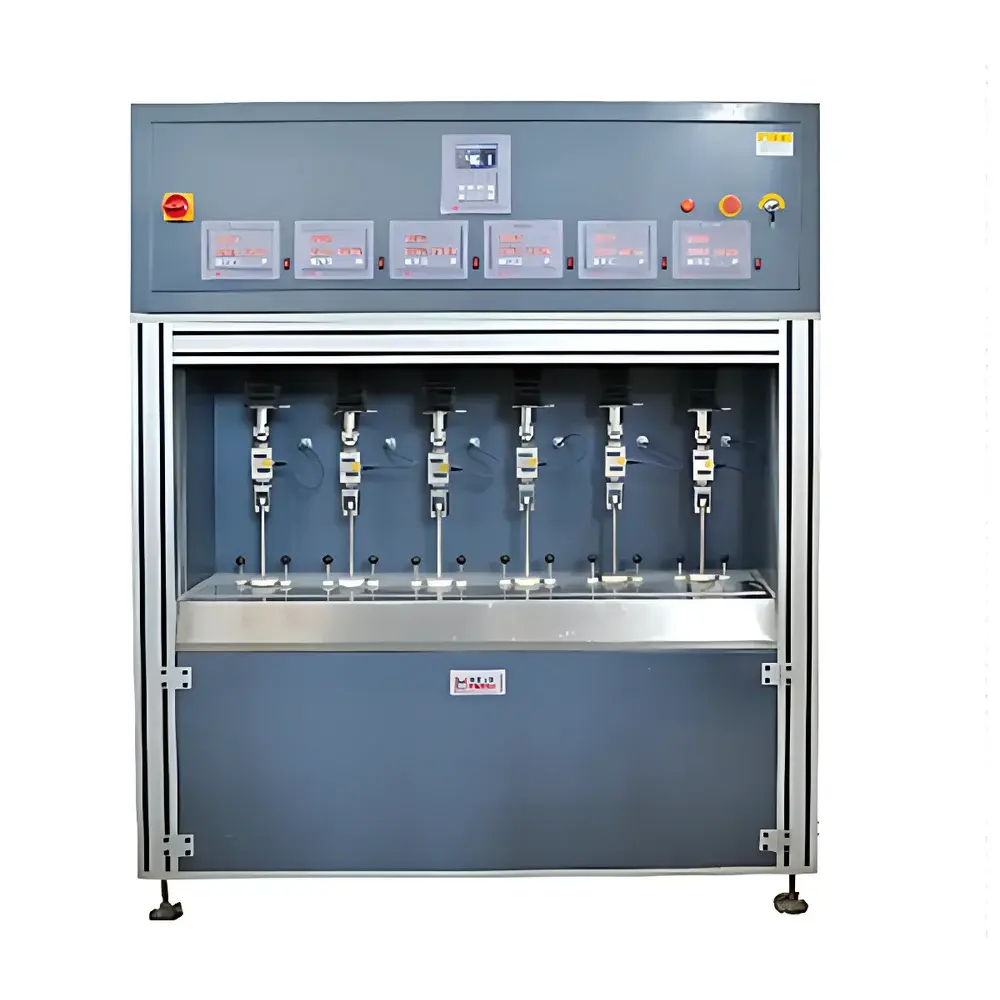
Hengyi HY(FNCT)0220W Full-Notch Creep Testing Instrument
| Brand | Hengyi |
|---|---|
| Origin | Shanghai, China |
| Manufacturer Type | Direct Manufacturer |
| Country of Origin | China |
| Model | HY(FNCT)0220W |
| Force Range | 20–5000 N |
| Force Accuracy | ±0.5% FS |
| Creep Displacement Range | 0–200 mm |
| Temperature Control Accuracy | ±0.5 °C |
| Test Stations | 6 or 12 independent stations |
| Power Supply | 380 V AC |
| Compliance Standards | GB/T 32682–2016, GB/T 15820, GB/T 11546, ISO 16770, ISO 3501 |
Overview
The Hengyi HY(FNCT)0220W Full-Notch Creep Testing Instrument is a precision-engineered system designed for standardized evaluation of environmental stress cracking (ESC) resistance in polyethylene and other thermoplastic polymers under static load conditions. Based on the fundamental principles of time-dependent viscoelastic deformation under constant tensile stress, this instrument implements the full-notch creep test (FNCT) method—defined in ISO 16770 and GB/T 32682–2016—to quantify failure time as a function of applied stress, temperature, and chemical environment. The system operates with specimens containing a machined circumferential notch, subjected to controlled axial tension within a thermostatically regulated water bath. Its architecture supports long-duration creep testing (up to thousands of hours), enabling reliable prediction of material service life in pipe, geomembrane, and pressure vessel applications.
Key Features
- Six or twelve fully independent test stations, each equipped with electromechanical loading actuators and real-time force feedback control—ensuring zero cross-talk between units during concurrent multi-condition experiments.
- Modular elastic support structure engineered to isolate mechanical vibration and thermal drift, maintaining measurement integrity over extended test durations.
- Integrated self-diagnostic firmware with overload protection, thermal runaway prevention, and position limit monitoring—designed for unattended operation in GLP-compliant laboratories.
- Precision temperature-regulated water bath subsystem with ±0.5 °C stability across the operational range (typically 23 °C to 80 °C), supporting both aqueous and surfactant-containing media per ISO 3501 and ASTM D1693 protocols.
- Dual-language (English/Chinese) PC-based control software compliant with 21 CFR Part 11 requirements for audit trail generation, electronic signatures, and secure data archiving.
Sample Compatibility & Compliance
The HY(FNCT)0220W accommodates standard FNCT specimens per ISO 16770: cylindrical polyethylene test bars (typically Ø10 mm × 100 mm) featuring a 0.5 mm deep circumferential notch. It also supports modified geometries for pipe extrusion validation and ASTM D2122-compliant pull-out testing of fused joint interfaces. All test configurations align with international regulatory frameworks including ISO 16770 (plastics — determination of environmental stress cracking resistance using full-notch creep test), ISO 3501 (plastics — determination of resistance to environmental stress cracking), and GB/T 32682–2016 (plastics — polyethylene — determination of environmental stress cracking resistance by full-notch creep test). The instrument meets essential requirements for GMP-aligned quality control labs and third-party certification bodies performing ESC validation for PE100 pipe systems.
Software & Data Management
The embedded Windows-based software provides synchronized acquisition of force, displacement, and temperature at user-defined intervals (minimum 1 s resolution). Raw data are stored in encrypted .hdf5 format with embedded metadata (operator ID, test standard, environmental parameters, calibration timestamps). Automated post-processing generates standardized outputs: time-to-failure (TTF) at specified stress levels, creep strain rate curves, and Weibull distribution plots for statistical lifetime modeling. Export options include CSV, PDF reports with traceable calibration certificates, and XML files compatible with LIMS integration. Audit logs record all user actions—including parameter changes, data exports, and software updates—with immutable timestamps and digital signatures.
Applications
- Environmental stress cracking resistance (ESCR) qualification of PE-RT, PE-X, and HDPE resins for gas/water distribution pipes.
- Accelerated aging studies of geosynthetic liners exposed to landfill leachate or aggressive soils.
- Comparative assessment of antioxidant package efficacy under elevated temperature and surfactant exposure.
- Validation of fusion joint integrity in butt-welded polyethylene pipeline segments per ISO 13954.
- Research into time-temperature superposition (TTS) behavior of semi-crystalline polymers using master curve construction.
FAQ
What standards does the HY(FNCT)0220W explicitly support?
It is configured and validated for GB/T 32682–2016, GB/T 15820, GB/T 11546, ISO 16770, ISO 3501, and ASTM D1693 Annex A4.
Can the system operate without continuous PC connection?
Yes—the controller includes onboard non-volatile memory for up to 30 days of standalone data logging; PC connectivity is required only for setup, real-time monitoring, and report generation.
Is calibration traceable to national metrology institutes?
Force transducers are calibrated per ISO 376 Class 0.5, with NIST-traceable certificates provided for each unit upon delivery.
What maintenance intervals are recommended for long-term reliability?
Annual verification of thermal uniformity, force linearity, and displacement encoder accuracy is advised; water bath filtration and antifouling treatment should occur every 90 days in continuous operation.
Does the software support automated pass/fail decision logic per ISO 16770 acceptance criteria?
Yes—users may define threshold TTF values and confidence intervals; the system flags outliers and generates summary statistics per ISO 5725–2 repeatability requirements.



