
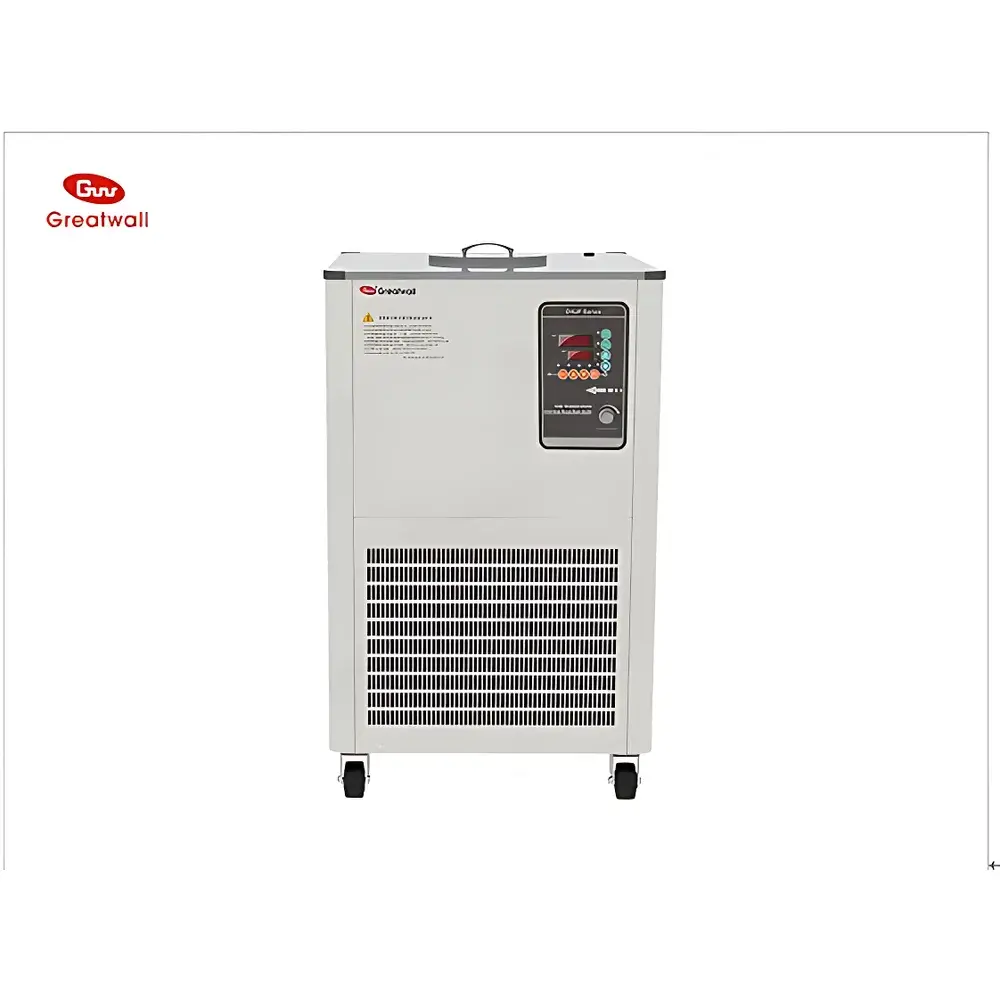
Zhengzhou Great Wall Scientific Industrial & Trading Co., Ltd. DHJF-1010 Low-Temperature Constant-Temperature Stirred Reaction Bath
| Brand | The Great Wall |
|---|---|
| Origin | Henan, China |
| Manufacturer Type | Direct Manufacturer |
| Country of Origin | China |
| Model | DHJF-1010 |
| Quotation | Upon Request |
| Cooling Capacity | 160 W at −60 °C, 70 W at −80 °C, 40 W at −100 °C |
| Bath Volume | 10 L |
| Temperature Range | −100 °C to −60 °C |
| Temperature Stability | ±2 °C |
| Control Resolution | 0.1 °C |
| Magnetic Stirring Power | 50 W |
| Stirring Speed | 100–1000 rpm |
| Refrigerant | Mixed Cryogenic Refrigerant |
| Rated Power | 2050 W |
| Bath Material | 304 Stainless Steel |
| External Dimensions (W×D×H) | 670 × 780 × 1085 mm |
| Net Weight | 150 kg |
| Ambient Operating Conditions | 5–35 °C, ≤70% RH |
| Power Supply | 220–240 V~, 50 Hz |
| Drain Port | 1/2″ NPT |
| Bath Opening Diameter | Ø210 mm |
| Bath Internal Dimensions | Ø250 × 250 mm |
| Max Flask Capacity | 3000 mL |
| Safety Protections | Delayed Start, Overcurrent, Overtemperature |
Overview
The Zhengzhou Great Wall Scientific Industrial & Trading Co., Ltd. DHJF-1010 Low-Temperature Constant-Temperature Stirred Reaction Bath is an engineered solution for precise cryogenic reaction control in synthetic chemistry, low-temperature catalysis, and materials science applications. Designed around a single-stage compression cascade refrigeration architecture with serial heat exchangers, the system achieves stable operation down to −100 °C without requiring liquid nitrogen or multi-compressor configurations. Its core thermodynamic design employs a custom mixed refrigerant blend circulated through a hermetically sealed Tecumseh-type reciprocating compressor, copper-brazed finned-tube air-cooled condenser, capillary tube expansion device, and immersed coil-type evaporator directly integrated into the 304 stainless steel bath reservoir. This configuration ensures high thermal efficiency, mechanical robustness, and long-term operational reliability under continuous sub-zero duty cycles. The bath’s structural integrity—welded refrigerant circuitry, minimal joint count, and corrosion-resistant wetted surfaces—meets fundamental requirements for GLP-compliant laboratory environments where reproducibility and contamination control are critical.
Key Features
- Single-compressor cascade refrigeration system enabling −100 °C operation via serial heat exchange and phase separation technology
- Immersion-type coil evaporator fully submerged in the 10 L 304 stainless steel bath, eliminating risk of freeze-induced mechanical failure
- Digital intelligent controller with 0.1 °C temperature resolution, real-time display, and programmable ramp/soak profiles
- Integrated magnetic stirring subsystem (50 W, 100–1000 rpm) with adjustable torque and non-contact coupling for sealed reactor compatibility
- Air-cooled condenser with oxygen-free copper helical tubing for enhanced heat transfer and simplified maintenance
- Comprehensive safety suite: delayed compressor restart, overcurrent cutoff, and dual-stage overtemperature protection on both refrigeration circuit and bath wall
- Standardized 1/2″ NPT drain port and Ø210 mm access opening for seamless integration with jacketed reactors and distillation assemblies
Sample Compatibility & Compliance
The DHJF-1010 accommodates standard laboratory glassware up to 3000 mL volume—including round-bottom flasks, jacketed reactors, and Schlenk tubes—via its Ø250 × 250 mm internal bath geometry. All wetted components comply with ASTM A240/A240M for 304 stainless steel, ensuring resistance to common organic solvents (e.g., THF, diethyl ether, liquid ammonia) and cryogenic brines. While not certified to IEC 61010-1 or UL 61010B as a standalone appliance, the unit adheres to fundamental electrical safety principles required for Class II laboratory equipment. Its operational envelope (5–35 °C ambient, ≤70% RH) aligns with ISO/IEC 17025 environmental conditioning guidelines for calibration-sensitive instrumentation. For regulated QC/QA workflows, the analog temperature output signal (0–5 V or 4–20 mA optional) supports traceable data logging compatible with 21 CFR Part 11–compliant SCADA systems when interfaced via external DAQ hardware.
Software & Data Management
The DHJF-1010 operates via embedded firmware with no proprietary PC software dependency. Temperature setpoints, stirring speed, and alarm thresholds are configured directly on the front-panel interface. For laboratories requiring audit trails, the unit provides analog process outputs that integrate with third-party data acquisition platforms (e.g., LabVIEW, Delta Tau PMAC, or Siemens Desigo CC). These interfaces support timestamped logging, trend analysis, and automated report generation in accordance with GLP documentation standards. No onboard data storage or network connectivity is included—consistent with industry practice for dedicated cryogenic baths where deterministic real-time control takes precedence over cloud-based telemetry.
Applications
- Low-temperature Grignard and organolithium reactions requiring sustained −78 °C to −100 °C bath stability
- Catalytic hydrogenation under cryogenic conditions to suppress side reactions and improve selectivity
- Polymerization initiation kinetics studies where precise thermal ramping below −60 °C influences molecular weight distribution
- Crystallization screening of pharmaceutical intermediates using controlled sub-zero nucleation protocols
- Calibration of cryogenic sensors and reference thermometers per ASTM E220 or ISO 5725
- Pre-cooling of analytical sample streams prior to GC or HPLC injection in method development labs
FAQ
What refrigerant is used in the DHJF-1010, and is it compliant with current environmental regulations?
The unit employs a proprietary mixed refrigerant formulation optimized for single-compressor cascade operation at ultra-low temperatures. It contains no R22, R134a, or other substances listed under the Montreal Protocol Annex A Group I or II. Current composition complies with EU F-Gas Regulation (EU) No 517/2014 for stationary refrigeration equipment.
Can the DHJF-1010 be operated continuously at −100 °C?
Yes—continuous operation at −100 °C is supported within the specified ambient conditions (5–35 °C, ≤70% RH) and with adequate ventilation around the condenser. Duty cycle limitations do not apply provided voltage supply remains within 220–240 V~ tolerance.
Is the magnetic stirrer compatible with PTFE-coated stir bars and glass-jacketed reactors?
The stirrer delivers consistent torque across the full 100–1000 rpm range and is fully compatible with standard PTFE- or ceramic-coated stir bars. Its coupling design avoids ferromagnetic interference, making it suitable for use beneath double-walled reactors with vacuum or inert gas jackets.
Does the unit include validation documentation for IQ/OQ protocols?
Factory-supplied documentation includes electrical schematics, refrigerant charge records, and as-built dimensional drawings. Full IQ/OQ execution requires user-defined test scripts aligned with internal SOPs; no pre-validated qualification packages are shipped.
What maintenance intervals are recommended for long-term reliability?
Condenser coil cleaning every 6 months (or more frequently in dusty environments), refrigerant leak inspection annually, and verification of bath seal integrity before first use after extended storage. No scheduled compressor oil changes are required—hermetic design eliminates serviceable lubrication points.



