
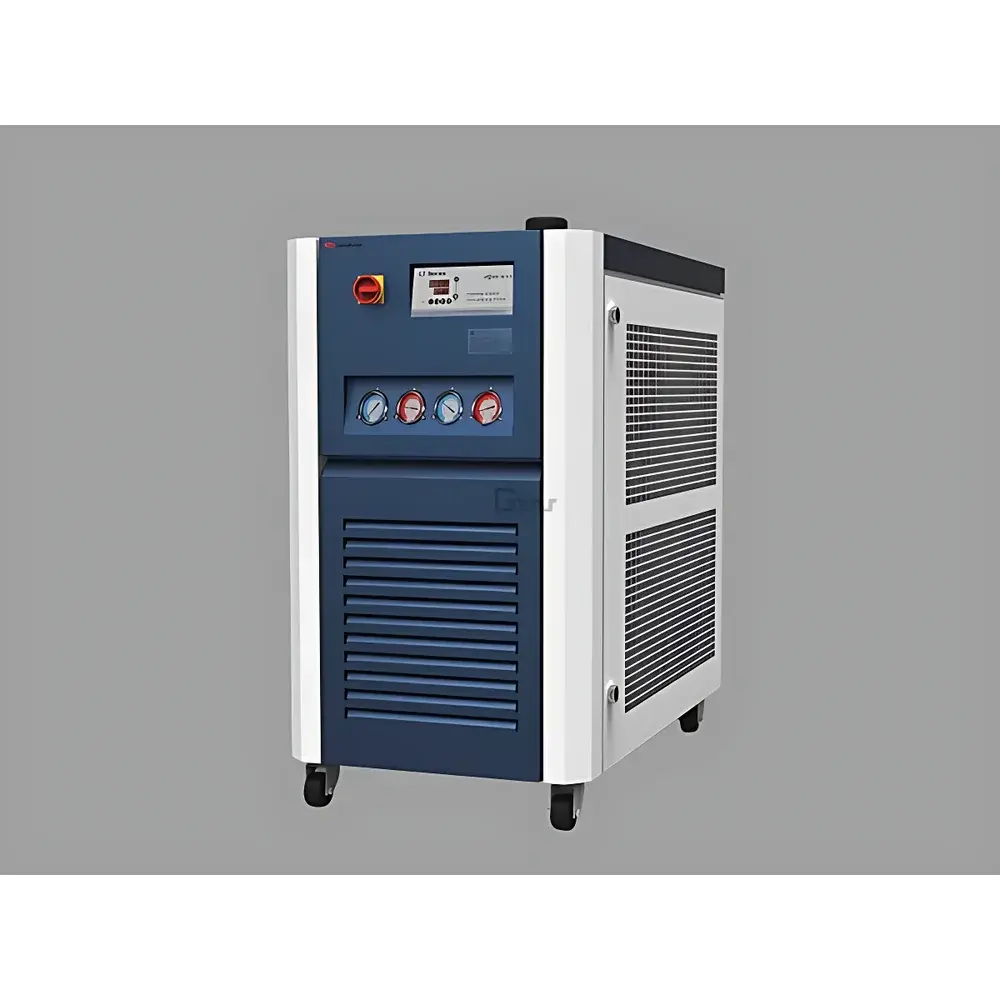
Great Wall LT-100-80 Low-Temperature Circulating Chiller
| Brand | The Great Wall |
|---|---|
| Origin | Henan, China |
| Manufacturer Type | Direct Manufacturer |
| Product Category | Domestic |
| Model | LT-100-80 |
| Instrument Type | Constant-Temperature Bath Chiller |
| Circulation Mode | Internal & External Loop |
| Temperature Control | Heating-Only Mode |
| Bath Volume | 10 L |
| Temperature Range | −80 °C to +40 °C |
| Temperature Stability | ±2 °C |
Overview
The Great Wall LT-100-80 Low-Temperature Circulating Chiller is an engineered thermal management system designed for precise, stable delivery of sub-ambient cooling fluids in laboratory and pilot-scale chemical synthesis environments. Unlike conventional water baths or heating-only circulators, the LT-100-80 integrates a dual-stage cascade refrigeration architecture capable of sustaining bath temperatures as low as −80 °C—enabling exothermic reaction control, cryogenic condensation, and low-temperature crystallization workflows. Its operational principle relies on closed-loop circulation of heat-transfer fluid (typically ethanol/water or silicone oil) through external process equipment—including jacketed reactors (20 L, 50 L, and 100 L), condensers, or analytical instrumentation—while maintaining setpoint accuracy within ±2 °C under dynamic load conditions. The unit is constructed with corrosion-resistant stainless-steel fluid pathways and features insulated bath housing to minimize ambient thermal interference.
Key Features
- Wide operational temperature range from −80 °C to +40 °C, optimized for deep-cryogenic applications without requiring liquid nitrogen or dry ice supplementation
- 10-liter stainless-steel bath reservoir with integrated level sensor and overflow protection to ensure consistent fluid volume during extended operation
- Dual-mode circulation system supporting both internal recirculation (for bath temperature homogenization) and external loop delivery (with adjustable flow rate and pressure up to 2.5 bar)
- Heating-only temperature control architecture—ideal for applications where active cooling is managed externally or where refrigeration capacity must be decoupled from heating regulation
- Robust mechanical design with industrial-grade compressors, copper-aluminum finned condensers, and vibration-dampened mounting to support continuous 24/7 operation in QC and R&D laboratories
- Front-panel digital interface with real-time display of bath temperature, setpoint, and system status; manual calibration offset adjustment supported for traceable thermal validation
Sample Compatibility & Compliance
The LT-100-80 is compatible with standard heat-transfer media including 30% aqueous ethylene glycol, 50% ethanol/water mixtures, and low-viscosity silicone oils (e.g., DC200 series). It interfaces seamlessly with jacketed glass reactors (Chemglass, Ace Glass), rotary evaporators, and vacuum distillation systems via standard 1/2″ NPT or G1/2″ BSP quick-connect fittings. While not certified to UL/CSA or CE for North American/EU commercial sale, its electrical and refrigerant handling conforms to GB/T 21362–2008 (Chinese national standard for laboratory chillers) and ISO 5170-2:2017 (thermal performance testing methodology). Users implementing this chiller in regulated environments (e.g., pharmaceutical process development) are advised to perform IQ/OQ qualification per internal SOPs and document thermal stability per ASTM E2922–22 (Standard Guide for Thermal Validation of Laboratory Equipment).
Software & Data Management
The LT-100-80 operates as a standalone instrument with no embedded data logging or network connectivity. Temperature setpoints and operational status are monitored locally via the LED interface. For integration into automated lab environments, optional analog 0–10 V or 4–20 mA output signals (available upon request) enable connection to PLC-based control systems or SCADA platforms. All units ship with a comprehensive English-language user manual covering safety protocols, maintenance schedules (including compressor oil inspection intervals and filter replacement guidelines), and troubleshooting matrices aligned with common failure modes (e.g., low-flow alarm, high-pressure cutout, bath temperature drift). Audit-ready calibration records may be generated manually using external NIST-traceable thermistors and documented per GLP-compliant templates.
Applications
- Low-temperature catalytic hydrogenation and Grignard reactions requiring sustained −70 °C to −80 °C reactor jacket control
- Cryogenic precipitation and polymorph screening in API development workflows
- Condenser cooling for high-boiling-point solvent removal under reduced pressure
- Thermal conditioning of FTIR, UV-Vis, and fluorescence spectrometers with temperature-sensitive detectors
- Supporting multi-step synthesis in parallel reactor systems (e.g., ChemSpeed or Uniqsis platforms) where independent thermal zoning is required
- Calibration reference baths for thermometer and RTD verification across extended sub-zero ranges
FAQ
What types of heat-transfer fluids are recommended for use with the LT-100-80?
Ethanol/water (50/50 v/v), propylene glycol/water (30/70), or low-viscosity silicone oils (e.g., Dow Corning DC200 10cSt) are validated for full temperature range operation. Avoid chlorinated solvents or glycerol-based fluids due to viscosity-related pump strain at low temperatures.
Can the LT-100-80 be used for both heating and cooling simultaneously?
No—the LT-100-80 is configured exclusively for heating-only temperature regulation. Active refrigeration is provided by the built-in cascade compressor system; heating elements are not present. Temperature reduction is achieved solely via refrigerant cycle modulation.
Is external insulation of the circulation tubing required?
Yes—especially when operating below −40 °C. Uninsulated tubing will cause significant heat ingress and reduce effective cooling capacity at the process endpoint. We recommend vacuum-jacketed or multilayer foam-insulated hoses rated to −100 °C.
Does the unit include overtemperature or low-level safety cutoffs?
Yes—integrated hardware interlocks monitor bath temperature deviation (>±5 °C from setpoint), fluid level (via capacitive sensor), and high-head pressure (compressor discharge >3.2 MPa), triggering immediate shutdown and visual alarm.
What maintenance intervals are recommended for uninterrupted operation?
Compressor oil inspection every 1,000 operating hours; refrigerant circuit leak check annually; bath reservoir cleaning and fluid replacement every 6 months or after 300 hours of continuous sub-zero operation.



