
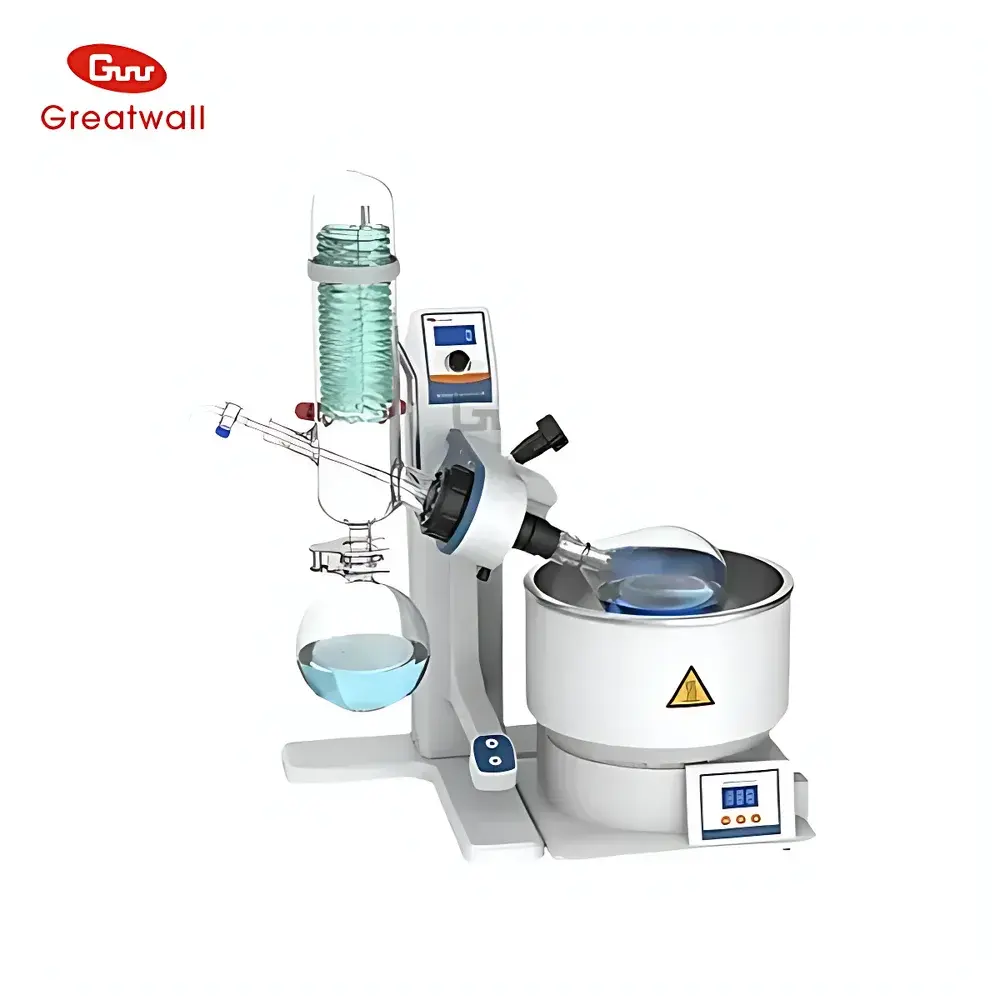
Shanghai Great Wall R-3001 Benchtop Motorized Lifting Rotary Evaporator
| Brand | Shanghai Great Wall |
|---|---|
| Origin | Henan, China |
| Manufacturer Type | Direct Manufacturer |
| Country of Origin | China |
| Model | R-3001 |
| Capacity | 1 L |
| Rotation Speed | 10–280 rpm |
| Condensing Area | 0.126 m² |
| Lifting Stroke | 150 mm |
| Sealing System | PTFE + Fluoroelastomer Dual-Seal |
| Condenser Type | Dual-Reflex Cold Finger |
| Evaporation Rate (Water) | 23 mL/min |
| Evaporation Rate (Ethanol) | 25 mL/min |
| Motor Power | 40 W |
| Display | LCD Digital |
| Vacuum Rise Rate | ≤ 0.33 kPa/min |
| Protection Features | Overcurrent, Ground Fault, Short-Circuit |
| Operating Temperature | 5–35 °C |
| Relative Humidity | ≤ 70 % RH |
| Power Supply | 110 V~, 60 Hz or 220–240 V~, 50/60 Hz |
| Dimensions (W×D×H) | 620 × 400 × 700/850 mm |
| Weight | 10 kg |
| Certification | CE (TUV certified) |
Overview
The Shanghai Great Wall R-3001 Benchtop Motorized Lifting Rotary Evaporator is an engineered solution for efficient solvent removal, fractional distillation, and compound purification under reduced pressure. Based on the principle of rotary evaporation—where a rotating flask increases surface area and promotes uniform thin-film formation while heat transfer occurs via a thermostatically controlled water or oil bath—the R-3001 delivers consistent performance in academic research labs, quality control environments, and small-scale pilot production. Its modular architecture separates the main drive unit from the heating bath, enabling flexible configuration with external chillers, vacuum controllers, and cold traps. Designed for reproducibility and operational safety, the system complies with CE directives verified by TÜV SÜD, supporting laboratories operating under ISO/IEC 17025-accredited workflows or GLP-compliant documentation requirements.
Key Features
- Motorized vertical lift mechanism with 150 mm stroke, enabling precise positioning of the rotating flask relative to the heating bath—critical for optimizing evaporation kinetics and preventing bumping.
- Stepless speed control (10–280 rpm) via digital LCD interface, ensuring stable rotational torque across viscosity ranges without belt slippage.
- Dual-reflux condenser with 0.126 m² effective cooling surface, fabricated from high-conductivity borosilicate glass and optimized for rapid vapor condensation at low coolant temperatures (e.g., −10 °C to +10 °C).
- PTFE-fluoroelastomer dual-seal rotary joint, rated for continuous operation under vacuum down to <5 mbar, minimizing seal degradation during prolonged use with aggressive solvents including chlorinated hydrocarbons and esters.
- Synchronous belt transmission system reduces mechanical noise (<55 dB(A)) and eliminates gear backlash, contributing to long-term rotational stability and bearing longevity.
- Integrated electrical protections: overcurrent cutoff, ground fault detection, and short-circuit isolation—aligned with IEC 61000-6-2 immunity standards.
Sample Compatibility & Compliance
The R-3001 accommodates standard 500 mL and 1000 mL evaporation flasks (ISO 2955 taper), paired with a 1000 mL collection flask. It supports aqueous, alcoholic, and moderately polar organic solvent systems—including water, ethanol, acetone, ethyl acetate, and dichloromethane—within its validated evaporation rate envelope (23 mL/min for water; 25 mL/min for ethanol, measured at ΔT = 50 °C between bath and vapor phase). All wetted parts are chemically resistant borosilicate 3.3 glass or PTFE-lined stainless steel. The unit meets EN 61010-1:2010 for laboratory electrical equipment safety and carries CE marking per Machinery Directive 2006/42/EC and EMC Directive 2014/30/EU, as certified by TÜV SÜD. It is suitable for use in environments compliant with USP Analytical Instrument Qualification protocols when integrated into documented IQ/OQ/PQ validation frameworks.
Software & Data Management
While the R-3001 operates as a standalone analog-digital hybrid instrument with local LCD readout, its vacuum inlet and bath temperature interfaces are compatible with third-party vacuum controllers (e.g., Vacuubrand VACUU·SELECT) and programmable circulators (e.g., Julabo F25). When connected to such devices, full parameter logging—including real-time rotation speed, bath temperature, and system pressure—is achievable via RS232 or analog 0–10 V outputs. Audit-trail-capable data acquisition systems may record timestamps, operator IDs, and setpoint deviations—supporting 21 CFR Part 11 compliance when deployed within validated electronic lab notebook (ELN) ecosystems.
Applications
- Concentration of natural product extracts (e.g., plant alkaloids, essential oils) prior to HPLC or GC-MS analysis.
- Removal of reaction solvents following Grignard, Suzuki, or esterification syntheses.
- Recovery and recycling of high-purity solvents in QC/QA laboratories.
- Preparative-scale dehydration of heat-sensitive biomolecules under gentle vacuum conditions.
- Teaching laboratory demonstrations of colligative properties, vapor pressure depression, and phase equilibrium principles.
FAQ
What vacuum level is recommended for optimal performance with the R-3001?
For most low-boiling solvents (e.g., diethyl ether, acetone), a system pressure of 10–50 mbar is typical. For higher-boiling compounds (e.g., glycerol, PEG), pressures below 5 mbar—achieved using a secondary cold trap—are advised.
Can the R-3001 be integrated with automated vacuum control?
Yes—its vacuum inlet accepts standard 1/4″ Swagelok fittings and is compatible with PID-controlled vacuum regulators offering analog or digital feedback loops.
Is the heating bath included with the base unit?
No—the R-3001 is supplied as a drive-and-condenser assembly only; heating baths (e.g., WB-101, WB-201) and circulation chillers must be selected separately based on thermal load and temperature range requirements.
What maintenance intervals are recommended for long-term reliability?
Inspect PTFE seals every 200 operating hours; replace fluororubber components annually or after exposure to halogenated solvents. Lubricate lifting screw threads quarterly with silicone-free grease.
Does the unit support GMP documentation workflows?
When used with qualified peripherals and operated under written SOPs—including calibration records for bath temperature and vacuum sensors—the R-3001 satisfies baseline instrumentation requirements for GMP Annex 11 and EU GMP Chapter 4 environments.



