
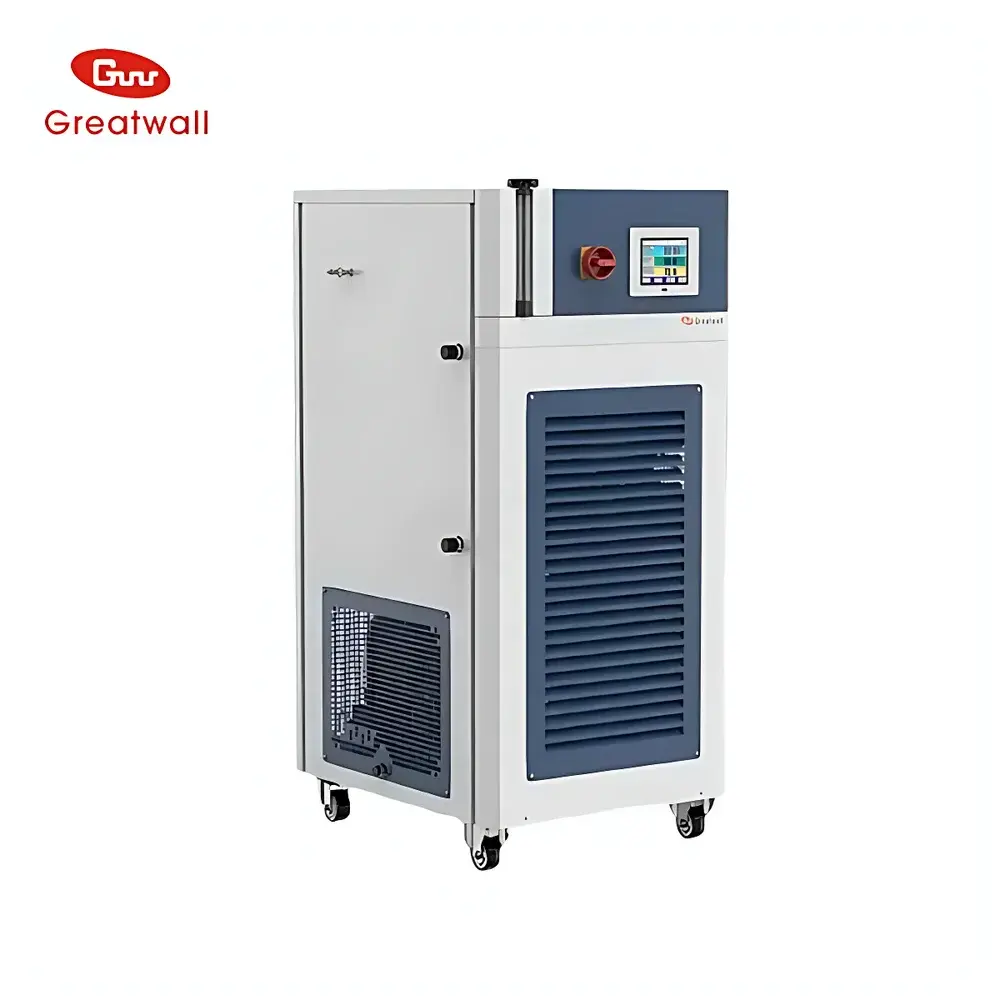
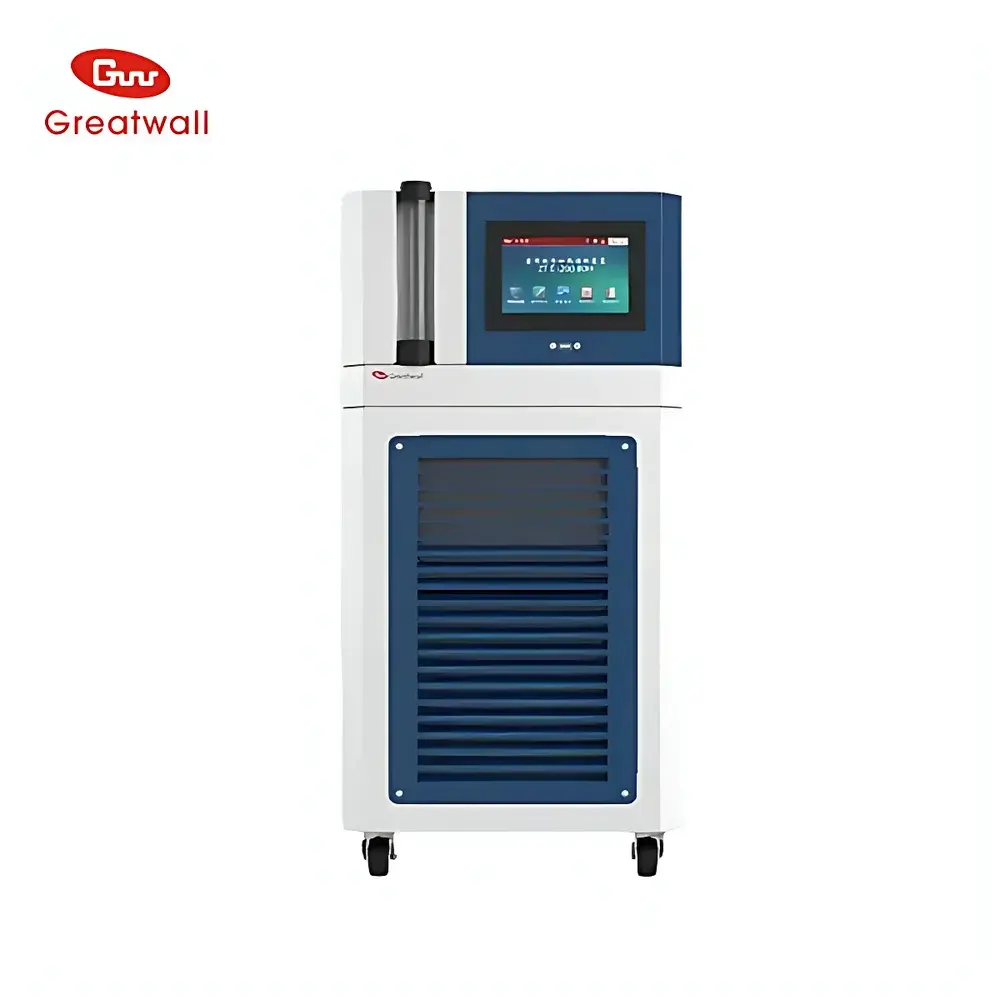
The Great Wall ZT-5-200-30H Closed-Loop Refrigerated & Heated Circulator
| Brand | The Great Wall |
|---|---|
| Origin | Henan, China |
| Manufacturer Type | Direct Manufacturer |
| Model | ZT-5-200-30H |
| Instrument Type | Integrated Unit |
| Cooling Method | Air-Cooled |
| Temperature Control Range | −30 °C to +200 °C |
| Temperature Stability | ±0.5 °C |
| Heating Power | 2 kW |
| Total Power Consumption | 3.0 kW |
| Refrigeration Capacity | 0.2–0.6 kW (varies with setpoint) |
| Circulating Pump Flow Rate | up to 25 L/min |
| Pump Pressure | up to 1.5 bar |
| Heat Transfer Fluid Volume | 3.5 L |
| Display | 7-inch color TFT touchscreen |
| Communication Interfaces | RS485, USB |
| Protection Features | Overtemperature, high-pressure refrigerant, leakage, phase sequence, thermal overload, overcurrent, and compressor delay-start protection |
| Enclosure Rating | IP20 |
| Operating Ambient | 5–35 °C, ≤70% RH |
| Refrigerant | R404A |
| Weight | 106 kg |
| Dimensions (W×D×H) | 420 × 640 × 850 mm |
Overview
The Great Wall ZT-5-200-30H is an integrated, air-cooled closed-loop refrigerated and heated circulator engineered for precise, stable, and bidirectional temperature control of external process equipment. It operates on a sealed circulation principle using synthetic heat transfer fluids (e.g., silicone oils or specialized glycol blends), minimizing evaporation, oxidation, and moisture absorption—thereby extending fluid service life and maintaining consistent thermal performance across extended operation cycles. Its dual-mode capability enables seamless transition between active cooling and resistive heating within a single unit, covering a wide operational range from −30 °C to +200 °C. This makes it suitable for applications demanding high thermal fidelity under dynamic load conditions—such as jacketed reactor temperature profiling, material testing under thermal stress, or calibration of temperature-sensitive instrumentation.
Key Features
- Hermetically sealed circulation system with real-time fluid level monitoring via integrated optical sensor, preventing degradation of heat transfer media and reducing maintenance frequency.
- Dual-stage safety architecture: independent hardware-level protections include overtemperature cutoff, refrigerant high-pressure shutdown, earth-leakage detection, compressor soft-start delay, thermal overload relay, overcurrent interruption, and three-phase sequence verification.
- High-resolution 7-inch color TFT touchscreen interface with 0.01 °C display and setting resolution; supports graphical visualization of temperature profiles, real-time trend logging, and multi-point setpoint programming.
- Configurable external temperature feedback loop via optional PT100 or thermocouple input, enabling cascade control mode where the circulator dynamically adjusts output based on actual process temperature rather than bath temperature alone.
- Standard digital connectivity: isolated RS485 port compliant with Modbus RTU protocol for integration into SCADA or PLC-based lab automation systems; USB 2.0 port for local data export (CSV format) and firmware updates.
- Robust mechanical design: cold-rolled steel enclosure with epoxy-polyester powder coating (IP20 rated); optimized airflow path for stable condenser performance in ambient temperatures up to 35 °C.
Sample Compatibility & Compliance
The ZT-5-200-30H is compatible with a broad spectrum of externally connected equipment requiring regulated thermal exchange—including double- and triple-jacketed glass reactors (up to 100 L volume), stirred tank reactors, distillation columns, environmental test chambers, vacuum desiccators, and semiconductor thermal test platforms. Its closed-loop architecture ensures compatibility with non-aqueous, high-boiling-point heat transfer fluids meeting ASTM D6793 and ISO 6743-12 specifications. All electrical components comply with IEC 61000-6-2 (immunity) and IEC 61000-6-4 (emissions). Safety design adheres to IEC 61010-1 for laboratory electrical equipment, including pollution degree 2 and overvoltage category II requirements. Optional audit trail and user access control modules support alignment with GLP and GMP documentation practices per FDA 21 CFR Part 11 when deployed in regulated pharmaceutical or biotech QC environments.
Software & Data Management
While the device operates autonomously via its embedded controller, the RS485 interface enables bidirectional communication with third-party software platforms such as LabVIEW, MATLAB, or custom Python-based control suites using open Modbus register mapping. Logged temperature data—including setpoint, actual bath temperature, external sensor reading, pump status, and alarm history—is timestamped with millisecond precision and exportable via USB in comma-separated values (CSV) format. No proprietary software installation is required; raw data files are directly readable in spreadsheet applications. For centralized fleet management, multiple units can be daisy-chained on a single RS485 bus with configurable node addressing. Firmware updates preserve all user-defined parameters and calibration offsets.
Applications
- Temperature control of jacketed chemical reactors during exothermic/endothermic synthesis, crystallization, or polymerization processes.
- Thermal conditioning of materials in tensile testing machines, DMA analyzers, or thermal cycling chambers per ASTM E1457 and ISO 11357 standards.
- Stabilization of optical benches, laser diodes, and photodetectors requiring sub-degree thermal drift suppression.
- Simulated environmental testing of automotive components (e.g., battery thermal management systems) under controlled ramp-and-soak profiles.
- Calibration of reference thermometers, RTDs, and infrared sensors across extended temperature spans in metrology labs.
- Process validation studies supporting FDA Process Validation Guidance (ICH Q5C) and EU Annex 15 requirements.
FAQ
What types of heat transfer fluids are recommended for use with the ZT-5-200-30H?
Silicone oils (e.g., DC200 series) or polyalkylene glycols (PAGs) with flash points above 220 °C and pour points below −40 °C are preferred. Avoid water-based fluids above 90 °C due to vapor pressure and corrosion risks.
Can the unit maintain ±0.5 °C stability while driving a 50-L reactor with rapid temperature ramps?
Yes—provided the reactor’s thermal mass and jacket geometry allow sufficient heat exchange surface area and flow velocity. Stability is specified under standard load conditions (25 °C ambient, 3.5 L internal loop volume, 20 L/min flow rate). Actual performance depends on external system hydraulics and insulation quality.
Is remote monitoring possible without additional hardware?
Basic status polling (temperature, alarms, pump speed) is supported via RS485 using Modbus function code 03. Full remote control (setpoint change, start/stop) requires a Modbus master device or gateway.
Does the unit meet CE marking requirements for export to the European Union?
Yes—the device carries CE marking per the Low Voltage Directive (2014/35/EU) and EMC Directive (2014/30/EU), with technical documentation available upon request for customs or regulatory submission.
How often should the refrigerant charge be verified or serviced?
Under normal operating conditions and proper installation (level mounting, adequate ventilation), the sealed R404A circuit requires no routine refrigerant servicing. Leak checks are recommended annually as part of preventive maintenance per ISO 5149-2 guidelines.



