YST Ultrasonic Flow Meter YST305SBCS1 — Clamp-On, Hot-Tap Insertion Type for Liquid Flow Measurement
| Brand | YST (Dalian Yist) |
|---|---|
| Origin | Liaoning, China |
| Model | YST305SBCS1 |
| Measuring Medium | Water, seawater, diesel, gasoline, lubricating oil, and single-phase chemical solutions |
| Pipe Diameter Range | DN50–DN6000 mm |
| Flow Velocity Range | 0.1–15 m/s |
| Accuracy | ±1.0% (under standard conditions) |
| Repeatability | ≤0.2% |
| Operating Temperature | Host: −20°C to +60°C |
| Probe | −40°C to +160°C |
| Max Working Pressure | ≤2.5 MPa |
| Protection Rating | IP65 (host), IP68 (probe) |
| Output Signals | 4–20 mA analog, RS485 (Modbus RTU), pulse output |
| Power Supply | AC 220 V ±10% (50/60 Hz) or DC 24 V ±10% |
Overview
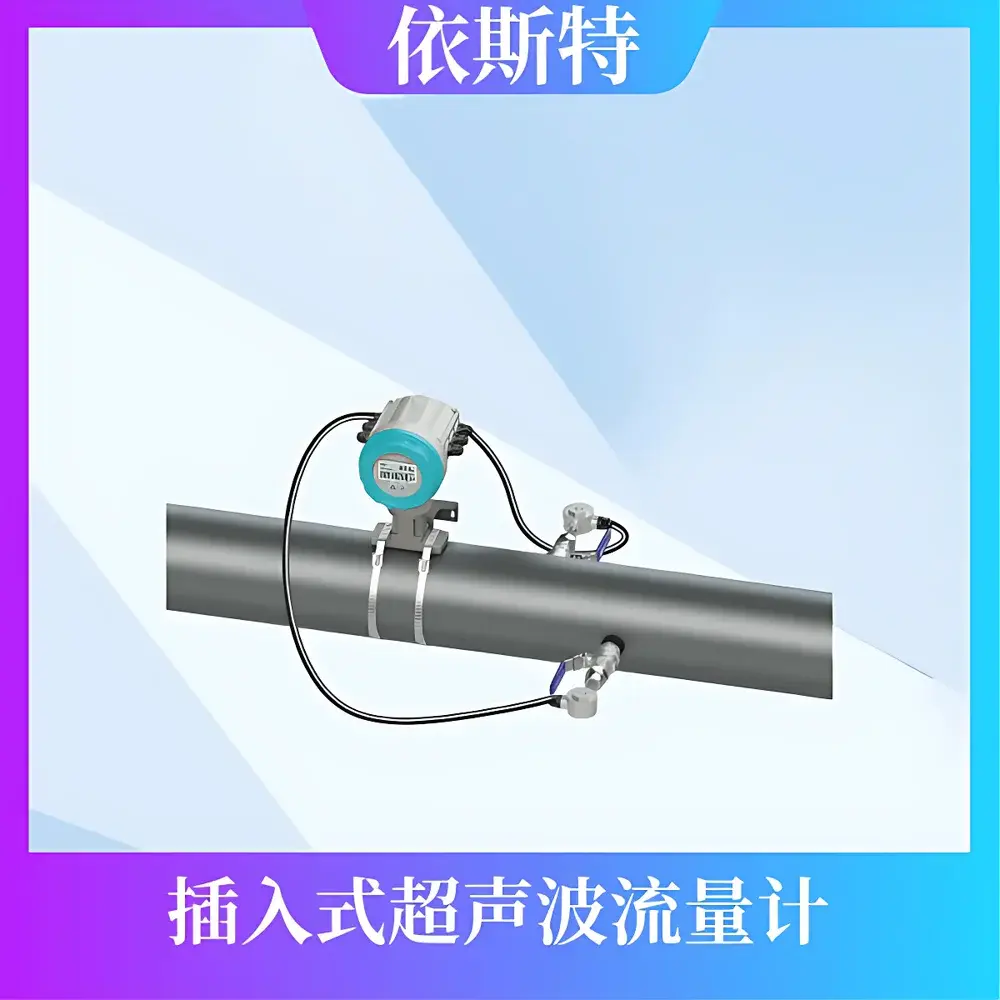
The YST Ultrasonic Flow Meter YST305SBCS1 is an engineered solution for non-intrusive, hot-tap flow measurement in liquid-carrying pipelines under continuous operation. Designed specifically for industrial process continuity and municipal infrastructure monitoring, it employs transit-time ultrasonic principle—measuring the differential time-of-flight of ultrasonic pulses traveling with and against the fluid flow—to compute volumetric flow rate without requiring pipe sectioning, valve isolation, or system shutdown. Its insertion-type probe configuration enables mechanical coupling directly into the pipe wall via a drilled port, establishing acoustic path alignment across the pipe cross-section while maintaining full hydraulic integrity. This architecture supports long-term deployment in pressurized systems up to 2.5 MPa and accommodates extreme thermal gradients between host electronics and wetted probe components—critical for applications ranging from chilled water distribution to high-temperature condensate return lines.
Key Features
- True hot-tap installation: No process interruption, no flange removal, no bypass piping—installation completed in under 90 minutes on live DN50–DN6000 pipes.
- Dual-sensor transit-time ultrasonic measurement with automatic zero-point drift compensation and temperature-corrected sound velocity modeling.
- Wide dynamic range: Stable operation from laminar flow (0.1 m/s) to turbulent high-velocity regimes (15 m/s), validated per ISO 6416 and ASTM D7160 for liquid flowmeter performance assessment.
- Robust environmental resilience: IP68-rated stainless-steel probe with PTFE-coated transducer face; resistant to corrosion from seawater, hydrocarbons, and mildly aggressive chemical solutions.
- Electromagnetic immunity: Shielded signal path and galvanically isolated I/O interfaces ensure stable operation near VFDs, transformers, and high-current motor control centers (compliant with IEC 61000-4-3 and IEC 61000-4-6).
- Low-power dual-supply architecture: Supports either AC 220 V or DC 24 V input with total power draw ≤10 W—suitable for remote sites with limited electrical infrastructure.
Sample Compatibility & Compliance
The YST305SBCS1 is validated for single-phase, acoustically conductive liquids with minimum sonic attenuation—including potable water, raw sewage (with suspended solids <10% v/v), refined petroleum products, glycol-based heat transfer fluids, and non-aqueous organic solvents. It is not suitable for multiphase flows, highly aerated media, or liquids with excessive particulate loading (>100 ppm abrasive solids). The device complies with electromagnetic compatibility requirements per EN 61326-1 (industrial environment) and meets mechanical protection standards per IEC 60529 (IP65/IP68). While not certified to SIL or ATEX, its design aligns with functional safety principles outlined in IEC 61508 for non-safety-critical monitoring applications. For regulated environments, audit-ready data logging supports GLP-compliant record retention when integrated with third-party SCADA platforms.
Software & Data Management
The meter embeds firmware supporting local parameter configuration via keypad and LCD interface, as well as remote setup through Modbus RTU over RS485. All operational parameters—including damping time, flow direction lock, zero calibration offset, and alarm thresholds—are user-configurable and retained during power cycling. Internal flash memory stores up to 12 months of hourly averaged flow data (timestamped, with flow rate, velocity, signal quality index, and temperature). Data export is enabled via serial polling or optional USB-to-RS485 adapter. When connected to enterprise-level SCADA or MES systems, the device provides real-time telemetry compatible with OPC UA servers and supports secure TLS-encrypted MQTT publishing for cloud integration. Audit trails include timestamped configuration changes and calibration events—essential for FDA 21 CFR Part 11 compliance in pharmaceutical water system monitoring.
Applications
- Municipal water supply networks: Real-time district metered area (DMA) balancing, leakage detection, and pressure-dependent demand analysis on live transmission mains (e.g., DN800 cast iron pipelines).
- Petrochemical cooling circuits: Monitoring closed-loop circulating water flow in refinery heat exchanger networks where downtime is cost-prohibitive and medium temperature exceeds 120°C.
- Wastewater treatment influent channels: Accurate volumetric billing and process control at headworks without interrupting biological treatment trains.
- Power plant auxiliary systems: Feedwater make-up, condensate return, and firewater loop verification in ASME B31.1-compliant piping.
- Food & beverage CIP line validation: Tracking cleaning solution volume and velocity profiles to verify rinse completeness per 3-A Sanitary Standards.
FAQ
Can the YST305SBCS1 be installed on lined or non-metallic pipes?
Yes—provided the pipe material permits ultrasonic coupling (e.g., carbon steel, stainless steel, ductile iron, PVC, HDPE) and wall thickness remains within manufacturer-specified limits. Lined pipes require verification of liner acoustic impedance match; epoxy-lined carbon steel is generally acceptable.
Is field recalibration required after initial installation?
No routine recalibration is needed. The device performs automatic zero-tracking during low-flow periods and includes built-in diagnostic tools to assess signal-to-noise ratio, path gain, and transducer health—enabling predictive maintenance planning.
How does the meter handle air bubbles or entrained gas?
Transient micro-bubbles (<1% vol) have negligible impact due to signal averaging across multiple pulse cycles. However, sustained two-phase flow or slug flow will degrade accuracy and trigger a low-signal-quality alert.
What documentation is provided for regulatory audits?
Factory calibration certificate (traceable to NIST-equivalent national metrology institutes), CE DoC, RoHS declaration, IP rating test report, and Modbus register map are included. Optional IQ/OQ protocols available upon request.