
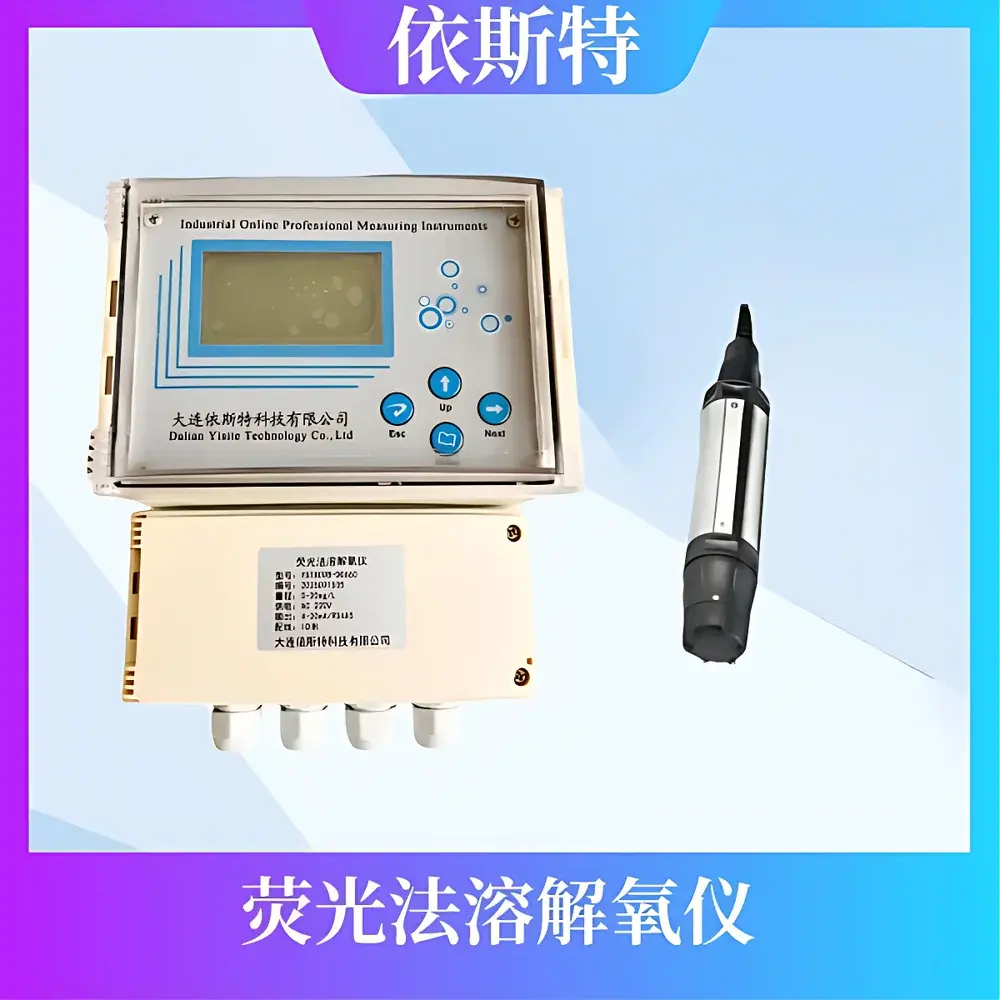
YST809B-DO660 Fluorescence-Based Dissolved Oxygen Analyzer by YST (Dalian Yist Instrument Co., Ltd.)
| Brand | YST (Dalian Yist Instrument Co., Ltd.) |
|---|---|
| Origin | Liaoning, China |
| Model | YST809B-DO660 |
| Measurement Principle | Fluorescence Quenching at 470 nm excitation |
| Range | 0–20 mg/L (standard), 0–50 mg/L or 0–20,000 ppb (trace) |
| Accuracy | ±0.2 mg/L (0–20 mg/L) |
| Resolution | 0.01 mg/L or 1 ppb |
| Operating Temperature | −5 to 50 °C |
| IP Rating | IP68 |
| Submersion Depth | Up to 30 m |
| Compensation | Automatic temperature, barometric pressure, and salinity compensation |
| Output Interfaces | RS485 (Modbus RTU), 4–20 mA analog |
| Response Time (t₉₀) | ≤30 s |
| Fluorescent Cap Lifetime | 1–3 years |
| Drift | <1% per year |
Overview
The YST809B-DO660 Fluorescence-Based Dissolved Oxygen Analyzer is an optical sensor system engineered for continuous, high-reliability dissolved oxygen (DO) measurement in natural waters, wastewater, drinking water distribution systems, and industrial process streams. It operates on the principle of dynamic fluorescence quenching: a 470 nm blue LED excites an oxygen-sensitive fluorophore embedded in a proprietary polymer matrix on the sensor cap. Molecular oxygen collides with the excited-state fluorophore, shortening its fluorescence lifetime and inducing a measurable phase shift between the excitation and emission signals. This phase difference is inversely proportional to the partial pressure of dissolved oxygen. The instrument converts the phase-shift signal into concentration units (mg/L or ppb) using built-in algorithms that apply real-time compensation for temperature, atmospheric pressure, and water salinity—critical variables affecting oxygen solubility per ISO 5814 and ASTM D888 standards.
Key Features
- Membrane-free, electrolyte-free sensing architecture: Eliminates drift caused by membrane fouling, electrolyte depletion, or cathode polarization—common failure modes in Clark-type electrochemical sensors.
- Zero oxygen consumption during measurement: Enables accurate DO profiling in stagnant or low-flow environments, including sediment pore water, sealed bioreactors, and deep aquifer monitoring wells.
- Chemical interference immunity: Unaffected by hydrogen sulfide (H₂S), chlorine, carbon dioxide, hydrogen cyanide, or heavy metal ions—making it suitable for anaerobic digesters, industrial effluents, and sulfate-reducing environments.
- Rapid response and cold-start capability: Achieves t90 ≤ 30 seconds without warm-up delay; stable readings are available immediately after power-on, supporting unattended field deployments.
- Robust submersible design: IP68-rated housing with 30-meter depth rating; stainless steel and PEEK construction ensures long-term stability in abrasive, biofouling-prone, or chlorinated water matrices.
- Low-maintenance operation: Fluorescent cap replacement required only every 12–36 months; annual calibration drift <1% FS; cleaning limited to gentle cap wiping with deionized water or ethanol—no recalibration needed after routine maintenance.
Sample Compatibility & Compliance
The YST809B-DO660 is validated for use across diverse aqueous matrices, including raw sewage, activated sludge, tertiary effluent, surface rivers and lakes, groundwater, desalinated seawater (up to 40 g/kg salinity), and potable water distribution networks. Its optical detection method complies with the functional equivalence requirements of ISO 5814:2012 (Water quality — Determination of dissolved oxygen — Electrochemical probe method) for fluorescence-based alternatives. While not certified under US EPA Method 360.1 or ASTM D888 for regulatory reporting, its performance characteristics meet the precision and stability thresholds recommended for process control and environmental trend monitoring under GLP-aligned operational protocols. The device supports configurable data logging intervals and alarm thresholds aligned with municipal wastewater discharge permits (e.g., EU Urban Wastewater Treatment Directive Annex I, US Clean Water Act NPDES compliance frameworks).
Software & Data Management
Data output is provided via dual parallel interfaces: isolated 4–20 mA analog output (HART-compatible) for integration into legacy SCADA or PLC systems, and RS485 serial communication implementing Modbus RTU protocol (slave ID configurable, baud rates 9600–115200 bps). No proprietary software is required for basic operation; configuration and diagnostics can be performed using standard Modbus master tools (e.g., QModMaster, Simply Modbus). For centralized deployment, the analyzer integrates natively into open-architecture telemetry platforms supporting MQTT or HTTP RESTful APIs via gateway-level protocol translation. Audit-trail functionality—including timestamped calibration events, cap replacement logs, and error codes—is retained onboard for ≥30 days and exportable via serial dump. Firmware updates are delivered via UART bootloader, ensuring field-upgradability without hardware replacement.
Applications
- Wastewater treatment: Real-time DO feedback control in aerobic basins and oxidation ditches; optimization of air blower energy consumption while maintaining nitrification efficiency.
- Drinking water distribution: Continuous monitoring at critical points (e.g., reservoir outlets, booster station inlets) to detect stagnation-induced DO depletion or rechlorination-related oxidative stress.
- Surface water quality networks: Solar-powered, cellular-connected deployments in remote rivers and reservoirs; synchronized with meteorological stations for dissolved oxygen saturation modeling.
- Hospital and pharmaceutical wastewater: Monitoring of high-BOD streams where H₂S and disinfectant residuals would compromise electrochemical sensors.
- Aquaculture and research mesocosms: High-frequency DO profiling in controlled aquatic ecosystems requiring non-invasive, flow-independent measurement.
FAQ
Does the YST809B-DO660 require zero-point or span calibration in the field?
No routine zero/span calibration is required. Factory calibration is traceable to NIST-certified DO standards. Field verification can be performed using air-saturated water (ASW) or water equilibrated with certified gas mixtures; deviation >±0.3 mg/L triggers optional user calibration.
Can the sensor be used in seawater or brackish environments?
Yes—the integrated salinity compensation algorithm accepts manual input or direct conductivity-derived salinity values (if paired with a compatible conductivity module), supporting measurements up to 40 g/kg total dissolved solids.
What is the expected service life of the fluorescent sensing cap?
Under typical municipal wastewater conditions (20–35 °C, moderate biofouling), the cap maintains metrological integrity for 18–36 months. UV exposure, extreme pH (<4 or >10), or abrasive particulates may reduce lifespan.
Is the device compliant with FDA 21 CFR Part 11 for electronic records in regulated water systems?
The standalone analyzer does not provide electronic signature or audit-trail encryption features required for Part 11 compliance; however, when integrated into validated SCADA or LIMS platforms with appropriate procedural controls, it supports ALCOA+ data integrity principles.
How is temperature compensation implemented?
An integrated Pt1000 RTD measures sensor tip temperature with ±0.15 °C accuracy. The compensation model follows the thermodynamic solubility equation per Benson-Krause and is pre-loaded with coefficients optimized for freshwater, seawater, and saline wastewater matrices.
Related Products







