
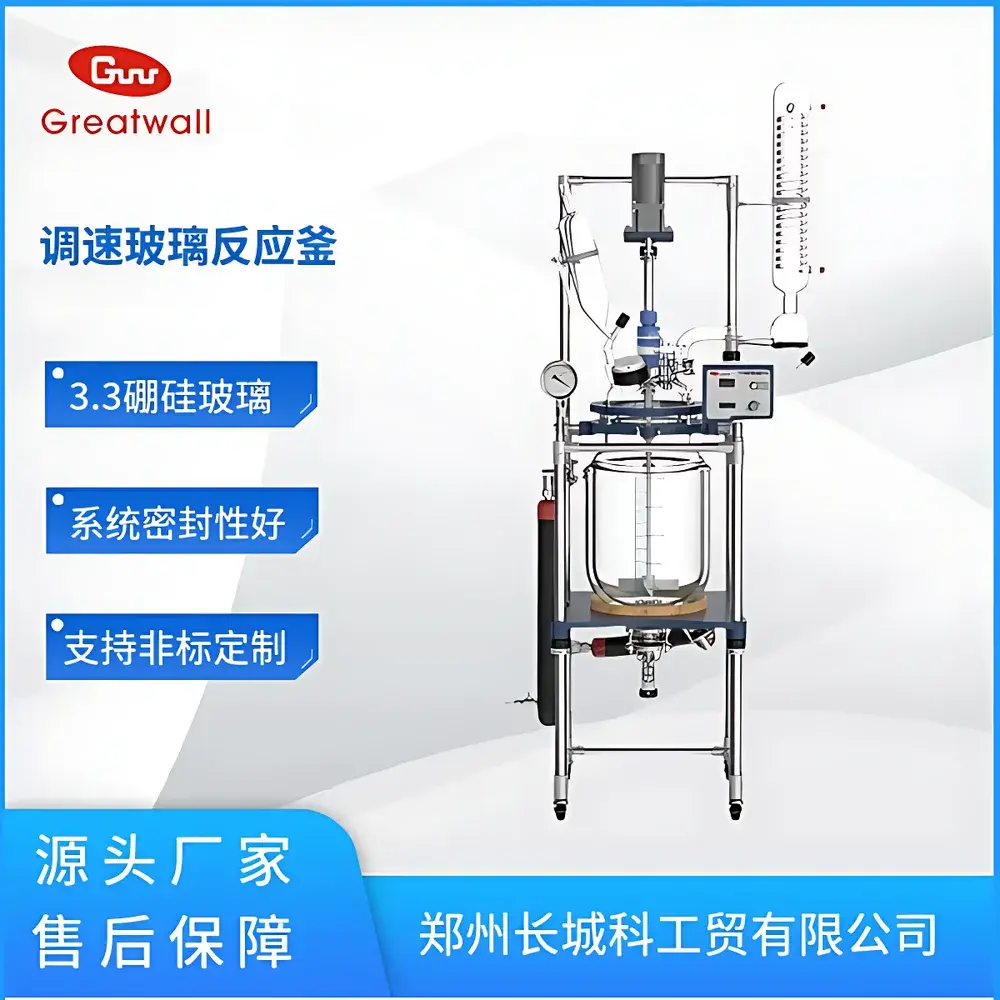
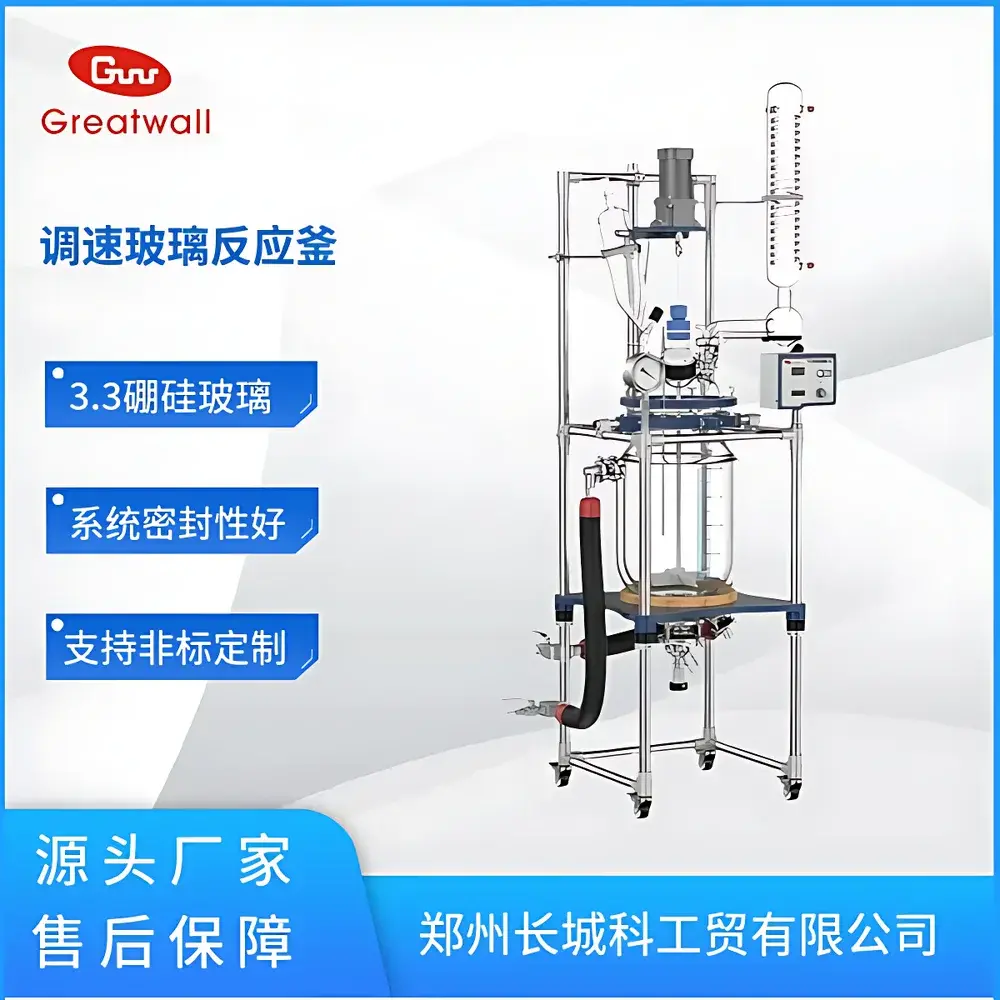
The Great Wall GR-20 Variable-Speed Glass Reactor
| Brand | The Great Wall |
|---|---|
| Origin | Henan, China |
| Manufacturer Type | Direct Manufacturer |
| Origin Category | Domestic |
| Model | GR-20 |
| Instrument Classification | Jacketed Glass Reactor |
| Usable Volume | Medium-Scale |
| Construction Material | Borosilicate Glass 3.3 |
| Operating Pressure | Low-Pressure (Vacuum to Atmospheric) |
| Capacity | 20 L |
| Glass Material | Borosilicate Glass 3.3 |
| Temperature Range | −80 °C to +200 °C |
| Internal Pressure Range | −0.1 MPa to 0 MPa |
| Jacket Pressure Rating | ≤ 0.03 MPa |
| Thermal Shock Resistance | 80 °C |
| Stirring Speed Range | 50–500 rpm |
| Speed Accuracy | ±1 rpm |
| Motor Type | Three-Phase Asynchronous Motor |
| Motor Power | 90 W |
| Speed Control | Frequency Inverter |
| Stirrer Shaft Material | 06Cr19Ni10 (AISI 304) with PTFE Cladding |
| Impeller Material | PTFE-Coated 06Cr19Ni10 |
| Impeller Type | Single-Layer Four-Inclined-Blade Open Turbine |
| Sealing System | Vacuum-Compatible Mechanical Seal with PTFE Support Bearings |
| Temperature Sensor | PT100 |
| Temp. Display Accuracy | ±0.1 °C |
| Frame Material | 06Cr19Ni10 + Powder-Coated Aluminum Alloy |
| Mobility | Casters with Brakes |
| Drain Valve Outlet | φ33 mm |
| Condenser Cooling Area | ~0.341 m² |
| Condenser/Port Interface | 40/38 standard taper |
| Addition Funnel Capacity | 2000 mL |
| Central Lid Port | 50# |
| Side Ports | S51 (35#), 40/38, 34/35, 80# Solid Feed Port |
| Lid & Body Material | Borosilicate Glass 3.3 |
| Jacket Inlet/Outlet | Rc 3/4 |
| Overall Dimensions (W×D×H) | ~825 × 665 × 1960 mm |
| Net Weight | ~67 kg |
Overview
The Great Wall GR-20 Variable-Speed Glass Reactor is a fully jacketed, vacuum-rated laboratory-scale reaction system engineered for precise control of temperature, pressure, and agitation during synthetic chemistry, distillation, concentration, and solvent recovery processes. Its core architecture follows the Couette-type stirred-tank principle, where a centrally mounted impeller induces controlled laminar-to-transitional flow within the reaction medium, enabling reproducible mass and heat transfer under defined thermal and mechanical boundary conditions. Constructed entirely from high-purity borosilicate glass 3.3 (DIN ISO 3585), the reactor vessel ensures exceptional chemical inertness against strong acids, alkalis, organic solvents, and halogenated reagents — critical for multi-step synthesis and catalyst-sensitive reactions. The double-jacket design supports simultaneous heating (via circulating oil or glycol) and cooling (with chilled fluid or dry ice/acetone), while the integrated vacuum pathway allows operation from atmospheric pressure down to −0.1 MPa (≈ 0.1 mbar abs), facilitating low-temperature distillations and moisture-sensitive reactions.
Key Features
- Borosilicate glass 3.3 construction throughout — compliant with ISO 3585 and ASTM E438 Type I, Class A specifications for thermal shock resistance (ΔT ≤ 80 °C) and hydrolytic resistance (Class HGB 1).
- Vacuum-mechanical dual-seal stirring assembly with PTFE-coated 304 stainless steel shaft and precision-ground ceramic/metal contact surfaces — rated for continuous operation at −0.1 MPa without leakage or lubricant contamination.
- Frequency-inverter-controlled three-phase motor delivering stable torque across 50–500 rpm, with digital RPM readout (±1 rpm accuracy) and real-time feedback for protocol repeatability.
- Ergonomic top-mounted inclined discharge valve (φ33 mm outlet) enabling complete, residue-free emptying without disassembly — validated for use with viscous slurries and crystalline precipitates.
- Modular lid configuration with six standardized ground-glass ports (50#, 35#, 40/38, 34/35, and 80# solid feed) supporting simultaneous condensation, addition, gas inlet, temperature monitoring, and sampling — all sealed via fluoropolymer gaskets (φ264 × φ220 × 3 mm).
- Corrosion-resistant frame fabricated from AISI 304 stainless steel and powder-coated aluminum alloy, fitted with locking casters for lab-floor mobility and stable positioning — meets IEC 61000-6-2 EMC immunity requirements.
Sample Compatibility & Compliance
The GR-20 accommodates heterogeneous and homogeneous reaction mixtures ranging from low-viscosity solvents (e.g., THF, DCM, MeOH) to high-boiling-point media (e.g., DMF, NMP, ethylene glycol) and suspension-based catalytic systems (e.g., Pd/C, Raney Ni). Its −80 °C to +200 °C operational envelope supports cryogenic lithiation, reflux esterification, and high-temperature dehydration protocols. All wetted components comply with USP Class VI biocompatibility testing and are compatible with cleaning validation per ASTM E3061-16. The system satisfies GLP-compliant documentation requirements when paired with external data loggers; optional PT100 sensor output supports integration into FDA 21 CFR Part 11–compliant electronic lab notebooks (ELNs) via analog signal interface.
Software & Data Management
The GR-20 operates as a standalone instrument with embedded digital controls — no proprietary software required. RPM and temperature values are displayed locally on dual LED modules (stirring speed and PT100 reading), each with ±1 rpm and ±0.1 °C resolution respectively. For automated process recording, the unit provides isolated 0–10 V analog outputs for both parameters, enabling connection to third-party data acquisition systems (e.g., LabVIEW, DeltaV, or Siemens Desigo CC) compliant with ISA-88 and ISA-95 process automation standards. Audit trails, user access logs, and calibration history must be maintained externally per ISO/IEC 17025:2017 Clause 7.7.
Applications
- Synthesis of fine chemicals and pharmaceutical intermediates under inert or reduced-pressure conditions.
- Batch-wise fractional distillation of thermally labile compounds using the integrated 0.341 m² condenser (40/38 interface).
- Controlled crystallization studies with real-time agitation profiling and endpoint detection via temperature plateau analysis.
- Catalytic hydrogenation screening using interchangeable gas dispersion impellers and pressure-rated lid assemblies (optional upgrade).
- Extraction and concentration of natural product isolates in food, cosmetic, and botanical R&D workflows.
- Teaching laboratory demonstrations of reaction kinetics, heat transfer coefficients, and phase-equilibrium behavior.
FAQ
What is the maximum allowable jacket pressure?
The夹套 (jacket) is rated for ≤ 0.03 MPa (3 bar gauge); exceeding this may compromise glass integrity or seal performance.
Can the GR-20 be used for exothermic reactions requiring rapid cooling?
Yes — the 9 L jacket volume and Rc 3/4 fluid ports support high-flow coolant circulation; typical cooling ramp rates of −5 °C/min are achievable from 150 °C using −20 °C ethylene glycol.
Is the PTFE-coated stirrer chemically resistant to HF or hot concentrated H₂SO₄?
No — while PTFE exhibits broad resistance, it degrades above 260 °C and is permeable to anhydrous HF; alternative Hastelloy-C276 shafts are available upon request.
Does the system include temperature control hardware?
No — the GR-20 provides only sensing and display; external circulators (e.g., Huber Chiller, Julabo F25) must be connected to the jacket ports for active thermal regulation.
What maintenance intervals are recommended for the mechanical seal?
Inspect seal faces and O-rings every 500 operating hours; replace PTFE support bearings annually or after exposure to abrasive solids or >150 °C sustained operation.



