
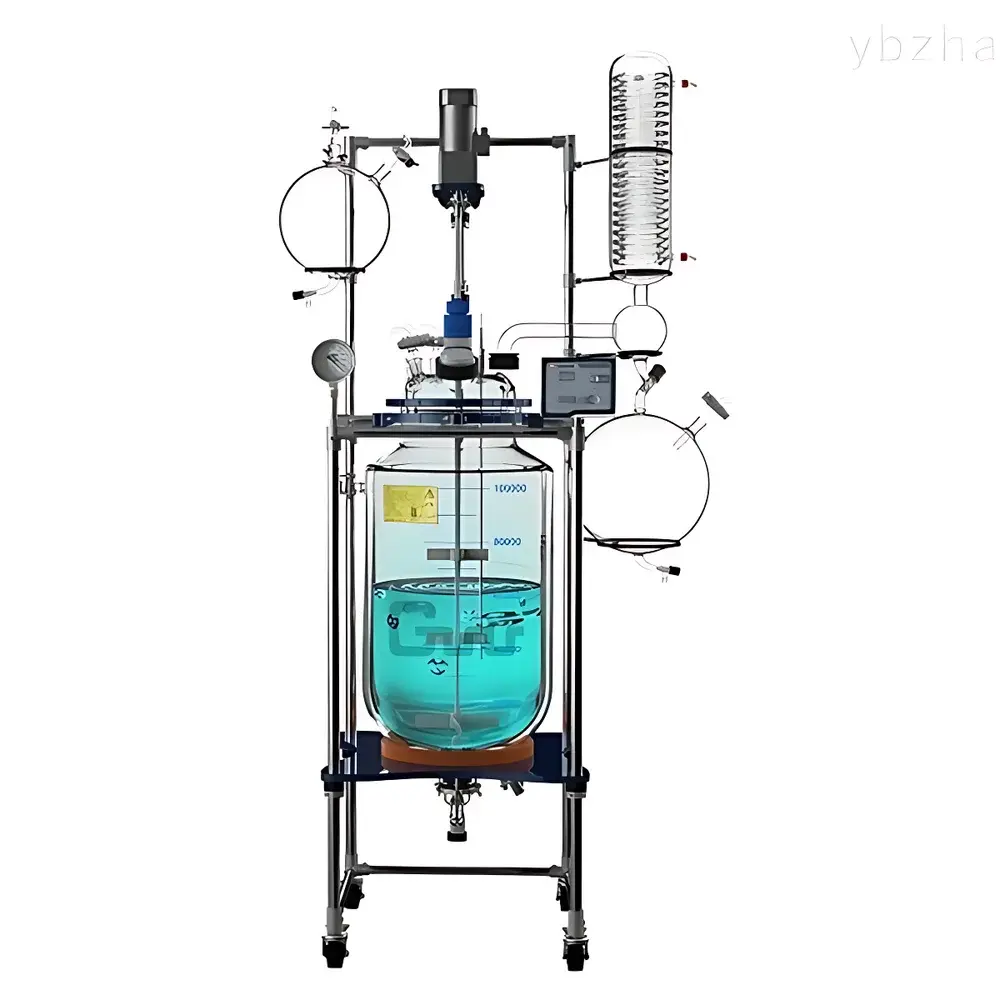
The Great Wall GR-150L Variable-Frequency Speed-Controlled Double-Jacketed Glass Reactor
| Brand | The Great Wall |
|---|---|
| Origin | Henan, China |
| Manufacturer Type | Direct Manufacturer |
| Country of Origin | China |
| Model | GR-150L |
| Price Range | USD 7,000–14,000 (FOB) |
| Usable Volume | 150 L (Large-Scale Lab Use) |
| Construction Material | Borosilicate Glass 3.3 |
| Operating Pressure Range | −0.1 to 0 MPa (Low-Pressure / Vacuum Service) |
| Jacket Volume | ~45 L |
| Condenser Heat Exchange Area | ~1.32 m² |
| Feed Bottle Capacity | 10 L |
| Receiver Bottle Capacity | 20 L |
| Temperature Range | −80 °C to +200 °C |
| Maximum ΔT (Inner/Outer Wall) | ≤80 °C |
| Jacket Pressure Rating | ≤+0.03 MPa |
| Vacuum System Leak Rate | ≤2 kPa/h |
| Stirring Motor Power | 370 W |
| Speed Control | Frequency Inverter |
| Speed Range | 50–300 rpm |
| Temperature Sensor | Pt100 (±0.1 °C display accuracy) |
| Stirrer Type | Paddle Agitator with PTFE Blades |
| Shaft Material | SUS304 stainless steel sheathed in PTFE |
| Sealing Material | PTFE |
| Casters | Lockable |
| Power Supply | 220–240 V~, 50/60 Hz |
| Ambient Operating Conditions | 5–35 °C, ≤65% RH |
| Overall Dimensions (W×D×H) | ~1250 × 1100 × 2700 mm |
Overview
The Great Wall GR-150L Variable-Frequency Speed-Controlled Double-Jacketed Glass Reactor is an engineered platform for scalable laboratory synthesis, process development, and controlled chemical reaction studies under precisely regulated thermal and pressure conditions. Designed around the principles of jacketed heat transfer and vacuum-compatible sealed operation, the system enables precise temperature control via external circulation of heating or cooling media (e.g., silicone oil, ethylene glycol, or cryogenic fluids) through the outer glass jacket. Its −0.1 to 0 MPa operating pressure range supports both inert-atmosphere reactions and low-pressure distillation or solvent removal. The reactor’s all-borosilicate-glass-3.3 construction ensures high transparency for real-time visual monitoring, excellent thermal shock resistance (ΔT ≤80 °C), and broad chemical compatibility — including resistance to strong acids, alkalis, and organic solvents across a −80 °C to +200 °C operational envelope.
Key Features
- Borosilicate glass 3.3 components conforming to DIN ISO 3585 standards for dimensional stability, low thermal expansion (3.3 × 10⁻⁶/K), and hydrolytic resistance (Class 1 per ISO 719).
- Frequency-inverter-driven stirring motor (370 W) delivering smooth, stepless speed control from 50 to 300 rpm with digital RPM readout and torque compensation at low speeds.
- Pt100 Class A temperature sensor (IEC 60751) embedded in the reactor lid, housed in SUS304 sheath with PTFE insulation, enabling ±0.1 °C display resolution and traceable calibration pathways.
- PTFE-sheathed SUS304 stirring shaft and paddle agitator with chemically inert PTFE blades — eliminating metallic contamination and ensuring long-term seal integrity.
- Vacuum-rated design with leak rate ≤2 kPa/h under static vacuum; compatible with diaphragm or scroll vacuum pumps for sustained operation down to 0.098 MPa (absolute).
- Stress-relieved fluid connections using 3/4″ stainless steel insulated flexible hoses for jacket inlet/outlet ports — preventing thermal-induced cracking at glass-metal interfaces.
- No-holdup bottom discharge valve with PTFE sealing and elevated outlet (~370 mm above floor) facilitating gravity-fed transfer into standard lab containers without disassembly.
- Lockable heavy-duty casters for safe repositioning within fume hoods or shared lab spaces, with leveling feet for stable operation on uneven surfaces.
Sample Compatibility & Compliance
The GR-150L is routinely deployed in academic research labs, pharmaceutical process R&D, fine chemical synthesis, and polymerization studies where visual process observation, thermal control fidelity, and material purity are critical. Its borosilicate glass 3.3 wetted path complies with USP , EP 3.2.1, and ISO 10993-5 biocompatibility screening prerequisites for non-contact applications. While not certified for GMP manufacturing, the system supports GLP-aligned workflows: temperature and agitation parameters are manually logged or integrated via optional analog/digital I/O modules for audit-ready documentation. Vacuum and pressure operations align with ASTM E2877-22 (Standard Guide for Vacuum System Integrity Testing) and ISO 2852:2018 (Jacketed Equipment Design Guidelines). All ground-glass joints meet ISO 3805 tolerances, and standard taper fittings (34#, 40#, 50#, 60#, 95#) ensure interoperability with third-party condensers, dropping funnels, and gas inlets.
Software & Data Management
The GR-150L operates as a standalone instrument with local digital controls for stir speed and temperature setpoint input. For enhanced data traceability, it supports integration with external PID controllers or PLC-based supervision systems via 0–10 V analog outputs (stir speed, temperature) and relay dry contacts (motor on/off, overtemperature alarm). Optional RS485 Modbus RTU communication enables connection to LabArchives, DeltaV, or custom SCADA platforms for time-stamped parameter logging, trend analysis, and electronic batch record generation compliant with FDA 21 CFR Part 11 requirements when paired with validated software layers and user access controls.
Applications
- Multi-step organic synthesis under reflux or reduced pressure, including Grignard, Suzuki, and esterification reactions.
- Solvent recovery via vacuum-assisted fractional distillation using the integrated 1.32 m² condenser surface area.
- Controlled exothermic reaction management via jacketed cooling with programmable ramp-soak profiles.
- Polymerization kinetics studies requiring extended agitation stability and inert gas purging (via 95#法兰 port).
- Crystallization process development with real-time slurry visualization and precise supersaturation control.
- Catalytic hydrogenation trials using interchangeable gas dispersion frits and pressure-rated accessories (sold separately).
FAQ
What is the maximum allowable temperature differential between the inner and outer walls of the reactor?
The design limits the wall-to-wall ΔT to ≤80 °C to prevent thermal stress fracture in borosilicate glass 3.3.
Can the GR-150L be used for reactions above atmospheric pressure?
No — it is rated for vacuum and ambient pressure only (−0.1 to 0 MPa gauge); positive pressure operation requires a separate pressure-rated metal reactor.
Is the stirring system suitable for viscous reaction mixtures?
Yes — the 370 W motor and robust PTFE-coated shaft deliver consistent torque across the full 50–300 rpm range, though optimal performance is achieved below 5000 cP viscosity.
How is temperature calibration verified on this system?
The Pt100 sensor is factory-calibrated to Class A tolerance; users may perform field verification using a NIST-traceable reference thermometer inserted via the dedicated 35# port.
Are replacement glass components available as spare parts?
Yes — all major glass assemblies (reactor vessel, condenser, feed/receiver bottles, lid) are stocked as OEM spares with serial-matched dimensional certification.



