
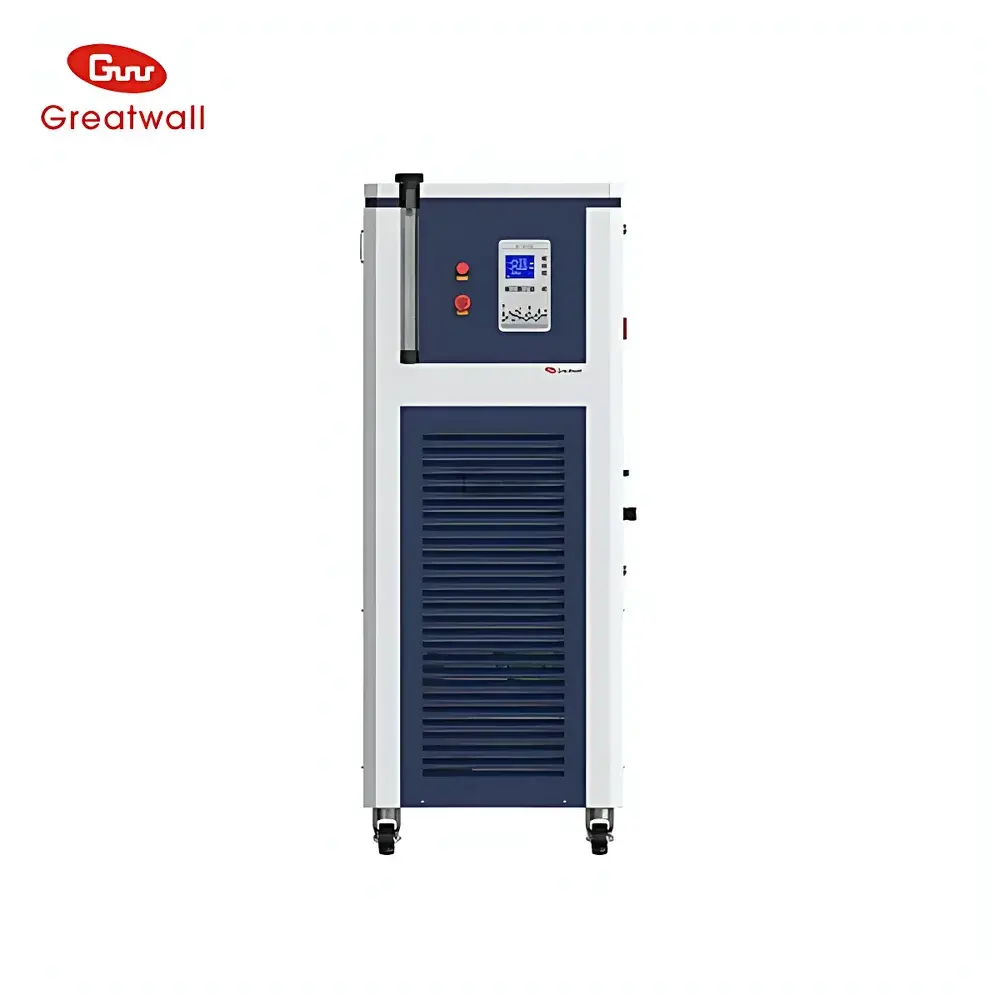
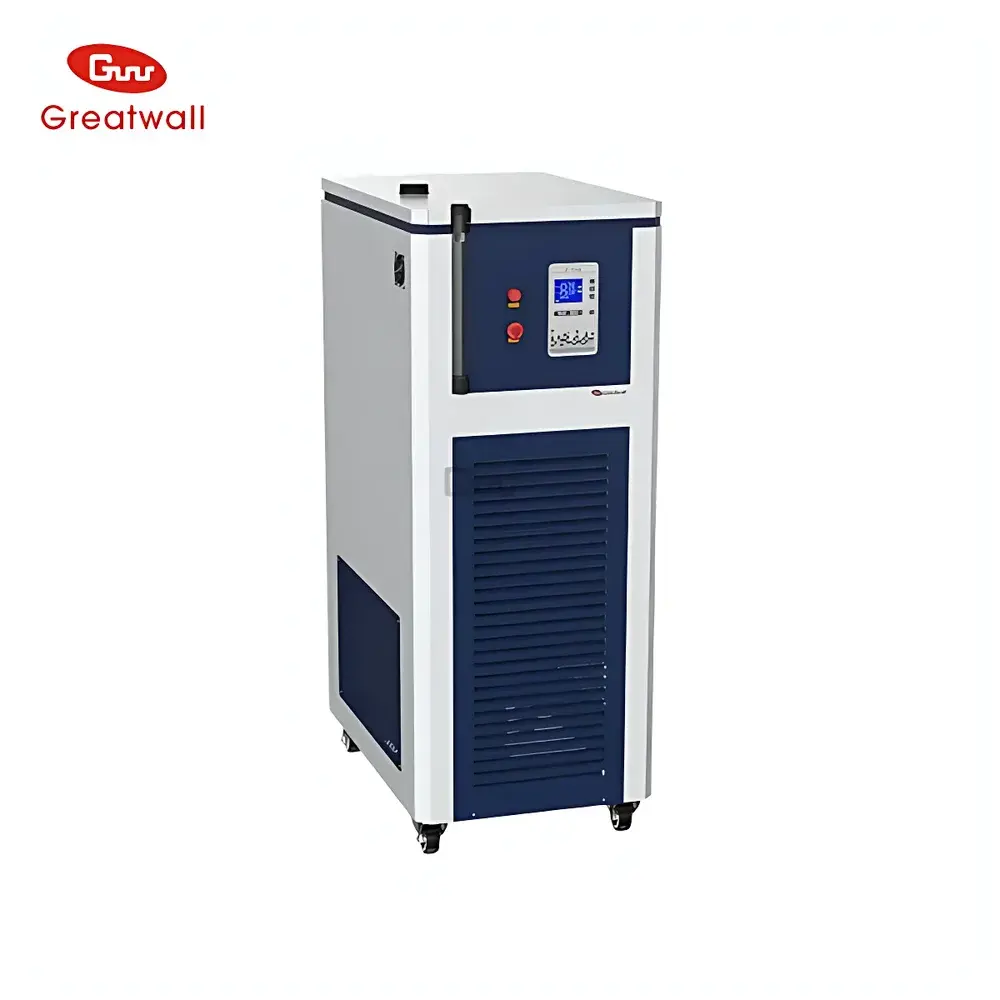
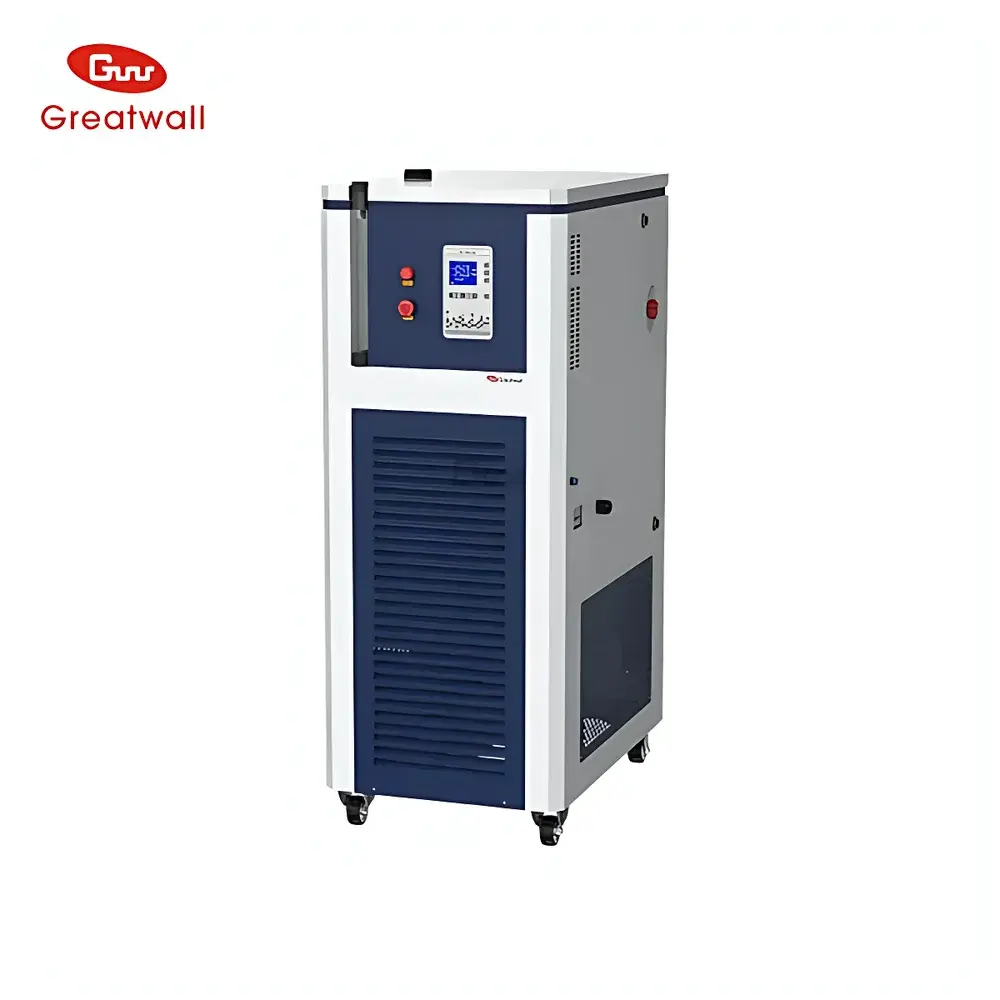
The Great Wall SY-200-200 High-Temperature Circulating Bath
| Brand | The Great Wall |
|---|---|
| Origin | Henan, China |
| Manufacturer Type | Direct Manufacturer |
| Country of Origin | China |
| Model | SY-200-200 |
| Circulation Mode | External Circulation |
| Temperature Control | Heating-Only |
| Temperature Range | Ambient +5 °C to 200 °C |
| Temperature Stability | ±0.5 °C |
| Total Power Consumption | 24.75 kW |
| Supply Voltage | 3-phase, 380 V, 50 Hz |
| Pump Power | 750 W |
| Max Flow Rate | 150 L/min |
| Max Pressure | 2.5 bar |
| Heat Transfer Fluid | Thermal Oil |
| Cooling Coil | Integrated water-cooled coil for auxiliary temperature regulation |
| Reservoir Capacity | 25 L |
| External Port Connection | R21 |
| IP Rating | IP20 |
| Pollution Degree | 2 |
| Dimensions (W×D×H) | 610 × 940 × 1590 mm |
| Weight | 240 kg |
Overview
The Great Wall SY-200-200 High-Temperature Circulating Bath is an industrial-grade thermal management system engineered for precise, stable, and reliable external heating of process vessels—including jacketed reactors, calorimeters, and material test fixtures—in pharmaceutical, chemical, petrochemical, and advanced materials laboratories. It operates on a closed-loop circulation principle: electric resistance heating elements raise the temperature of a thermally stable heat transfer fluid (typically synthetic or mineral-based thermal oil), which is then pumped via a high-capacity centrifugal circulation pump to external equipment through insulated R21-threaded ports. Unlike open-bath systems, its sealed architecture minimizes fluid oxidation, evaporation, and moisture absorption—critical for maintaining long-term fluid integrity and consistent thermal performance across extended operational cycles up to 200 °C.
Key Features
- Robust 24 kW heating capacity with total system power of 24.75 kW, enabling rapid ramp-up and stable maintenance within ±0.5 °C across the full ambient+5 °C to 200 °C operating range
- Integrated water-cooled coil for active auxiliary cooling—essential for stabilizing temperatures between ambient+5 °C and 60 °C without requiring external chiller integration
- High-flow circulation system delivering up to 150 L/min at 2.5 bar maximum pressure, compatible with large-volume reactor jackets and multi-point distribution manifolds
- Comprehensive safety architecture including independent overtemperature cutoff, earth-leakage protection, thermal overload relays, phase-sequence monitoring, and overcurrent circuit breakers
- Real-time liquid level indicator for proactive maintenance and prevention of dry-run conditions
- IP20-rated enclosure with pollution degree 2 compliance—designed for controlled indoor laboratory and pilot-plant environments
- Stainless steel reservoir and fluid-path components resistant to thermal degradation and oil compatibility stress
Sample Compatibility & Compliance
The SY-200-200 is not a sample analysis instrument but a precision thermal utility device supporting temperature-critical unit operations. Its closed-loop thermal oil circuit ensures compatibility with glass, stainless steel, and Hastelloy reaction vessels, as well as DSC, TGA, and rheometry accessories requiring external thermal conditioning. While it does not perform analytical measurements, its temperature stability and repeatability support GLP- and GMP-aligned processes where thermal protocol adherence is auditable. The system’s electrical design conforms to IEC 61000-6-2 (immunity) and IEC 61000-6-4 (emissions); safety circuits comply with IEC 61000-1-2 and EN 60204-1. Documentation packages—including FAT/SAT reports, wiring diagrams, and CE-conformity declarations—are available upon request for regulatory validation workflows.
Software & Data Management
The SY-200-200 operates via an integrated digital PID controller with local LED interface and manual setpoint adjustment. It does not include embedded data logging, Ethernet connectivity, or PC-based software. However, analog 4–20 mA output signals (temperature and status) and digital relay outputs (fault, ready, heating active) are provided for integration into centralized SCADA, DCS, or PLC-based process control networks. For users requiring electronic audit trails per FDA 21 CFR Part 11 or Annex 11, third-party data acquisition modules can be interfaced to record temperature profiles, alarm events, and operational uptime—enabling traceable thermal history documentation in validated environments.
Applications
- Temperature control of jacketed glass or stainless-steel reactors during exothermic/endothermic synthesis, hydrogenation, polymerization, and crystallization
- Thermal preconditioning and stabilization of samples prior to mechanical testing (e.g., tensile, creep, DMA) under ISO 6721 or ASTM D696 protocols
- Calibration and verification of temperature sensors and thermocouples across extended ranges
- Supporting accelerated aging studies per ICH Q1A(R3) guidelines using controlled thermal stress profiles
- Heating and thermal soak of catalyst beds, distillation columns, and extraction vessels in pilot-scale chemical processing
- Providing stable thermal input to spectroscopic cells, optical benches, and vacuum chamber thermal shrouds
FAQ
What heat transfer fluids are compatible with the SY-200-200?
Synthetic aromatic or silicone-based thermal oils rated for continuous operation up to 250 °C are recommended. Mineral oils may be used below 180 °C; consult fluid manufacturer specifications for oxidation stability and vapor pressure limits.
Can the unit operate continuously at 200 °C?
Yes—provided ambient conditions remain ≤30 °C, ventilation meets minimum 1.2 m³/s free-air exchange, and thermal oil is replaced per OEM-recommended intervals (typically every 6,000–8,000 operational hours).
Is external cooling water required for all operating temperatures?
Cooling water is mandatory only when maintaining setpoints between ambient+5 °C and 60 °C. Above 60 °C, the internal heater-only mode suffices; the coil remains inactive unless actively engaged for rapid cooldown.
Does the system support remote start/stop or setpoint modulation?
No native Ethernet or RS485 interface is included. Remote control requires external relay interfacing via the provided dry-contact terminals or analog 4–20 mA setpoint input (optional configuration).
What maintenance intervals are recommended?
Biannual inspection of pump seals, electrical connections, and fluid condition; annual calibration of the PT100 sensor against a NIST-traceable reference; filter replacement every 12 months or after 2,000 operating hours—whichever occurs first.



