
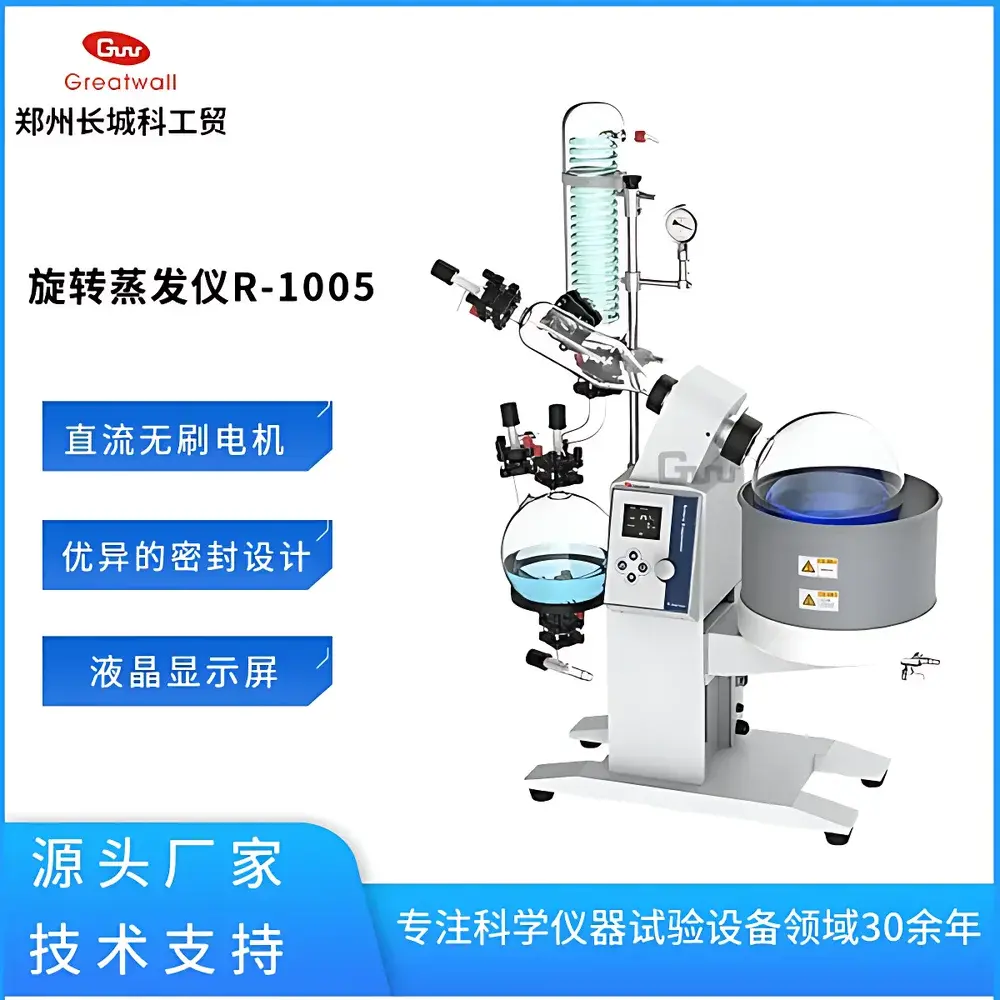
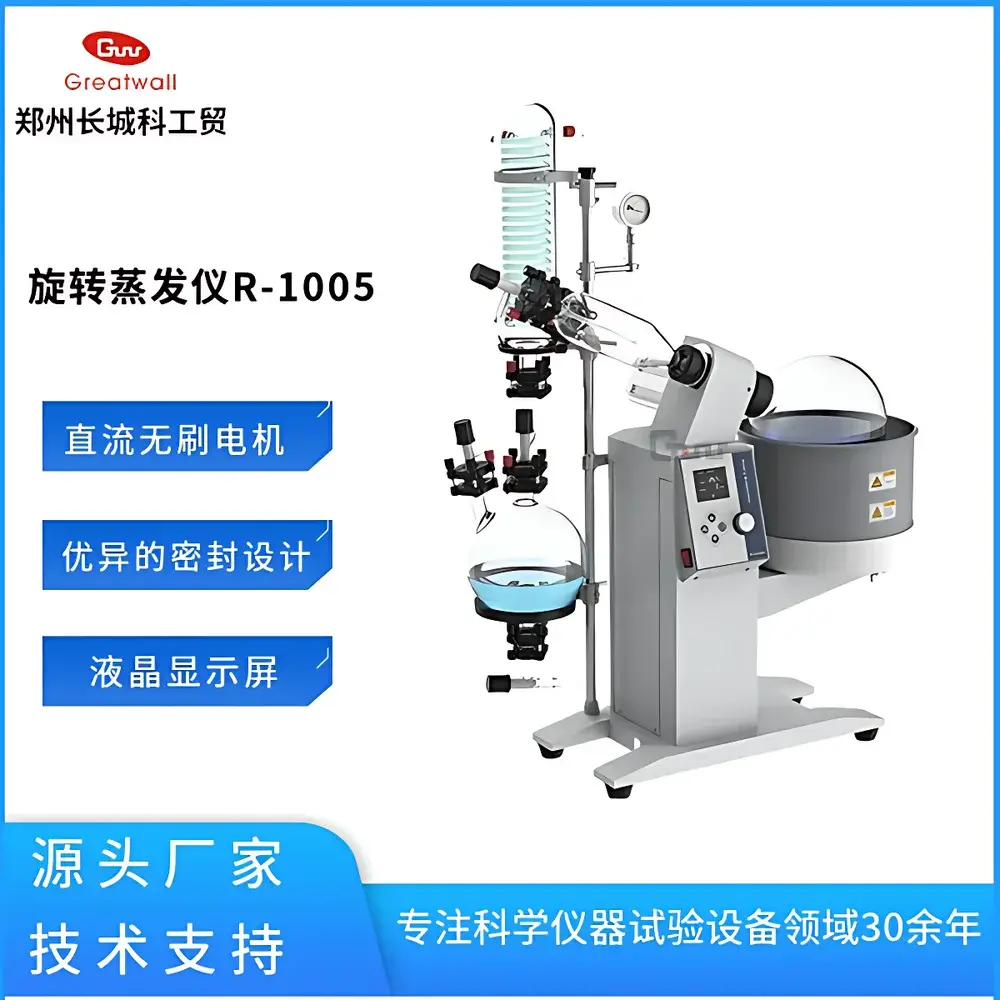
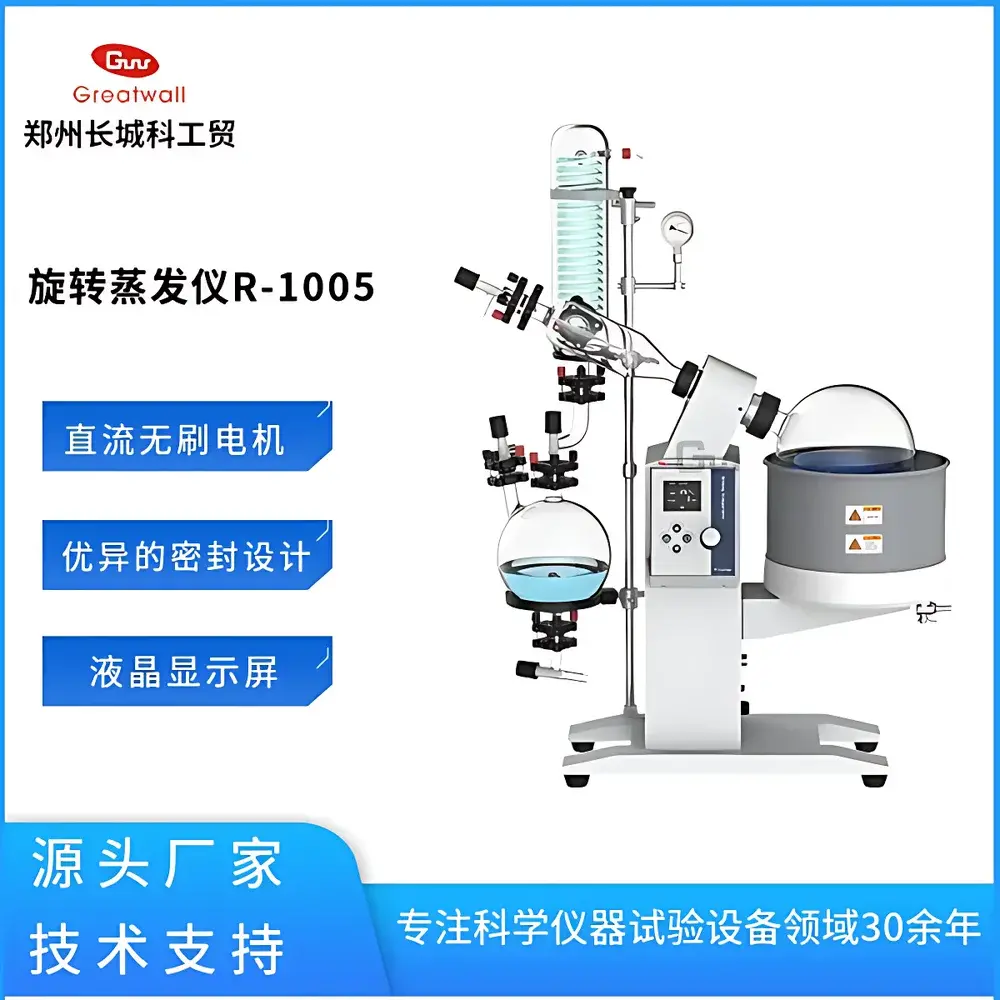
The Great Wall R-1005 Rotary Evaporator
| Brand | The Great Wall |
|---|---|
| Origin | Henan, China |
| Manufacturer Type | Direct Manufacturer |
| Origin Category | Domestic (China) |
| Model | R-1005 |
| Capacity | 5.0 L Rotating Flask |
| Rotation Speed | 20–140 rpm |
| Temperature Control Range | Ambient +5 °C to 95 °C |
| Temperature Control Accuracy | ±1.5 °C |
| Condensing Area | 0.278 m² |
| Heating Power | 2000 W |
| Rotating Motor Power | 250 W |
| Total Rated Power | 2300 W |
| Display | LCD Digital Display |
| Lift Mechanism | Electric升降 (10 mm/s, 0–150 mm Stroke) |
| Bath Material | 06Cr19Ni10 Stainless Steel (Φ300 × 170 mm) |
| Condenser Type | High-Efficiency Dual-Return Condenser |
| Collection Flask Volume | 3.0 L |
| Sealing System | Modified PTFE + Fluoroelastomer Dual-Seal |
| Feed Valve Core Material | PTFE |
| Evaporation Rate (Water) | 2.0 L/h |
| Leakage Rate | ≤0.03 kPa/min |
| Safety Features | Liquid-level Protection, Overtemperature, Overcurrent, Ground-Fault Protection |
| Operating Environment | 5–35 °C, ≤70% RH |
| Power Supply | 110 V~, 60 Hz or 220–240 V~, 50/60 Hz |
| Dimensions (W×D×H) | 840 × 520 × 1140 mm |
| Weight | 35 kg |
Overview
The Great Wall R-1005 Rotary Evaporator is an engineered solution for efficient, reproducible solvent removal and concentration under reduced pressure in research laboratories, quality control facilities, and pilot-scale synthesis environments. Based on the fundamental principle of vacuum-assisted rotary distillation—where reduced system pressure lowers the boiling point of solvents while controlled rotation increases surface area and promotes uniform thin-film formation—the R-1005 delivers consistent performance across organic, aqueous, and heat-sensitive sample matrices. Its design integrates thermal stability, mechanical precision, and process safety into a single platform suitable for routine purification, extract concentration, and preparative chemistry workflows. The instrument operates within a defined vacuum range (typically 1–100 mbar, compatible with standard lab vacuum pumps), enabling rapid evaporation without thermal degradation of thermolabile compounds.
Key Features
- High-integrity borosilicate glass 3.3 construction for all major components—including rotating flask, condenser, vapor duct, and receiving flask—ensuring exceptional thermal shock resistance, chemical inertness, and optical clarity for real-time process monitoring.
- LCD digital display with intuitive one-knob (rotary encoder) interface for simultaneous, independent adjustment and readout of bath temperature and rotation speed—eliminating manual calibration drift and enhancing operator repeatability.
- Integrated liquid-level detection circuitry that automatically halts heating upon low-bath-fluid condition, preventing dry-heating events and extending bath heater lifespan.
- Dual-return condenser geometry with 0.278 m² effective cooling surface area, optimized for high recovery efficiency (>95% for common solvents such as ethanol, acetone, and ethyl acetate at standard operating conditions).
- Tri-way buffer flask fabricated from borosilicate glass 3.3, positioned between evaporating and condensing zones to dampen vapor surges and suppress bumping or carryover during vigorous boiling.
- Patented dual-material sealing system combining modified polytetrafluoroethylene (PTFE) and fluoroelastomer O-rings—providing low-permeability static and dynamic sealing across wide temperature and vacuum ranges (≤0.03 kPa/min leakage rate verified per ISO 2859-1 sampling protocol).
- Motor-driven vertical lift mechanism (10 mm/s, 0–150 mm travel) with ergonomic positioning and external thermal insulation sleeve on the heating bath—minimizing operator exposure to surface temperatures above 60 °C.
- PTFE-sleeved drain valve with corrosion-resistant core, rated for continuous use with aggressive solvents including concentrated acids, bases, and halogenated organics.
- Quick-connect flange joints (DN32 standard) throughout the glass train—enabling tool-free assembly/disassembly in under 90 seconds without compromising vacuum integrity or alignment tolerance.
Sample Compatibility & Compliance
The R-1005 supports broad sample compatibility across pharmaceutical intermediates, natural product extracts, polymer solutions, and synthetic reaction mixtures. Its borosilicate glass train complies with USP Class A dimensional tolerances and meets ASTM E438 Type I, Class A specifications for laboratory glassware. The stainless steel bath (06Cr19Ni10, equivalent to AISI 304) satisfies FDA 21 CFR 178.3570 requirements for indirect food additives contact surfaces. Electrical safety conforms to IEC 61010-1:2010 (Measurement, Control and Laboratory Equipment – Safety Requirements). While not inherently 21 CFR Part 11 compliant, the instrument’s analog control architecture permits integration with validated LIMS or ELN systems via optional RS-232/485 output modules—supporting GLP/GMP audit trails when deployed in regulated environments.
Software & Data Management
The R-1005 operates as a standalone benchtop instrument with embedded microcontroller-based regulation—no proprietary software required for basic operation. All setpoints and real-time values (temperature, rpm, lift position) are locally displayed and retained in non-volatile memory across power cycles. For traceable process documentation, optional data logging modules (sold separately) provide timestamped CSV export via USB or serial interface. These modules support configurable sampling intervals (1–60 s), alarm event tagging (e.g., “temp deviation >±2°C”), and password-protected parameter locking—facilitating alignment with internal SOPs and external quality audits.
Applications
- Concentration of crude botanical extracts prior to HPLC or GC-MS analysis.
- Removal of reaction solvents (e.g., THF, DMF, DCM) following Grignard, Suzuki, or amidation reactions.
- Recovery and recycling of high-purity solvents in multi-step synthesis campaigns.
- Preparative isolation of heat-labile APIs where traditional distillation would induce decomposition.
- Standardized evaporation protocols in QC labs performing residual solvent testing per ICH Q3C guidelines.
- Teaching laboratory demonstrations of colligative properties, phase equilibria, and vacuum thermodynamics.
FAQ
What vacuum level is recommended for optimal performance with the R-1005?
A stable vacuum between 10–30 mbar is generally ideal for balancing evaporation rate and condensation efficiency across most common solvents; lower pressures may increase bumping risk without proportional throughput gains.
Can the R-1005 be used with corrosive solvents like concentrated HCl or bromine-containing compounds?
Yes—provided all wetted parts (glass train, PTFE valve core, dual-seal rings) remain intact and undamaged; however, prolonged exposure to fuming nitric acid or molten alkali metals is not advised.
Is the heating bath fluid temperature calibrated to NIST-traceable standards?
Factory calibration is performed using reference-grade PT100 sensors with ±0.3 °C uncertainty; users may perform field verification using a certified immersion thermometer per ASTM E74-22.
Does the R-1005 support external temperature probe input for jacketed reactor coupling?
No—the unit lacks auxiliary sensor inputs; temperature feedback is exclusively derived from the integrated bath RTD.
What maintenance intervals are recommended for long-term reliability?
Visual inspection of seals and glass integrity before each use; lubrication of lift rail every 6 months; annual verification of vacuum leakage rate and thermostat hysteresis per manufacturer’s service manual (document #GW-R1005-SM-Rev4.2).



