
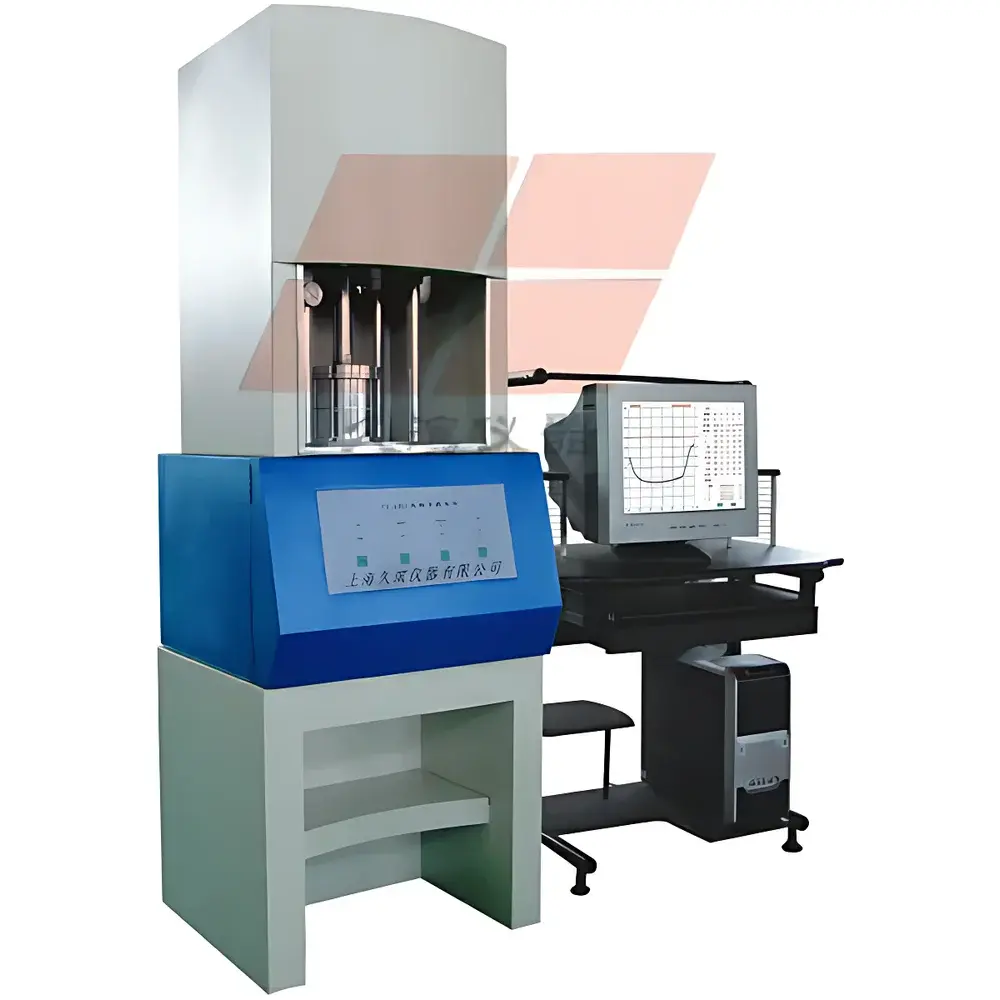
Jiubin Instruments JB-236B Rotorless Vulcanizer
| Brand | Jiubin Instruments |
|---|---|
| Origin | Shanghai, China |
| Manufacturer Type | Authorized Distributor |
| Country of Origin | China |
| Model | JB-236B |
| Price Range | USD 4,200 – 7,000 |
| Temperature Range | Ambient to 200 °C |
| Temperature Control Accuracy | ±0.15 °C |
| Torque Resolution | 1/500,000 |
| Torque Accuracy | ±0.3% |
| Oscillation Frequency | 1.67 Hz (100 cycles/min) |
| Oscillation Amplitude | ±1° ±0.03° (standard), optional ±0.5° or ±3° |
| Sampling Rate | 200 Hz |
| Heating Rate | Ambient → 170 °C in ≤2 min 40 sec (±0.3 °C) |
| Mold Cavity | Alpha-type sealed cavity with fluoropolymer sealing ring |
| Force Sensor | High-precision torque sensor (0.001 N·m resolution) |
| Pressure Monitoring | Integrated high-accuracy pressure transducer |
| Compliance | GB/T 16584, ISO 6502, ASTM D5289, UNI standards |
Overview
The Jiubin Instruments JB-236B Rotorless Vulcanizer is an ASTM D5289– and ISO 6502–compliant rheometric instrument engineered for precise characterization of uncured rubber compounds during vulcanization. It operates on the principle of oscillatory shear rheometry within a fully sealed, temperature-controlled cavity—eliminating rotor-based mechanical interference and enabling direct measurement of torque response under small-strain dynamic deformation. The lower die oscillates sinusoidally at a fixed frequency (1.67 Hz) and amplitude (±1° ±0.03°), inducing controlled shear strain in the sample; the resulting restoring torque is measured in real time via a high-fidelity load cell (0.001 N·m resolution). This torque–time profile—the vulcanization curve—quantifies critical kinetic and viscoelastic parameters including scorch time (ts1, ts2), cure onset (t10), optimum cure (t50, t90), minimum/maximum torque (ML, MH), and cure rate indices (Vc1, Vc2). Designed for laboratory-scale formulation development and QC release testing, the JB-236B delivers traceable, reproducible data essential for rubber compound optimization, process window definition, and regulatory documentation under GLP/GMP-aligned workflows.
Key Features
- Alpha-type sealed cavity architecture with FKM sealing rings ensures zero material extrusion, eliminates oxidative degradation, and guarantees exceptional test-to-test repeatability—meeting ISO 6502’s requirement for cavity integrity and thermal uniformity.
- High-stability temperature control system featuring Omron PID controllers and real-time compensation algorithms achieves ±0.15 °C accuracy across 0–200 °C, with <1.5 min cavity temperature recovery post-closing and <30 s re-equilibration after step-change transitions (e.g., 170 °C ↔ 190 °C).
- Dual-sensor monitoring: A calibrated torque transducer (0.001 N·m resolution, ±0.3% full-scale accuracy) and an integrated pressure transducer (0.3% FS resolution) enable concurrent tracking of rheological and pneumatic behavior during cure.
- 200 Hz data acquisition rate captures rapid early-stage kinetics—including millisecond-scale scorch onset—supporting statistical robustness per ASTM D5289 Annex A1.
- Modular hardware platform includes NSK precision bearings, SMC/Deli Xi pneumatic actuators, and military-grade electronic components for >10,000-cycle operational durability and long-term calibration stability.
- Automated safety interlock system with motorized door actuation and force-limited closure prevents operator exposure to high-temperature surfaces and pressurized cavities.
Sample Compatibility & Compliance
The JB-236B accepts standard 38 mm diameter × 11.4 mm thick rubber specimens (per ASTM D5289 and GB/T 16584), accommodating natural rubber (NR), SBR, BR, EPDM, CR, silicone, and thermoplastic elastomers—including filled, oil-extended, and peroxide- or sulfur-cured systems. Its sealed cavity design inherently supports low-viscosity compounds and avoids edge effects common in rotor-type instruments. All firmware and data handling comply with FDA 21 CFR Part 11 requirements for electronic records and signatures when configured with audit-trail-enabled software. Test reports include mandatory metadata: timestamp, ambient conditions (T, RH, P), calibration certificate IDs, operator ID, and raw torque/temperature arrays—ensuring full traceability for ISO/IEC 17025-accredited labs.
Software & Data Management
The embedded Windows-based control suite (v4.2+) provides synchronized dual-channel real-time plotting (torque vs. time; cavity temperature vs. time), automated parameter extraction per ISO 6502 definitions, and multi-curve overlay with customizable color mapping. Raw datasets are exported in CSV and XML formats compliant with LIMS integration protocols. Built-in comparison tools support statistical analysis (mean, SD, CV%) across batches or formulations. Software validation documentation—including IQ/OQ protocols and version-controlled change logs—is provided. Optional modules support automated pass/fail logic against user-defined specification limits (e.g., t90 ∈ [380 ± 15] s), generating PDF certificates with digital signature and tamper-evident hash.
Applications
This instrument serves as a primary tool in rubber R&D laboratories for crosslink density profiling, accelerator package screening, filler dispersion assessment, and reversion resistance evaluation. In production environments, it supports incoming raw material verification (e.g., polymer lot consistency), batch release testing (per ASTM D3182), and troubleshooting of extrusion/molding defects linked to under- or over-cure. Academic users apply it to study network formation kinetics using time–temperature superposition (TTS) and Arrhenius modeling. Its compliance with UNI 7725 and JIS K6300 further enables multinational supply chain harmonization for automotive, aerospace, and medical-grade elastomer suppliers.
FAQ
What standards does the JB-236B meet for regulatory submission?
It conforms to GB/T 16584, ISO 6502:2017, ASTM D5289–22, and UNI 7725, with documented traceability to NIST-traceable torque and temperature standards.
Can the instrument operate unattended overnight?
Yes—equipped with thermal runaway protection, pressure relief valves, and automatic shutdown on communication loss or timeout, it supports extended curing protocols up to 12 hours.
Is third-party calibration certification included?
A factory-issued calibration report (traceable to CNAS-accredited labs) is supplied; annual recalibration services with ISO/IEC 17025 certificates are available.
How is data integrity ensured during power interruption?
Non-volatile memory retains all active test buffers; upon restart, the system resumes acquisition from last valid timestamp without data loss.
Does the software support multi-language UI and report generation?
Yes—interface and reports are configurable in English, Simplified Chinese, and Traditional Chinese, with customizable templates adhering to internal SOPs or customer-specific formats.






