
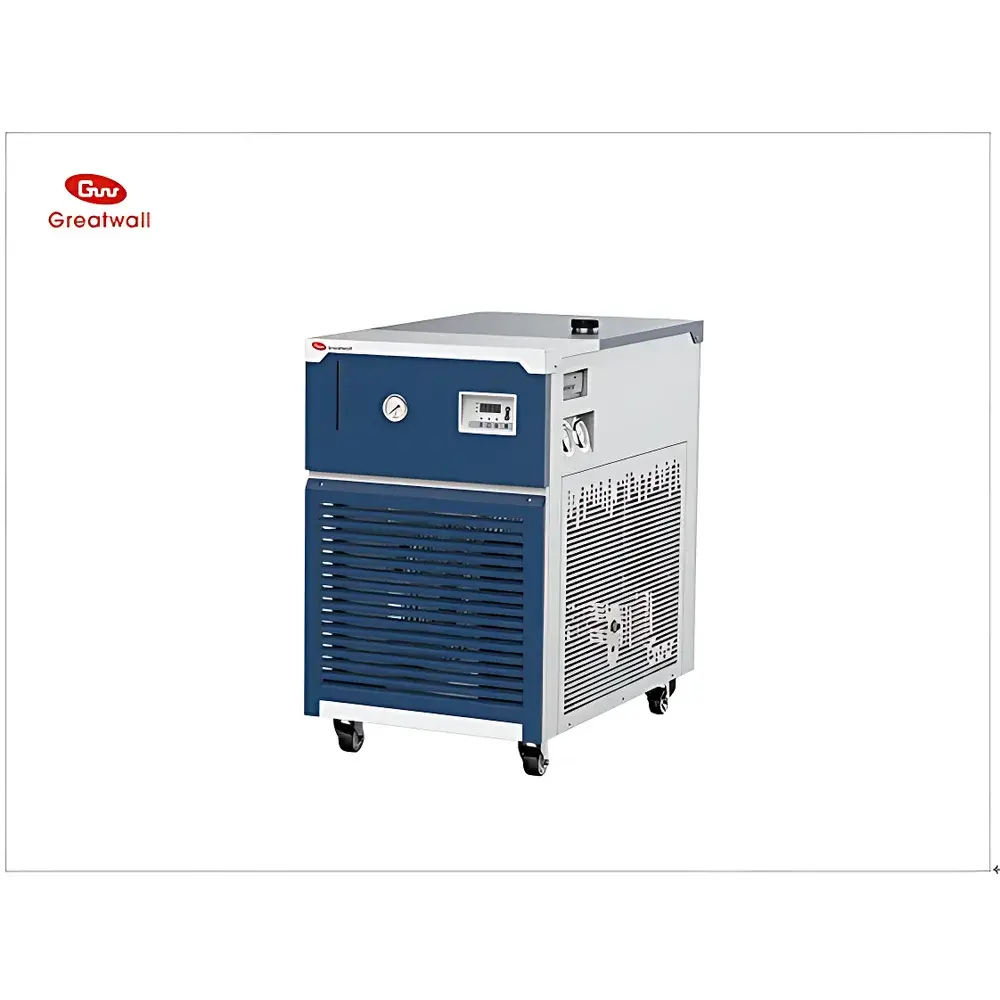
Great Wall DL10-3000G Circulating Chiller
| Brand | Great Wall |
|---|---|
| Origin | Henan, China |
| Manufacturer Type | Direct Manufacturer |
| Product Category | Domestic Laboratory Refrigeration Equipment |
| Model | DL10-3000G |
| Cooling Capacity | 3000 W (at 25°C ambient, 15°C coolant) |
| Operating Temperature Range | –10°C to 25°C (max. setpoint ≤ ambient – 5°C) |
| Temperature Stability | ±2°C |
| Control Algorithm | PID |
| Refrigerant | R134a (CFC-free) |
| Pump Flow Rate | 16 L/min |
| Reservoir Volume | 30 L |
| Reservoir Material | SUS304 Stainless Steel |
| External Port | Rc 1/2 internal thread |
| Power Supply | 220–240 V~, 50 Hz |
| Rated Power | 2200 W |
| Rated Current | 11.7 A |
| Dimensions (W×D×H) | 495 × 760 × 860 mm |
| Net Weight | 108 kg |
| Ambient Operating Conditions | 5–35°C, ≤70% RH |
| Safety Protections | Compressor delay start, high-pressure, overload, and overcurrent protection |
| Temperature Sensor | Pt100 |
| Display | Digital temperature readout with integrated level and pressure indicators |
Overview
The Great Wall DL10-3000G Circulating Chiller is an engineered thermal management solution designed for continuous, stable cooling of external laboratory equipment—including rotary evaporators, spectrophotometers, laser systems, and analytical instrumentation requiring precise low-temperature fluid circulation. It operates on a vapor-compression refrigeration cycle using environmentally compliant R134a refrigerant, eliminating ozone-depleting chlorofluorocarbons (CFCs) and hydrochlorofluorocarbons (HCFCs). The unit integrates a high-efficiency Copeland scroll compressor with dual-flex design, delivering superior energy efficiency (COP), low acoustic emission (<62 dB[A]), and mechanical resilience under prolonged duty cycles. Its compact footprint and robust stainless-steel reservoir (SUS304) support integration into regulated laboratory environments where corrosion resistance, traceability, and long-term fluid integrity are critical.
Key Features
- High-Reliability Refrigeration Core: Equipped with a Copeland ZB series scroll compressor featuring DU sleeve bearings and dual-flex mounting—reducing vibration transmission and extending service life beyond 20,000 operating hours.
- Optimized Heat Exchange Architecture: Air-cooled fin-and-tube condenser with oxygen-free copper helical tubing and proprietary mid-section expansion bonding ensures consistent thermal transfer and simplified maintenance access.
- Integrated Immersion Evaporator: 304 stainless steel coil-type evaporator mounted directly inside the reservoir prevents freeze-induced mechanical stress during low-temperature operation and eliminates external leak paths.
- Contaminant-Resistant Fluid Circuit: Dual-stage filtration system—comprising inlet strainer at the reservoir outlet and refill port filter—retains particulates down to 50 µm, protecting downstream instrumentation and pump internals.
- Precision Thermal Regulation: PID-based digital temperature controller with Pt100 sensing (IEC 60751 Class B) delivers ±2°C stability across the –10°C to +25°C range; maximum setpoint constrained to ambient temperature minus 5°C per ASHRAE Guideline 15 compliance.
- Comprehensive System Safeguards: Real-time monitoring of discharge pressure, motor current, and compressor winding temperature enables automatic shutdown in response to overpressure (>3.0 MPa), overcurrent (>13.5 A), or thermal overload conditions.
Sample Compatibility & Compliance
The DL10-3000G is compatible with water, water-glycol mixtures (up to 30% v/v), and other non-corrosive, low-viscosity heat-transfer fluids meeting ISO 6743-22 (L-QA class) specifications. Its 30 L SUS304 reservoir supports uninterrupted operation for >8 hours at full-load cooling (3000 W) with 15°C setpoint under standard lab conditions (25°C ambient, 50% RH). The unit conforms to IEC 61000-6-3 (EMC emissions), IEC 61000-6-2 (immunity), and GB 4706.1-2005 (safety). While not certified to UL or CE for export markets without regional adaptation, its electrical architecture complies with EN 60335-1 requirements when configured with appropriate input filters and grounding provisions. Documentation includes factory calibration records traceable to NIM (National Institute of Metrology, China) standards.
Software & Data Management
The DL10-3000G features a standalone front-panel interface with LED-displayed real-time values for temperature, reservoir level (via calibrated sight tube), and system pressure (0–10 bar gauge). No embedded firmware or network connectivity is provided; however, analog 0–10 V or 4–20 mA output signals (optional upon request) enable integration into centralized building management systems (BMS) or SCADA platforms for remote status logging. All operational parameters—including cumulative runtime, compressor starts, and fault history—are stored in non-volatile memory and accessible via diagnostic mode. For GLP/GMP-aligned laboratories, users may implement manual logbooks or integrate third-party data acquisition software (e.g., LabVIEW or Delta Tau) using the analog outputs to satisfy 21 CFR Part 11 audit-trail requirements.
Applications
- Cooling jackets of rotary evaporators (e.g., Buchi R-300, IKA RV 10) during solvent recovery at controlled sub-ambient temperatures.
- Thermal stabilization of UV-Vis and FTIR spectrometers with Peltier-cooled detectors or flow cells.
- Heat dissipation for high-power diode lasers (≤50 W optical output) used in Raman spectroscopy or particle sizing systems.
- Temperature conditioning of HPLC column ovens and detector cells in QC/QA workflows adhering to USP and ASTM E2910.
- Supporting cryogenic sample preparation stages in materials science labs where reproducible –5°C to +20°C baths are required for polymer crystallization studies.
FAQ
What is the minimum ambient temperature required for stable operation?
The chiller requires a minimum ambient temperature of 5°C. Below this threshold, refrigerant subcooling may impair compressor lubrication and reduce volumetric efficiency.
Can the unit operate continuously at –10°C setpoint?
Yes—provided ambient temperature remains ≤15°C (to satisfy the Tmax ≤ Tambient – 5°C constraint) and coolant concentration is adjusted to prevent freezing (e.g., 25% ethylene glycol/water mixture).
Is the reservoir volume sufficient for external systems with large fluid volumes?
With 30 L capacity and 16 L/min flow rate, the unit supports external loops up to ~120 L total volume while maintaining dynamic thermal equilibrium within ±2°C under steady-state load.
Does the chiller support external temperature feedback control?
Not natively—the PID controller regulates only internal bath temperature. For process-coupled control, users must implement external PID controllers interfaced via analog I/O signals.
What maintenance intervals are recommended for long-term reliability?
Compressor oil inspection every 12 months; refrigerant circuit integrity check every 24 months; filter element replacement every 6 months or after 1000 operating hours—whichever occurs first.



