
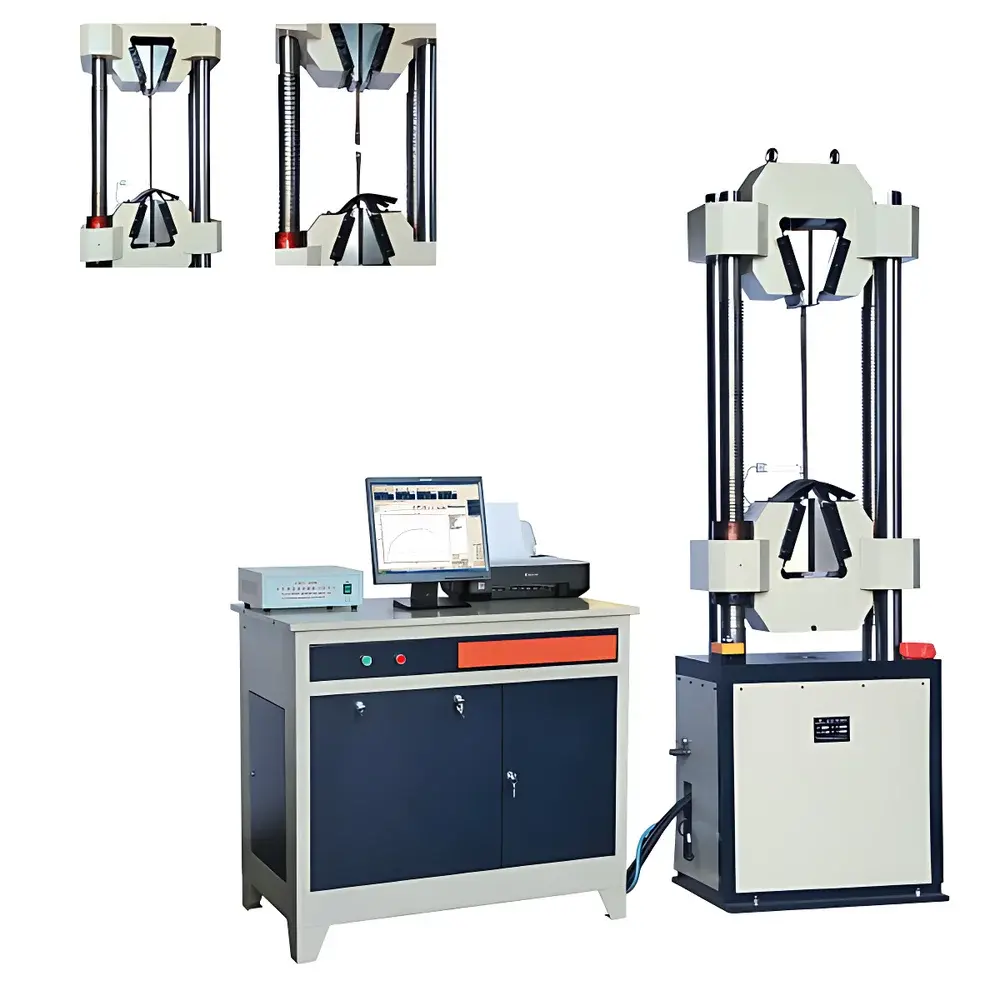
JB/GWA-1000B Electro-Hydraulic Servo Testing Machine for Prestressed Steel Strands
| Key | Brand: Jiubin Instruments |
|---|---|
| Origin | Shanghai, China |
| Model | JB/GWA-1000B |
| Type | Electro-hydraulic servo universal testing machine |
| Max. Test Force | 1000 kN |
| Force Range | 50–1000 kN |
| Force Resolution | 0.01 kN |
| Displacement Resolution | 0.01 mm |
| Deformation Accuracy | ±0.01 mm |
| Tensile Space | 1000 mm |
| Compression Space | 600 mm |
| Piston Stroke | 150 mm |
| Clamp Jaw Diameter (Std.) | 15.20 mm |
| Piston Speed | 0–50 mm/min |
| Clamping Method | Automatic hydraulic clamping |
| Host Dimensions (W×D×H) | 890 × 660 × 2500 mm |
| Load Frame Type | Cylinder-under structure |
Overview
The JB/GWA-1000B Electro-Hydraulic Servo Testing Machine is a high-capacity, precision-engineered system specifically designed for mechanical property evaluation of prestressed steel strands used in post-tensioned concrete structures, bridge cables, and geotechnical anchoring systems. It operates on the principle of closed-loop electro-hydraulic servo control, delivering stable, programmable force and displacement profiles compliant with ASTM A416/A416M, ISO 15630-3, and GB/T 5224 standards for steel strand testing. The machine features a cylinder-under load frame architecture, enabling extended tensile travel (1000 mm) and optimized alignment for high-aspect-ratio specimens—critical for minimizing bending moments during axial loading. Its dual-range load cell (50–1000 kN), coupled with 0.01 kN force resolution and synchronized displacement feedback via high-fidelity optical encoder, ensures traceable, repeatable measurements of ultimate tensile strength (Rm), 0.2% proof stress (Rp0.2), elastic modulus (E), and total elongation at break (At) per ISO 6892-1 and EN 10002-1.
Key Features
- Electro-hydraulic servo actuation with digital proportional valve control, enabling precise force ramping, hold, and cyclic loading protocols up to 50 mm/min piston speed
- Automatic hydraulic clamping system with dedicated extended-jaw fixtures (standard 15.20 mm diameter) engineered to promote central fracture—reducing premature slippage or end-necking failure
- Integrated high-accuracy extensometer (YYU-15/200, Beijing Iron & Steel Research Institute) for direct strain measurement across gauge lengths up to 200 mm, meeting Class 1 accuracy per ISO 9513
- Dual-sensor data acquisition: simultaneous capture of load (via calibrated 1000 kN pressure transducer), displacement (optical encoder, 0.01 mm resolution), and axial deformation (extensometer, ±0.01 mm accuracy)
- Modular software architecture supporting multi-curve real-time plotting: Force–Displacement, Force–Deformation, Stress–Strain, Stress–Displacement, Force–Time, and Deformation–Time
- Role-based user management (Administrator / Tester) with audit-trail logging for GLP-compliant environments
Sample Compatibility & Compliance
The JB/GWA-1000B accommodates standard 7-wire prestressed steel strands (e.g., 1×7, 1×19 configurations) with nominal diameters of 12.7 mm, 15.2 mm, and 15.7 mm. Optional jaw sets (not included) extend compatibility to 12.9 mm and 17.8 mm strands. Compression testing is supported using a Φ160 mm platens for concrete or grout cube evaluation per ASTM C39/C39M and GB/T 50081. All hardware and firmware comply with electromagnetic compatibility (EMC) requirements per IEC 61326-1 and functional safety principles aligned with ISO 13849-1. Mechanical design adheres to ISO 7500-1 (Class 1 load frame verification) and ISO 5893 (displacement measurement accuracy).
Software & Data Management
The system runs on a Windows-based universal testing platform developed in-house by Jiubin Instruments. It supports full test method customization—including stepwise load control, displacement-controlled ramps, and hybrid force/displacement profiles. Test definitions, calibration records, and specimen metadata are stored in encrypted SQLite databases with optional network backup. Reporting follows FDA 21 CFR Part 11 readiness: electronic signatures, immutable audit logs, and revision history for all test parameters and results. Excel-based report templates allow users to define column order, units, statistical summaries (mean, SD, CV%), and pass/fail thresholds against specification limits (e.g., Rm ≥ 1860 MPa per ASTM A416). Raw ASCII data export (.csv) enables third-party analysis in MATLAB, Python, or Minitab.
Applications
- Quality assurance of pre-stressing strands in wire rod mills and strand manufacturing plants
- Verification testing per project specifications for bridge stay cables, nuclear containment tendons, and seismic retrofitting systems
- R&D of high-strength low-alloy (HSLA) and corrosion-resistant coated strands (e.g., galvanized, epoxy-coated, Galfan®)
- Calibration and validation of secondary reference machines in metrology laboratories accredited to ISO/IEC 17025
- Educational use in civil engineering and materials science curricula for fracture mechanics and constitutive modeling labs
FAQ
What standards does the JB/GWA-1000B support for steel strand testing?
ASTM A416/A416M, ISO 15630-3, GB/T 5224, and EN 10138-3 — including procedures for determination of 0.1% and 0.2% non-proportional extension strengths.
Is the system compatible with third-party extensometers or load cells?
Yes — the analog input channels accept industry-standard ±10 V or 4–20 mA signals; however, factory calibration and ISO 7500-1 verification require use of the supplied transducers.
Can test sequences be automated for batch processing of multiple specimens?
Yes — the software supports queued execution of predefined test methods with auto-save, sequential numbering, and pass/fail flagging based on user-defined criteria.
Does the system meet requirements for ISO/IEC 17025 accredited laboratories?
It provides the necessary traceability, uncertainty estimation tools, and documentation features; final accreditation depends on site-specific validation and external assessment by the relevant national body.
What maintenance is required for long-term force accuracy?
Annual recalibration of the load cell and extensometer is recommended; hydraulic oil replacement every 24 months and filter servicing every 6 months ensure consistent servo response and thermal stability.



