
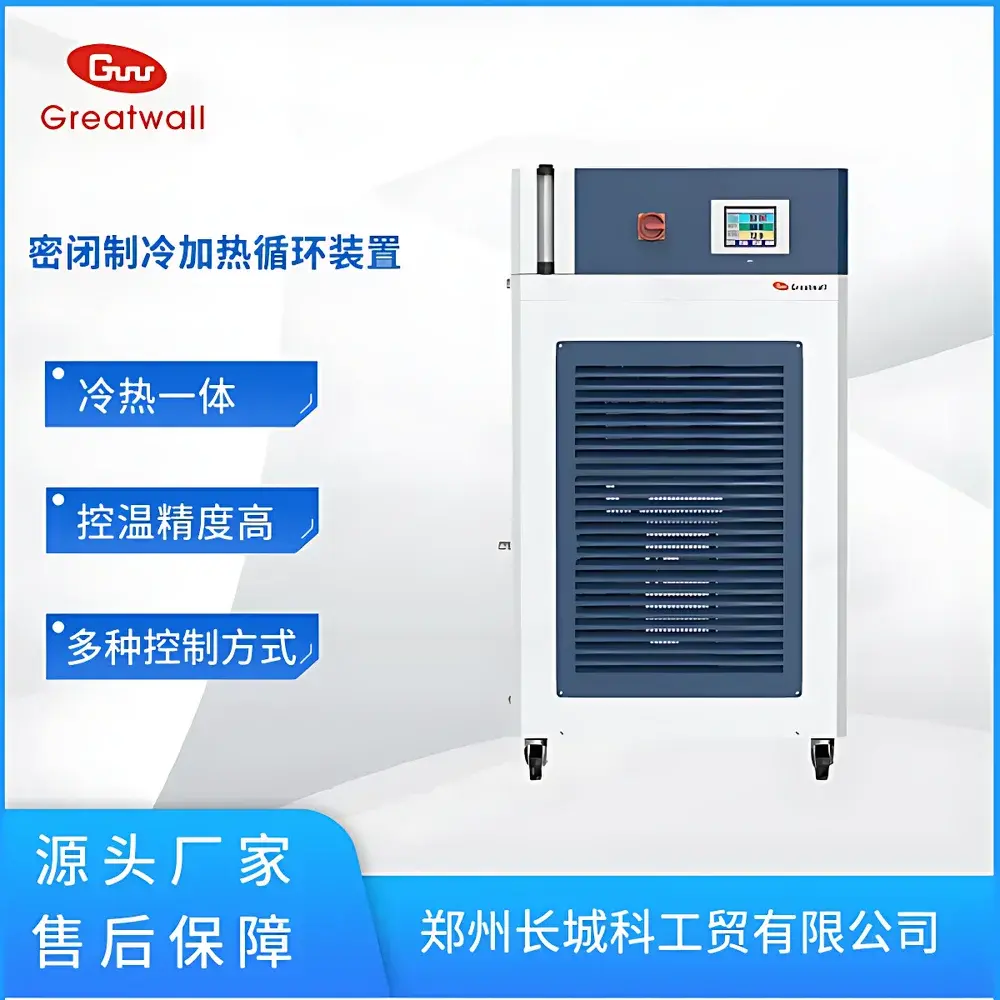
The Great Wall ZT-20-200-80H Closed-Loop Refrigerated & Heated Circulator
| Brand | The Great Wall |
|---|---|
| Origin | Henan, China |
| Manufacturer Type | Direct Manufacturer |
| Model | ZT-20-200-80H |
| Temperature Stability | ±0.5 °C (at 15–65 °C) |
| Temperature Range | −80 to 200 °C |
| Cooling Capacity | 1.7 kW @ 200 °C, 4.3 kW @ 10 °C, 3.1 kW @ −10 °C, 2.3 kW @ −20 °C, 1.2 kW @ −30 °C, 2 kW @ −35 °C, 1.4 kW @ −60 °C, 0.45 kW @ −78 °C |
| Heating Power | 3 kW |
| Total Power Consumption | 7.9 kW |
| Pump Flow Rate | 30 L/min (max), Pressure: 1 bar (max) |
| Bath Volume | 12 L |
| Display | 7″ color TFT touchscreen, resolution 0.01 °C |
| Communication | RS485, USB |
| Refrigerants | R404A + R23 |
| Protection | Overtemperature, high-pressure refrigeration, leakage, phase sequence, thermal overload, overcurrent, compressor delay start |
| Enclosure | Cold-rolled steel with powder coating |
| IP Rating | IP20 |
| Pollution Degree | 2 |
| Dimensions (W×D×H) | 885 × 1315 × 1565 mm |
| Weight | 393 kg |
| Ambient Operating Conditions | 5–35 °C, ≤70% RH |
| Standard Accessories | 2.6 m insulated stainless-steel flexible hose |
Overview
The Great Wall ZT-20-200-80H is a high-performance closed-loop refrigerated and heated circulator engineered for precise, stable, and repeatable temperature control across demanding laboratory and pilot-scale process applications. Unlike open-bath systems, its fully sealed circulation architecture prevents evaporation, oxidation, and moisture absorption by the heat transfer fluid—significantly extending fluid service life and maintaining consistent thermal properties over extended operation. The unit integrates dual-refrigerant technology (R404A and R23) to achieve an exceptionally wide operational temperature span of −80 °C to +200 °C in a single system, eliminating the need for separate cryogenic and high-temperature units. Its robust mechanical design includes wind-cooled condensation, a high-efficiency 3 kW electric heater, and a 7.9 kW total power architecture optimized for dynamic thermal loads. Temperature stability is rated at ±0.5 °C within the 15–65 °C range—critical for reaction calorimetry, polymerization kinetics, and crystallization studies—and maintains traceable repeatability under GLP-compliant operating conditions.
Key Features
- Hermetically sealed circulation loop with inert atmosphere compatibility, minimizing thermal fluid degradation and enabling long-term use of silicone oils or specialized synthetic heat transfer media.
- Real-time liquid level monitoring via integrated capacitive sensor, preventing dry-run damage and supporting automated top-up integration in centralized utility systems.
- Multi-layer safety architecture: independent overtemperature cutoff, refrigeration circuit high-pressure shutdown, earth-leakage detection, compressor soft-start delay, thermal overload protection, overcurrent tripping, and three-phase sequence verification.
- High-resolution 7-inch full-color TFT touchscreen interface with 0.01 °C display and setpoint resolution, supporting graphical trend logging of bath and external probe temperatures.
- Standard digital I/O suite including isolated RS485 (Modbus RTU protocol compliant) and USB host/device ports for seamless integration into SCADA, LIMS, or PLC-based process control networks.
- External Pt100 sensor input (2-wire or 4-wire) enables direct material-in-vessel temperature feedback control, decoupling bath setpoint from actual process temperature—a necessity for exothermic reaction management and jacketed reactor applications.
Sample Compatibility & Compliance
The ZT-20-200-80H is designed for compatibility with standard laboratory and industrial thermal interfaces, including DIN/ISO jacketed reactors (double- and triple-wall), stirred tanks, distillation columns, environmental test chambers, and vacuum-compatible thermal platforms. Its R23/R404A refrigerant blend complies with current non-ozone-depleting substance (ODS) regulations under the Montreal Protocol Annex A Group II, and all electrical components meet IEC 61000-6-2 (immunity) and IEC 61000-6-4 (emission) standards. The enclosure conforms to IEC 60529 IP20 ingress protection and IEC 60664-1 Pollution Degree 2 requirements. While not certified to UL/CSA or CE for standalone medical device use, the system supports validation protocols aligned with ISO 17025, ASTM E2877 (for thermal calibration), and FDA 21 CFR Part 11 when deployed with audit-trail-enabled software extensions.
Software & Data Management
Data acquisition and remote supervision are enabled through native Modbus RTU support over RS485, allowing bidirectional communication with programmable logic controllers or third-party SCADA platforms. The onboard touchscreen logs timestamped temperature profiles (bath, external probe, and compressor discharge) with internal non-volatile memory retention for ≥72 hours. USB export supports CSV-formatted datasets compatible with MATLAB, Python (pandas), and Excel for post-hoc statistical analysis—including derivative-based rate-of-change evaluation for kinetic modeling. Optional firmware upgrades introduce TLS-secured HTTP API endpoints for cloud-based monitoring, though local network deployment remains the default configuration to ensure data sovereignty and low-latency control response.
Applications
- Temperature control of glass or stainless-steel jacketed reactors (2L–100L) in pharmaceutical API synthesis, where precise ramp/hold profiles impact chiral selectivity and impurity profiles.
- Thermal conditioning of polymer melt rheometers and DSC sample stages during dynamic mechanical analysis (DMA) and thermal transition characterization.
- Simulated environmental stress testing of automotive electronics modules, requiring rapid transitions between −40 °C and +125 °C per AEC-Q200 guidelines.
- Controlled cooling of vacuum distillation condensers and cold traps in fine chemical purification workflows.
- Stabilization of semiconductor wafer probing stations and laser diode mounts during photonic device characterization.
- Calibration of reference thermometers and secondary temperature standards in metrology labs operating under ISO/IEC 17025 accreditation.
FAQ
What is the minimum recommended heat transfer fluid volume for stable operation?
The system requires a minimum of 10 L of compatible fluid (e.g., silicone oil, polyalphaolefin, or low-temperature synthetic ester) to ensure adequate pump submergence and thermal mass for stability; the nominal fill capacity is 12 L.
Can the ZT-20-200-80H maintain ±0.5 °C stability at −70 °C?
At −70 °C, the specified stability is ±1.0 °C due to reduced refrigerant efficiency and increased ambient heat leak; ±0.5 °C is guaranteed only between 15 °C and 65 °C per ISO 17025 traceable calibration documentation.
Is external temperature feedback control supported out-of-the-box?
Yes—the rear-panel Pt100 input accepts 2-wire or 4-wire sensors and defaults to cascade control mode, using the external probe reading as the primary process variable while modulating bath output to minimize error.
Does the unit include validation documentation for GMP environments?
Factory-installed IQ/OQ documentation packages are available upon request, including as-delivered calibration certificates (NIST-traceable), alarm response verification reports, and electronic logbook templates compliant with ALCOA+ data integrity principles.
What maintenance intervals are recommended for the dual-refrigerant system?
Compressor oil and filter replacement is required every 12 months or 4,000 operating hours; refrigerant charge verification and leak testing should be performed annually by certified HVAC-R technicians holding EPA Section 608 certification.
Related Products



