
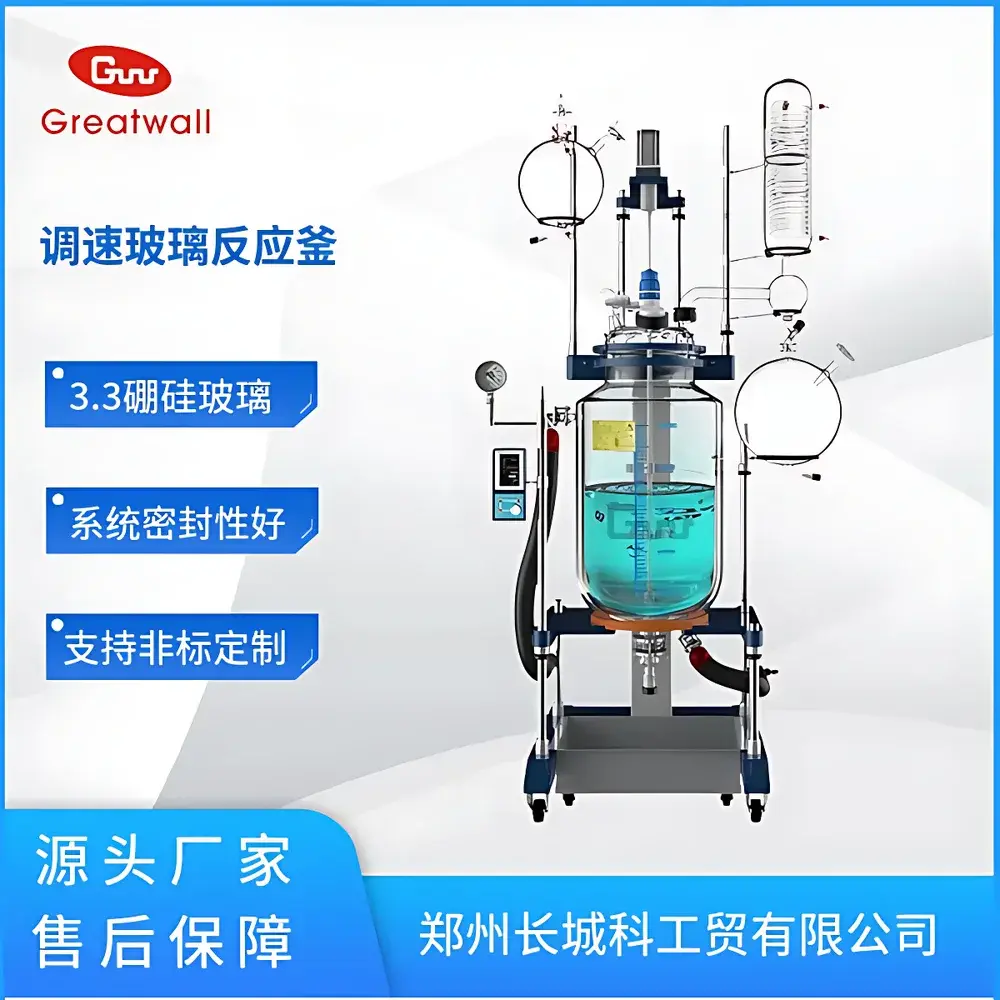
The Great Wall GRF-100 Borosilicate Glass Reactor System
| Brand | The Great Wall |
|---|---|
| Origin | Henan, China |
| Manufacturer Type | Direct Manufacturer |
| Origin Category | Domestic |
| Model | GRF-100 |
| Instrument Classification | Jacketed Glass Reactor |
| Vessel Material | ASTM E438 Type I, Class A 3.3 borosilicate glass |
| Effective Working Volume | 100 L |
| Minimum Agitation Volume | ~5 L |
| Operating Temperature Range | −80 °C to +200 °C |
| Pressure Rating | −0.1 MPa (vacuum) to 0 MPa (atmospheric) |
| Jacket Volume | 25 L |
| Jacket Pressure Limit | ≤0.03 MPa |
| Thermal Shock Resistance | ΔT ≤ 80 °C |
| Vacuum Level | ≤ −0.098 MPa (absolute) |
| Stirring Speed Range | 50–500 rpm |
| Speed Accuracy | ±1 rpm |
| Motor Power | 250 W |
| Drive Type | Three-phase AC inverter-controlled motor |
| Stirring Seal | Vacuum-rated mechanical seal with PTFE components |
| Stirrer Configuration | Triple-layer impeller assembly (four inclined-blade open turbine + two four-flat-blade open turbines) |
| Impeller & Shaft Material | 06Cr19Ni10 (AISI 316L) substrate with full PTFE cladding |
| Bottom Valve Outlet ID | φ21 mm |
| Discharge Port Diameter | φ33 mm |
| Condenser Surface Area | 0.954 m² |
| Condenser Joint Size | 40/38 |
| Constant-Pressure Addition Funnel Capacity | 10,000 mL |
| Solid Feed Port | 95# standard taper (φ338 mm flange) |
| Receiver Flask Capacity | 20,000 mL |
| Frame Construction | Hybrid structure — stainless steel 06Cr19Ni10 base, carbon steel frame with epoxy-polyester powder coating, and anodized aluminum uprights |
| Casters | Locking heavy-duty polyurethane wheels |
| Drip Tray | AISI 316L stainless steel |
| Temperature Sensor | PT100 RTD (IEC 60751 Class B), digital display, ±0.1 °C accuracy |
| Ambient Operating Conditions | 5–35 °C, ≤70% RH (non-condensing) |
| Overall Dimensions (W×D×H) | 1250 × 1000 × 2470 mm |
Overview
The Great Wall GRF-100 Borosilicate Glass Reactor System is a fully jacketed, vacuum-capable laboratory-scale reaction platform engineered for precise thermal control, inert atmosphere handling, and reproducible agitation across demanding synthetic, catalytic, and process-development workflows. Built on the foundational principles of jacketed heat transfer and sealed mechanical stirring, the system employs ASTM E438 Type I, Class A 3.3 borosilicate glass—certified for chemical resistance, low thermal expansion (3.3 × 10⁻⁶/K), and high transparency—to ensure optical monitoring of reaction progress without compromising structural integrity. Its design conforms to ISO 15528:2018 (laboratory glassware specifications) and supports operation under controlled vacuum (≤ −0.098 MPa absolute) and thermal cycling from −80 °C to +200 °C—enabling cryogenic lithiation, high-temperature esterification, hydrogenation under inert gas blanket, and solvent reflux protocols common in pharmaceutical intermediate synthesis and fine chemical R&D.
Key Features
- Triple-layer agitator assembly optimized for radial and axial flow: one four-inclined-blade open turbine (for macro-mixing and suspension) plus two four-flat-blade open turbines (for high-shear dispersion and gas–liquid mass transfer).
- Vacuum-rated dual-face mechanical seal with PTFE dynamic components and ceramic stationary face—rated for continuous operation at ≤ −0.098 MPa and compatible with aggressive solvents including THF, DMF, chlorinated hydrocarbons, and concentrated acids/bases.
- Full PTFE-clad 06Cr19Ni10 (AISI 316L) stirrer shaft and impellers—eliminating galvanic corrosion pathways while retaining torsional rigidity and fatigue resistance under variable load conditions.
- Stress-relieved jacket inlet/outlet ports with flexible 316L stainless steel insulated hoses—preventing torque-induced flange distortion during thermal expansion cycles.
- Drainage-optimized bottom valve with zero dead-volume geometry and φ21 mm internal bore—ensuring quantitative discharge of viscous or particulate-laden reaction mixtures.
- Modular 7-port borosilicate glass lid (including 60#, S51, 35#, 40/38, 34/35×2, and 95# standard taper joints) enabling simultaneous condensation, inert gas purging, temperature monitoring, reagent addition, and sampling without breaking vacuum or atmosphere.
- Integrated 316L drip tray and lockable casters with reinforced load-bearing capacity (≥300 kg)—supporting safe relocation, alignment, and containment compliance per ISO 14001 secondary containment guidelines.
Sample Compatibility & Compliance
The GRF-100 accommodates heterogeneous, multiphase, and highly exothermic reactions involving organic solvents, aqueous electrolytes, slurries, and air-sensitive organometallics. Its all-glass wetted path eliminates metal leaching—critical for catalyst studies and GMP-aligned API process validation. The system meets mechanical safety requirements outlined in EN 61000-6-2 (EMC immunity) and EN 61000-6-3 (EMC emission), and its pressure-rated jacket complies with PED 2014/68/EU Annex I essential safety requirements for Group 2 fluid systems operating below 0.5 bar gauge. While not certified for ASME BPVC Section VIII, it is routinely deployed in GLP-compliant laboratories where documented operational limits (−0.1 to 0 MPa vessel pressure; ≤0.03 MPa jacket pressure) are enforced via SOP-controlled startup/shutdown procedures.
Software & Data Management
The GRF-100 operates as a standalone instrument with embedded digital instrumentation: a dual-channel controller simultaneously monitors and displays real-time stirrer speed (±1 rpm resolution) and PT100-measured vessel temperature (±0.1 °C). All setpoints and readings are logged to non-volatile memory with UTC timestamps. Optional RS485 Modbus RTU interface enables integration into centralized LabVantage or DeltaV DCS environments for audit-trail-enabled data capture compliant with FDA 21 CFR Part 11 (when paired with validated third-party SCADA software). No proprietary cloud platform or vendor-locked firmware is required—data export is supported via USB-C dump to CSV or Excel-compatible formats.
Applications
- Batch synthesis of active pharmaceutical ingredients (APIs) requiring strict temperature ramping profiles and inert headspace control.
- Catalytic hydrogenation and hydrosilylation under H2 or SiH4 atmospheres with integrated pressure relief and vent scrubbing.
- Polymerization kinetics studies—including free-radical, condensation, and ring-opening mechanisms—with inline FTIR probe compatibility via 40/38 side port.
- Extraction and purification workflows using solvent recycling loops, fractional distillation, and phase separation monitoring.
- Electrochemical synthesis cells with auxiliary electrode ports and corrosion-resistant current collector mounts.
- Scale-up feasibility testing from 1 L to 100 L volume range, supporting QbD-based DoE (Design of Experiments) for critical process parameter identification.
FAQ
What is the maximum allowable thermal gradient between jacket fluid and reactor contents?
The system is rated for a maximum thermal shock of 80 °C—e.g., introducing −40 °C coolant into a vessel at +40 °C is permissible; exceeding this differential may induce microfractures in the 3.3 borosilicate glass.
Can the GRF-100 be operated under positive pressure?
No. The vessel is designed for vacuum-to-atmospheric operation only (−0.1 to 0 MPa). Positive pressure applications require alternative pressure-rated reactors conforming to ASME Section VIII Div. 1.
Is the mechanical seal compatible with hydrofluoric acid (HF) or molten alkali metals?
No. While the PTFE components resist most organic and mineral acids, HF attacks PTFE at elevated temperatures, and alkali metals degrade fluoropolymer seals. Use quartz-lined or Hastelloy alternatives for such chemistries.
What maintenance intervals are recommended for the stirrer bearing assembly?
Under continuous operation at ≥300 rpm, inspect the mechanical seal faces and PTFE bellows every 500 operational hours; replace the entire seal cartridge every 2,000 hours or after exposure to abrasive slurries.
Does the system include calibration certificates for the PT100 sensor and tachometer?
Factory calibration certificates traceable to NIST standards are provided with each unit; user-performed periodic verification is recommended annually per ISO/IEC 17025-accredited metrology protocols.



