
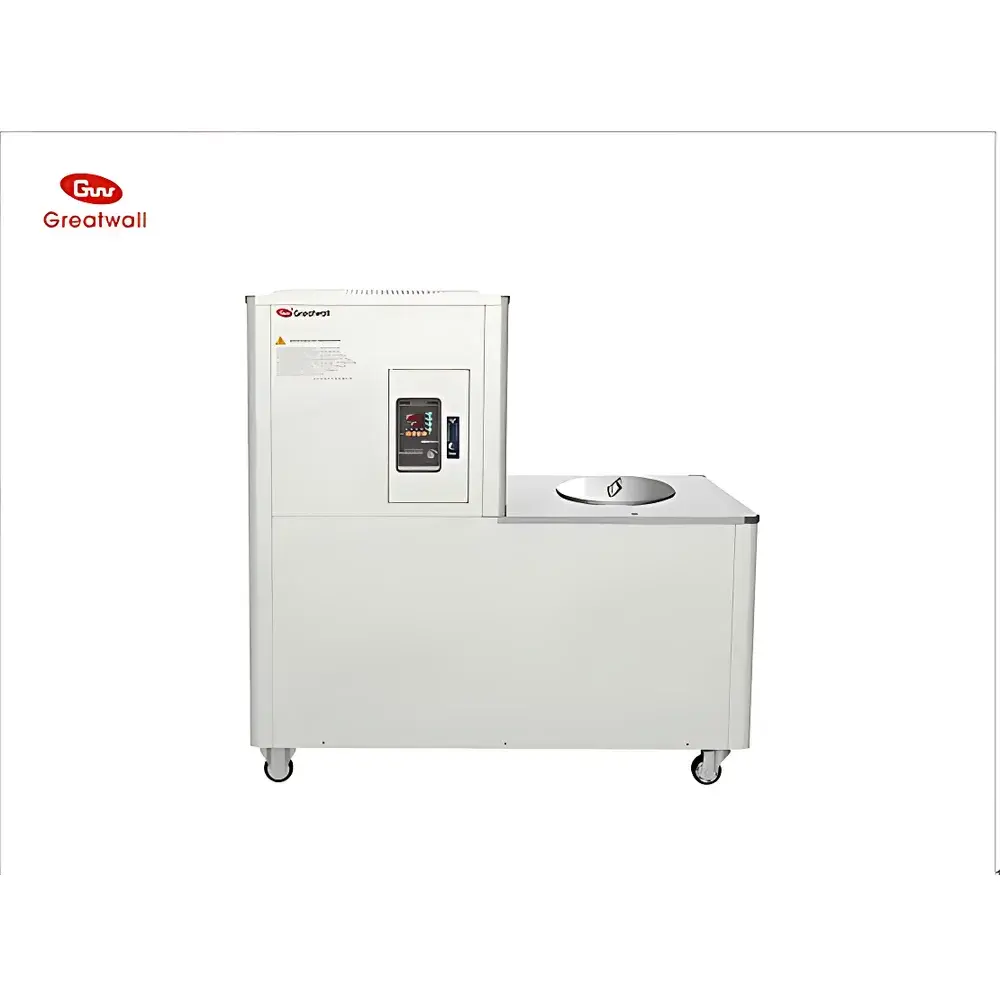
Zhengzhou Great Wall Scientific Industrial & Trading Co., Ltd. DHJF-1020 Ultra-Low-Temperature Circulating Cooling Bath
| Brand | The Great Wall |
|---|---|
| Origin | Henan, China |
| Manufacturer Type | OEM Manufacturer |
| Country of Origin | China |
| Model | DHJF-1020 |
| Quotation | Upon Request |
| Cooling Capacity | 600 W at −60 °C, 480 W at −80 °C, 180 W at −100 °C |
| Temperature Range | −100 °C to −60 °C |
| Temperature Stability | ±2 °C |
| Bath Volume | 20 L |
| Pump Flow Rate | 20 L/min |
| Maximum Pressure | 0.4 bar |
| Circulation Pump Power | 100 W |
| Total Power Consumption | 4 kW |
| Refrigerant | Mixed Cryogenic Refrigerant |
| Evaporator Type | Coil-in-Tank (Immersion) |
| Compressor | Panasonic Hermetic Scroll Compressor |
| Condenser | Air-Cooled Finned-Tube with Oxygen-Free Copper |
| Heat Exchanger Architecture | Single-Stage Compression with Series-Coupled Subcooling Stages |
| Control Interface | LCD Display with Digital Keypad |
| Safety Protections | Phase Sequence Monitoring, Overcurrent Protection, Overtemperature Cut-off, Delayed Start, Thermal Overload Relay |
| Ambient Operating Conditions | 5–35 °C, ≤70% RH |
| Power Supply | 3-phase, 380 V, 50 Hz |
| External Port Size | 1/2″ BSP |
| Bath Opening Diameter | 280 mm |
| Bath Dimensions (Ø × H) | 300 × 300 mm |
| Max Flask Capacity | 5000 mL |
| Bath Material | AISI 304 Stainless Steel |
| Footprint (W × D × H) | 810 × 1160 × 1310 mm |
| Net Weight | 154 kg |
Overview
The Zhengzhou Great Wall Scientific Industrial & Trading Co., Ltd. DHJF-1020 Ultra-Low-Temperature Circulating Cooling Bath is an engineered solution for sustained, stable thermal control in demanding low-temperature laboratory applications. Designed around a single-stage hermetic scroll compressor architecture enhanced by series-coupled subcooling heat exchange, the system achieves reliable operation down to −100 °C without requiring cascade refrigeration or liquid nitrogen supplementation. Its core thermodynamic configuration employs a fully welded refrigerant circuit with minimal brazed joints, minimizing leak pathways and enhancing long-term operational integrity. The immersion-type coil evaporator is directly integrated into the 20 L AISI 304 stainless steel bath reservoir—ensuring uniform thermal distribution while eliminating mechanical stress on the heat exchanger during cryogenic fluid phase transitions. This design enables safe, uninterrupted operation even when the heat transfer fluid approaches its freezing point, provided external circulation is disabled below −90 °C per system interlock logic.
Key Features
- Hermetically sealed Panasonic scroll compressor with integrated thermal overload protection and flexible mounting to suppress vibration transmission.
- Air-cooled finned-tube condenser utilizing oxygen-free copper tubing with proprietary expansion-bonding technology for high thermal conductivity and corrosion resistance.
- Multi-stage serial subcooling heat exchanger assembly enabling deep cooling performance from a single compression stage—reducing complexity, maintenance frequency, and refrigerant charge volume.
- Coil-in-tank evaporator fully submerged within the 304 stainless steel bath, rated for continuous operation at −100 °C and mechanically isolated from ice formation damage.
- Low-temperature-rated centrifugal circulation pump (100 W, 20 L/min, 0.4 bar max) with stainless steel wetted parts compatible with common cryogenic heat transfer fluids including ethanol/water, methanol/water, and silicone oils.
- Digital PID-controlled LCD interface with real-time temperature display, setpoint programming, and alarm status logging—all accessible via tactile keypad navigation.
- Comprehensive safety architecture including phase sequence detection, overcurrent cutoff, dual-stage overtemperature sensing, delayed startup sequencing, and automatic circulation lockout below −90 °C.
Sample Compatibility & Compliance
The DHJF-1020 is intended for use with standard laboratory glassware up to 5 L capacity, accommodating round-bottom flasks, jacketed reactors, and condenser assemblies via its 280 mm bath opening. All wetted surfaces—including bath chamber, internal coil, and circulation loop piping—are constructed from AISI 304 stainless steel, ensuring compatibility with non-aggressive organic solvents and aqueous cryogenic mixtures. While not certified to IEC 61010-1 or UL 61010B as a standalone medical device, the unit complies with general-purpose electrical safety requirements for industrial laboratory equipment operating under EN 61000-6-3 (EMC emission limits) and EN 61000-6-2 (immunity). Its control firmware supports manual log review but does not include audit-trail functionality required for FDA 21 CFR Part 11 compliance; users implementing this system in regulated environments must supplement with external data capture and validation protocols.
Software & Data Management
The DHJF-1020 operates via embedded microcontroller firmware with no external PC connectivity or proprietary software dependency. All operational parameters—including setpoint, actual bath temperature, pump status, and active fault codes—are displayed in real time on the backlit LCD screen. Temperature data is not stored internally beyond current session values; no timestamped historical logs, export functions, or remote monitoring interfaces are provided. For integration into GLP/GMP workflows, third-party data acquisition systems may be connected via analog 0–10 V or 4–20 mA output signals (optional hardware module required). Firmware updates are performed exclusively by authorized service personnel using diagnostic hardware interfaces—not end-user accessible.
Applications
This ultra-low-temperature bath serves critical roles in synthetic chemistry, materials science, and analytical method development where precise, sustained sub-zero thermal control is mandatory. Typical use cases include: cryogenic Grignard and organolithium reaction quenching; low-temperature crystallization studies of pharmaceutical intermediates; calibration of infrared and Raman spectrometers requiring stabilized cold-stage environments; thermal cycling validation of polymer composites; and controlled condensation in vacuum distillation setups. Its robust construction and absence of consumables make it suitable for extended unattended operation in research laboratories, pilot-scale process development labs, and quality control facilities conducting ASTM D2570 (low-temperature brittleness testing) or ISO 9920 (thermal comfort assessment) preparatory conditioning.
FAQ
What is the lowest temperature achievable with external circulation enabled?
External circulation must be disabled below −90 °C to prevent pump cavitation and thermal shock-induced seal failure. The bath itself maintains −100 °C stably, but fluid delivery ceases at that threshold.
Which heat transfer fluids are recommended for operation at −100 °C?
Ethanol/water (30/70 v/v) or specialized low-viscosity silicone oils meeting ASTM D5275 specifications are validated for use. Glycol-based fluids are not recommended below −60 °C due to increased viscosity and reduced thermal conductivity.
Is the DHJF-1020 compatible with GMP documentation requirements?
No. It lacks electronic recordkeeping, user access controls, and audit trail generation. Validation must rely on external calibrated thermometry and procedural documentation.
Does the unit support RS-485 or Ethernet communication protocols?
No. Communication is limited to local display and optional analog signal outputs. No digital bus interface is available.
What maintenance intervals are specified for the refrigeration system?
Compressor oil inspection every 24 months; refrigerant circuit integrity verification annually; condenser coil cleaning quarterly under standard lab ambient conditions.
Related Products



