
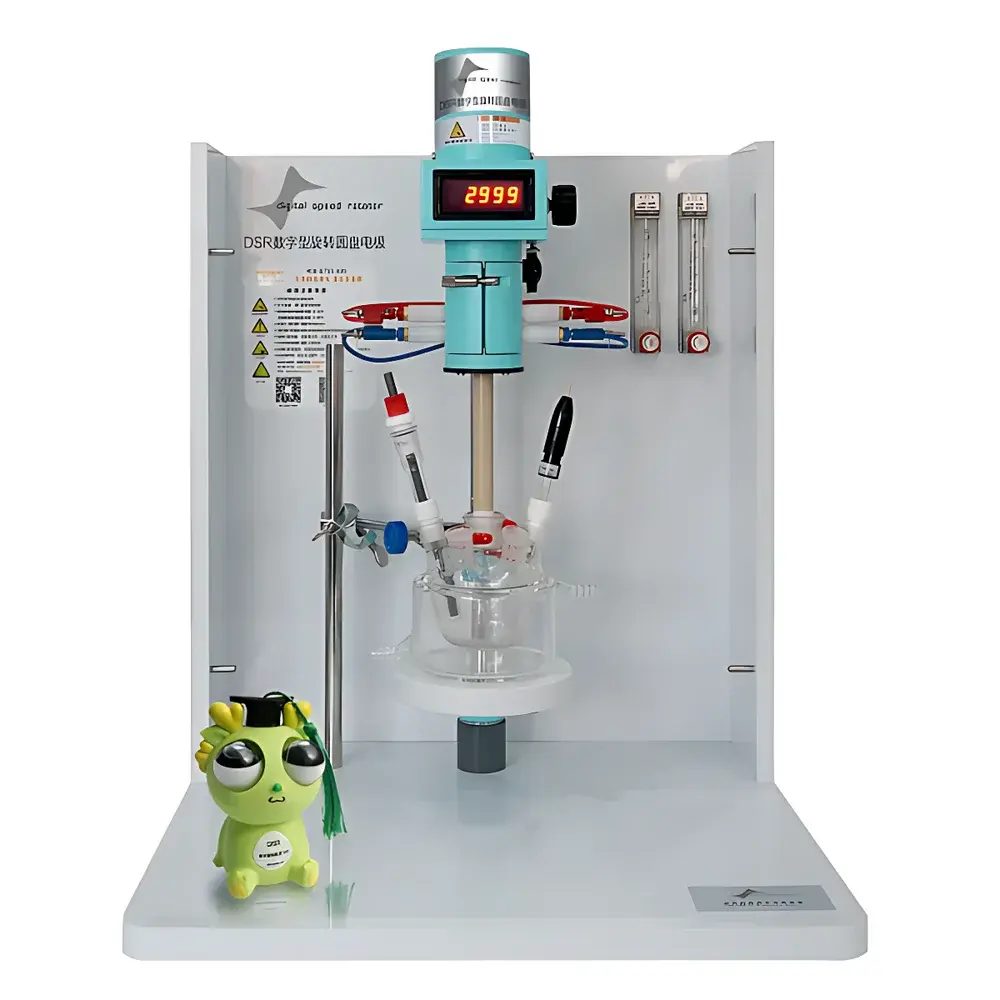
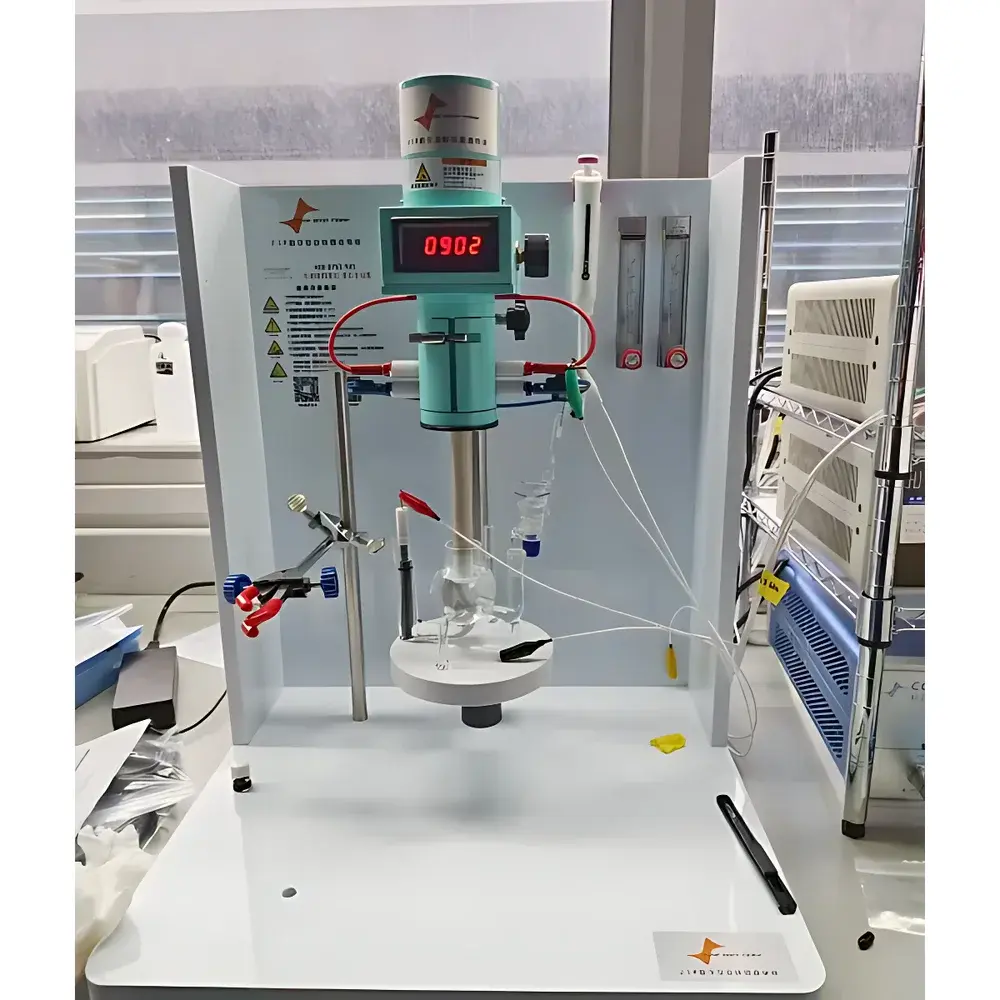
Digital Speed Rotator DSR Digital Rotating Disk and Ring-Disk Electrode System by dc-energies
| Brand | dc-energies |
|---|---|
| Origin | Hubei, China |
| Model | DSR |
| Type | Rotating Disk Electrode (RDE) and Rotating Ring-Disk Electrode (RRDE) Control System |
| Motor Power | 20 W |
| Speed Range | 0–10,000 rpm |
| Shaft Length | 170 mm |
| Shaft Outer Diameter | 15 mm |
| Disk Electrode Diameter | 5.0 mm |
| Disk Electrode Outer Diameter | 15 mm |
| RRDE Geometry | Disk Diameter = 5.61 mm, Ring Inner Diameter = 6.25 mm, Ring Outer Diameter = 7.92 mm |
| Collection Efficiency | 37% |
| Disk/Ring Electrode Materials | Glassy Carbon with PTFE or PEEK insulating sheaths |
| Electrical Contact | Silver-carbon brushes |
| Power Supply | DC |
| Control Architecture | Integrated digital microcontroller |
| External Trigger Input | Yes (compatible with potentiostats/galvanostats) |
| Explosion-Proof Enclosure | Yes |
| Electrolyte Cell Compatibility | Standard 5-neck cells or custom designs |
| Gas Flow Control | Dual mass flow meters (inert gas + O₂) |
| Operating Temperature Range | Ambient to elevated temperatures (PTFE/PEEK-compatible) |
Overview
The dc-energies DSR Digital Speed Rotator is a precision-engineered rotating disk electrode (RDE) and rotating ring-disk electrode (RRDE) control system designed for quantitative electrochemical kinetics studies under controlled hydrodynamic conditions. Based on the Levich and Koutecký–Levich formalisms, the DSR enables rigorous determination of electron transfer kinetics, reaction intermediates, and mass transport-limited current densities by imposing well-defined laminar flow at the electrode surface. Its digitally regulated motor delivers stable, reproducible rotation from 0 to 10,000 rpm—critical for resolving diffusion-controlled processes in oxygen reduction (ORR), oxygen evolution (OER), hydrogen evolution (HER), and CO₂ reduction (CO₂RR). The system integrates seamlessly with commercial potentiostats and electrochemical workstations via TTL-triggered speed modulation, supporting synchronized acquisition of transient ring and disk currents essential for mechanistic analysis.
Key Features
- Digital microcontroller-based speed regulation ensures ±1 rpm stability across the full 0–10,000 rpm range, eliminating drift during extended chronoamperometric or cyclic voltammetric scans.
- Silver-carbon brush contacts minimize electrical noise and signal attenuation, preserving integrity of low-amplitude faradaic currents—particularly vital for ring collection efficiency calibration and detection of short-lived intermediates.
- Modular, glovebox-compatible design with quick-release shaft coupling allows safe operation inside inert-atmosphere enclosures without compromising rotational accuracy or thermal management.
- DC-powered architecture suppresses line-frequency interference and electromagnetic coupling from adjacent instrumentation, enhancing signal-to-noise ratio in low-current measurements (<100 nA).
- Explosion-proof housing meets IEC 60079-0 general requirements for equipment used in potentially hazardous atmospheres, enabling safe operation with volatile organic electrolytes or high-pressure gas-saturated cells.
- Interchangeable electrode shafts (170 mm length, 15 mm OD) support standardized cell geometries and custom configurations—including high-temperature cells with PEEK or PTFE insulation rated up to 200 °C.
Sample Compatibility & Compliance
The DSR accommodates standard glassy carbon disk electrodes (5.0 mm active diameter, 15 mm outer dimension) and high-precision RRDEs with certified geometry: disk diameter = 5.61 mm, ring inner/outer diameters = 6.25 mm / 7.92 mm, gap ≤ 320 µm, and collection efficiency validated at 37%. Insulating sleeves are available in chemically inert PTFE and mechanically robust PEEK—both compliant with ASTM D4897 (electrochemical cell materials) and ISO 8502-9 (surface cleanliness for electrochemical testing). The dual-mass-flow meter module supports precise inert gas purging (N₂, Ar) and O₂ saturation per ASTM D1193 Type II water specifications, ensuring reproducible dissolved oxygen concentrations. All firmware and hardware comply with CE electromagnetic compatibility (EMC) Directive 2014/30/EU and RoHS 2011/65/EU.
Software & Data Management
The DSR operates as a peripheral device—no proprietary software required. Speed setpoints and real-time feedback are communicated via TTL-level digital input from the host potentiostat (e.g., BioLogic SP-300, Pine Research WaveNow, or Metrohm Autolab PGSTAT302N), enabling closed-loop synchronization during multi-step protocols. All operational parameters—including actual RPM, motor temperature, and brush contact status—are logged alongside electrochemical data in standard .txt or .mpt formats. For GLP/GMP environments, the system supports audit-trail-enabled workflows when paired with 21 CFR Part 11-compliant electrochemical platforms, where speed commands and timestamps are embedded directly into raw data files for traceability.
Applications
- Quantitative ORR mechanism studies via ring-current analysis to distinguish between 2e⁻ vs. 4e⁻ pathways and quantify H₂O₂ yield.
- Kinetic parameter extraction (k⁰, α) for HER and OER catalysts using Koutecký–Levich plots across variable rotation rates.
- In situ detection of reactive intermediates in CO₂RR (e.g., CO, formate, oxalate) through selective ring potential stepping.
- Electrocatalyst stability assessment under accelerated stress tests (ASTs) with concurrent disk/ring current monitoring.
- Corrosion science applications: determination of passivation breakdown potentials and inhibitor efficiency via rotating cylinder electrode (RCE)-derived mass transfer coefficients.
- Fuel cell membrane electrode assembly (MEA) catalyst layer characterization, including ionomer distribution effects on local O₂ transport resistance.
FAQ
Is the DSR compatible with third-party potentiostats?
Yes—the DSR accepts standard TTL trigger signals (0–5 V) for speed control and provides real-time tachometer feedback, ensuring interoperability with all major electrochemical workstations.
What is the typical lifetime of the silver-carbon brushes under continuous operation?
Under nominal load (≤8,000 rpm, ambient temperature), brush service life exceeds 2,000 hours; replacement kits are field-serviceable without recalibration.
Can the DSR be operated inside an argon-filled glovebox?
Yes—the modular, DC-powered design and quick-disconnect shaft interface enable safe, vibration-isolated installation in Class I–IV gloveboxes without external power feedthroughs.
How is collection efficiency verified for the RRDE configuration?
Each RRDE is supplied with a certificate of conformance referencing independent SEM metrology (gap tolerance ±0.01 mm) and experimental validation against the theoretical value for the specified geometry per Bard & Faulkner’s Electrochemical Methods.
Does the system support temperature-controlled rotation?
While the DSR itself does not include integrated heating/cooling, its PTFE and PEEK shaft assemblies are rated for use with externally jacketed cells operating from –20 °C to +200 °C, provided rotational stability is maintained.




