
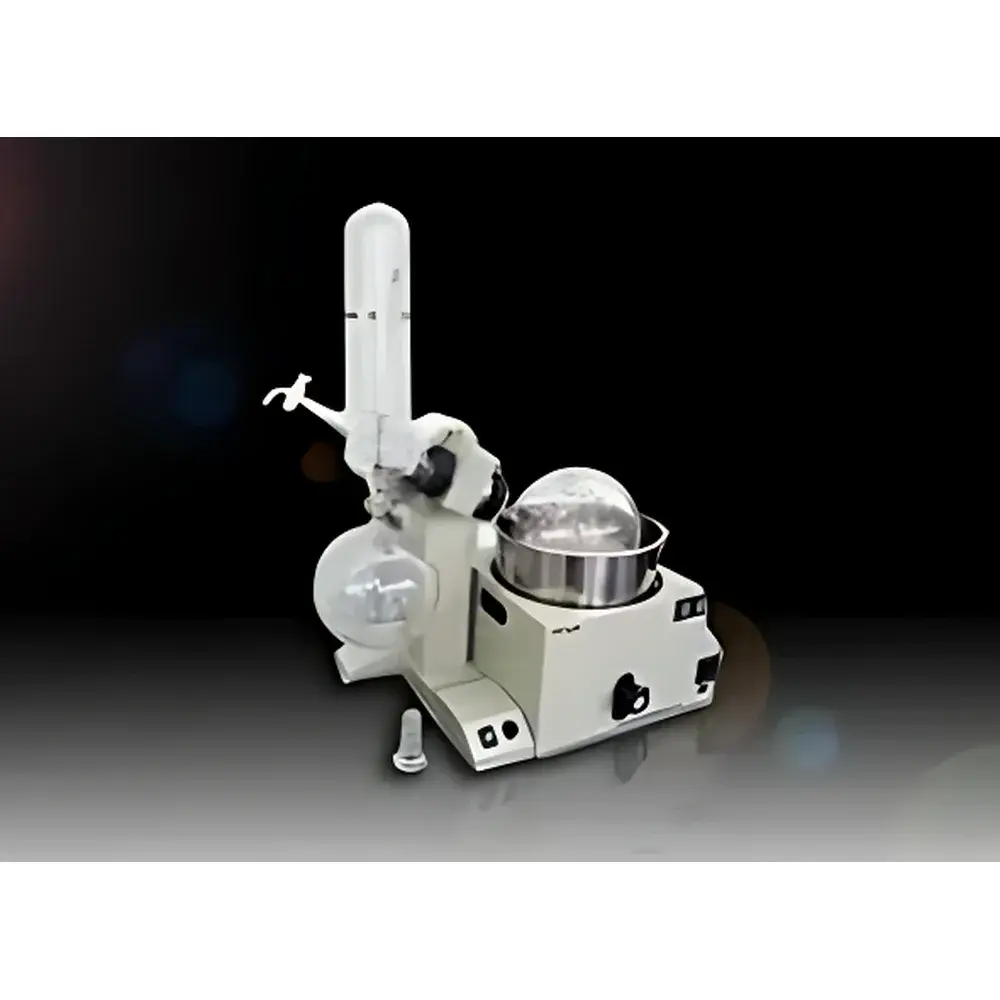
Hanuo RE-5205 Rotary Evaporator
| Brand | Hanuo |
|---|---|
| Origin | Shanghai, China |
| Model | RE-5205 |
| Rotational Speed Range | 0–130 rpm |
| Vacuum Level | ≤ 0.098 MPa (≤ 740 mmHg) |
| Heating Bath Temperature Range | Ambient to 98 °C |
| Temperature Control Accuracy | ±0.5 °C |
| Evaporation Flask Capacity | 5 L |
| Collection Flask Capacity | 3 L |
| Cooling Surface Area | 0.11 m² |
| Heating Bath Lift Mechanism | Manual Handwheel |
| Condenser Type | Vertical dual-coil serpentine with standard taper joints (29/32) |
| Total Power Consumption | 2100 W |
Overview
The Hanuo RE-5205 Rotary Evaporator is an engineered solution for efficient solvent removal, concentration, and purification under controlled reduced-pressure conditions. Based on the principle of thin-film evaporation, it operates by rotating a sample-containing flask in a thermostatically regulated water bath while simultaneously applying vacuum. This rotation generates a uniform, high-surface-area liquid film along the inner wall of the flask—significantly enhancing heat transfer and mass transfer kinetics. Volatilized solvent vapors travel through a vertical dual-coil serpentine condenser, where they undergo rapid phase transition via counter-current cooling, and are collected in a dedicated 3 L receiving flask. Designed specifically for thermally sensitive compounds—including active pharmaceutical ingredients (APIs), natural extracts, and labile biomolecules—the RE-5205 maintains precise thermal control (±0.5 °C) across its full operating range (ambient to 98 °C), minimizing degradation risks during prolonged processing.
Key Features
- Robust 5 L evaporation capacity: Accommodates large-volume batch processing typical in pilot-scale synthesis, extract purification, and QC sample preparation.
- Manual handwheel lift mechanism: Enables smooth, backlash-free vertical adjustment of the heating bath—ensuring reproducible immersion depth and optimal heat coupling without motorized complexity or calibration drift.
- Vertical dual-coil serpentine condenser: Constructed from borosilicate glass (3.3) with standardized 29/32 taper joints; provides extended condensation path length and high thermal efficiency over conventional single-coil designs.
- Precision temperature regulation: Digital PID controller delivers stable bath temperature within ±0.5 °C tolerance—critical for maintaining compound integrity during low-boiling-point solvent removal (e.g., dichloromethane, ethyl acetate) or high-viscosity matrix evaporation.
- Wide rotational speed range (0–130 rpm): Adjustable via calibrated analog dial; supports optimization for varying viscosities—from low-density organic solvents to viscous crude extracts—without film rupture or bumping.
- Integrated vacuum compatibility: Sealed glass train and reinforced PTFE stopcocks withstand sustained operation at ≤ 0.098 MPa (equivalent to ~740 mmHg), enabling boiling point depression sufficient for gentle removal of solvents with initial boiling points up to 100 °C at atmospheric pressure.
Sample Compatibility & Compliance
The RE-5205 is compatible with common laboratory solvents (e.g., acetone, methanol, hexane, toluene) and aqueous-organic mixtures used in extraction, recrystallization, and reaction workup. Its all-glass fluid path—comprising borosilicate 3.3 components—ensures chemical inertness, thermal shock resistance, and ease of cleaning. While not certified to ISO/IEC 17025 or GLP as a standalone instrument, the system supports compliance-driven workflows when operated within documented SOPs. Its manual controls and absence of embedded software simplify validation protocols required under GMP environments (e.g., ICH Q7, FDA 21 CFR Part 211), particularly where audit trails and electronic signatures are not mandated for basic concentration tasks.
Software & Data Management
The RE-5205 operates via analog controls only—no onboard microprocessor, digital interface, or data logging capability. Temperature setpoint and rotation speed are manually adjusted and visually monitored using integrated analog dials and calibrated thermometers. This architecture eliminates firmware dependencies, cybersecurity concerns, and software qualification requirements—making it suitable for laboratories prioritizing operational simplicity, long-term serviceability, and regulatory transparency. Users may integrate external digital thermometers or vacuum gauges (e.g., capacitance manometers) for enhanced process documentation, provided such devices comply with local metrological standards.
Applications
- Concentration of natural product extracts (e.g., plant alkaloids, essential oils) without thermal decomposition
- Solvent recovery and reuse in multi-step organic synthesis (e.g., post-Suzuki coupling workup)
- Removal of volatile reaction by-products prior to chromatographic analysis
- Drying and solvent exchange in polymer solution preparation
- Preparative-scale lyophilization feedstock conditioning
- QC batch release testing requiring residual solvent quantification per USP <467>
FAQ
What is the maximum recommended operating vacuum level for the RE-5205?
The system is rated for continuous operation at ≤ 0.098 MPa (≈ 740 mmHg). For optimal condensation efficiency and bumping prevention, we recommend pairing it with a two-stage diaphragm vacuum pump capable of reaching ≤ 10 mbar ultimate pressure.
Can the RE-5205 be used with corrosive solvents such as concentrated HCl or bromine solutions?
No. The standard glass train and PTFE seals are incompatible with strong oxidizers and mineral acids. Use only with solvents listed in ASTM D471 and ISO 1817 compatible with borosilicate 3.3 and virgin PTFE.
Is the heating bath filled with water only, or can other heat transfer media be used?
The bath is designed for water-based operation up to 98 °C. Silicone oil may be substituted for higher-temperature applications, but requires verification of seal compatibility and thermal stability at extended dwell times.
Does the RE-5205 include a vapor trap or chiller connection?
It does not include an integrated refrigerated circulator. However, the condenser features standard 29/32 ground-glass ports compatible with external coolant loops (e.g., 5–10 °C glycol/water mixture) for improved condensation efficiency with low-boiling solvents.
What maintenance intervals are recommended for long-term reliability?
Inspect PTFE stopcocks and seals quarterly; lubricate with high-vacuum silicone grease. Clean condenser coils after each use with appropriate solvent rinse. Verify bath heater calibration annually using a traceable NIST-certified thermometer.



