
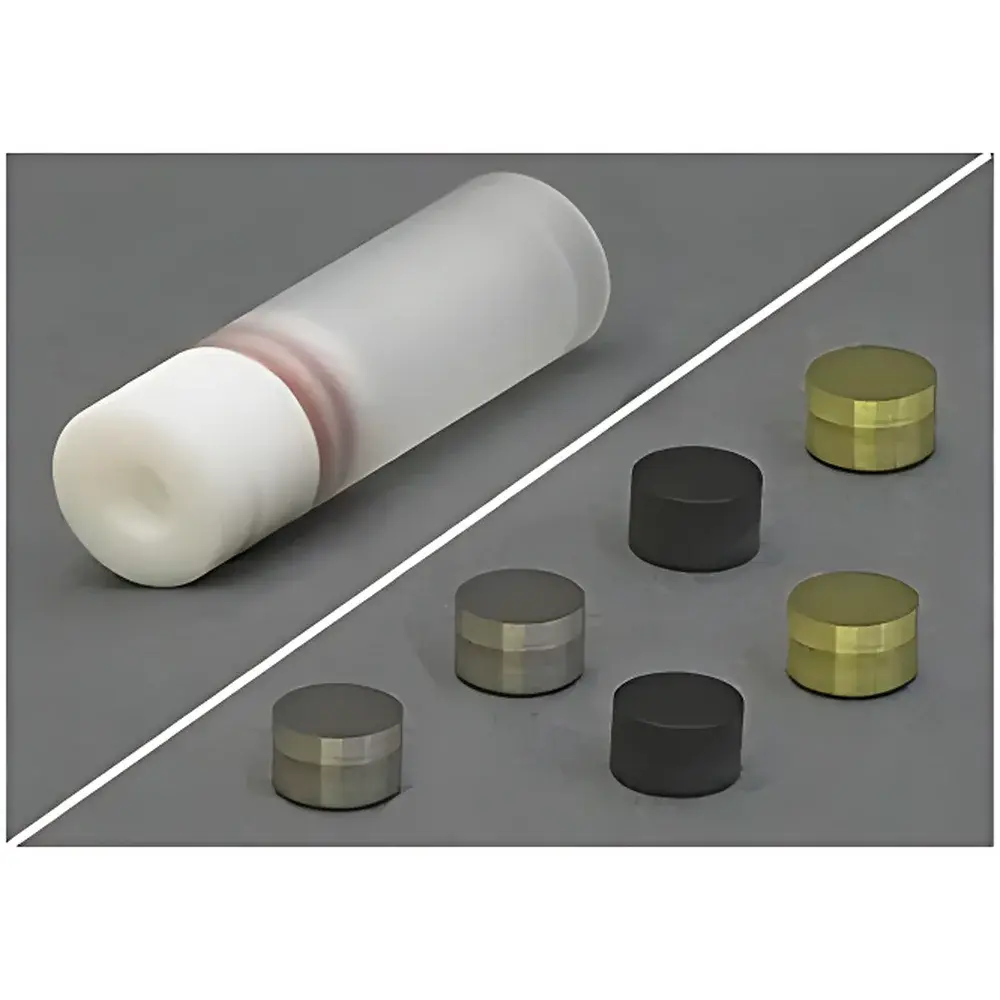
dc-energies E4 Rotating Disk Electrode (RDE) with Interchangeable Glassy Carbon Disk
| Brand | dc-energies |
|---|---|
| Origin | Hubei, China |
| Manufacturer Type | Authorized Distributor |
| Country of Origin | China |
| Model | Interchangeable-Disk RDE |
| Instrument Category | Electrochemical Electrode |
| Disk Material | Glassy Carbon (GC), Gold (Au), Platinum (Pt) |
| Operating Temperature Range | 10–25 °C |
| Disk Diameter | 5 mm |
| Shaft Material | PTFE-insulated Stainless Steel |
| Rotation Speed Compatibility | Compatible with Standard RDE Controllers (e.g., Pine Research, BASi, CHI) |
| Sealing Mechanism | U-Cup Compression Seal |
Overview
The dc-energies E4 Rotating Disk Electrode (RDE) with interchangeable glassy carbon disk is a precision-engineered electrochemical working electrode designed for controlled hydrodynamic voltammetry and kinetic studies in fundamental and applied electrochemistry. Based on the classical Levich equation and Koutecký–Levich analysis, this RDE enables quantitative separation of diffusion-controlled and kinetic current components by imposing well-defined laminar flow at the electrode surface through controlled rotation. The E4 platform employs a rigid, coaxial stainless steel shaft insulated with chemically inert PTFE, ensuring mechanical stability and electrical isolation during high-speed rotation (typically 100–10,000 rpm). Its defining feature—the U-Cup compression sealing system—allows rapid, tool-free replacement of the disk material without compromising alignment, tip flatness, or ohmic contact integrity. This design supports rigorous reproducibility across multiple disk materials (GC, Pt, Au) while maintaining strict geometric consistency (5.0 ± 0.02 mm active diameter, <0.1 µm surface roughness Ra).
Key Features
- Interchangeable disk architecture with U-Cup mechanical retention: eliminates adhesive bonding or epoxy mounting, enabling clean, repeatable disk swaps in under 60 seconds.
- Electrochemically validated glassy carbon disk (99.99% purity, low residual capacitance, wide potential window: −1.0 to +1.2 V vs. Ag/AgCl in aqueous media).
- Precision-machined stainless steel body with PTFE insulation: provides thermal and chemical resistance up to 80 °C and compatibility with organic solvents (acetonitrile, DMF, DMSO) and acidic/alkaline electrolytes.
- Geometrically certified active surface: disk protrusion ≤ 0.5 µm relative to insulator edge, ensuring minimal edge effects and adherence to ISO 13485-aligned manufacturing tolerances.
- Direct compatibility with industry-standard RDE rotators (Pine Research AFMSRX, BASi RE1, CHI 660E): uses universal ¼”-28 UNF threaded interface and integrated tachometer coupling groove.
Sample Compatibility & Compliance
The E4 RDE supports heterogeneous electron transfer studies across diverse electroactive systems—including O2 reduction, CO2 electroreduction, hydrogen evolution, and metal ion deposition—under both aqueous and non-aqueous conditions. Its GC disk meets ASTM D664 (acid number titration) and ASTM E2792 (electrochemical sensor calibration) dimensional and surface finish requirements. The electrode assembly complies with IEC 61000-6-3 (EMC emissions) for laboratory instrumentation and conforms to GLP documentation standards when used with audit-trail-capable potentiostats (e.g., BioLogic SP-300 with EC-Lab v12+). No hazardous substances are used in fabrication; RoHS 3 (2015/863/EU) compliance is verified per material declaration.
Software & Data Management
While the E4 RDE is a passive transducer requiring external potentiostat control, it integrates seamlessly into modern electrochemical data workflows. When paired with compliant instruments (e.g., Metrohm Autolab PGSTAT302N or Gamry Interface 5000P), full experimental metadata—including rotation speed, temperature, electrode history, and disk material ID—is automatically logged alongside current-potential and current-time datasets. EC-Lab, NOVA, and Framework software support direct Koutecký–Levich linearization, Levich slope extraction, and rotating ring-disk electrode (RRDE) synchronization protocols. All raw data exports adhere to IEEE 1596.3-compliant .mpt/.txt formats, enabling traceability under FDA 21 CFR Part 11 when deployed in regulated QC environments.
Applications
- Kinetic parameter determination (k0, α) for outer-sphere redox couples (e.g., Fe(CN)63−/4−) via scan-rate–independent Levich analysis.
- Catalyst activity benchmarking for ORR in PEMFC research: mass activity (A gPt−1), electron transfer number (n), and H2O2 yield quantification using RRDE coupling.
- Diffusion coefficient measurement of novel redox mediators in battery electrolytes (LiTFSI in carbonate blends).
- Corrosion rate modeling via Tafel extrapolation under controlled mass transport conditions.
- Electrodeposition studies of Cu, Ni, and Co films with real-time nucleation/growth analysis.
FAQ
What disk materials are supported beyond glassy carbon?
The E4 platform accepts standard 5-mm-diameter disks of platinum, gold, nickel, and boron-doped diamond (BDD), provided they meet ISO 8130-12 surface flatness specifications (≤0.2 µm deviation over 5 mm). Custom disk fabrication services are available upon request.
Is recalibration required after disk replacement?
No. The U-Cup system maintains fixed axial positioning and electrical contact resistance (<5 mΩ variation between swaps), eliminating the need for geometric recalibration. Users must only update the material identifier in their acquisition software.
Can the E4 RDE be used in high-temperature electrochemical cells?
The PTFE insulation limits continuous operation to ≤80 °C. For elevated-temperature applications (>100 °C), we recommend the optional ceramic-insulated E4-HT variant (Al2O3 sleeve, rated to 200 °C).
How is disk alignment verified post-installation?
A supplied optical alignment gauge (±0.5 µm resolution) enables visual verification of disk coplanarity with the insulator edge under 10× magnification—consistent with ASTM G102 practice for electrode metrology.
Does dc-energies provide certification documentation for quality assurance?
Yes. Each E4 RDE ships with a Certificate of Conformance (CoC) listing dimensional inspection data (CMM report), surface roughness (profilometer trace), and electrical continuity test results. ISO/IEC 17025-accredited calibration certificates are available as an add-on service.




