
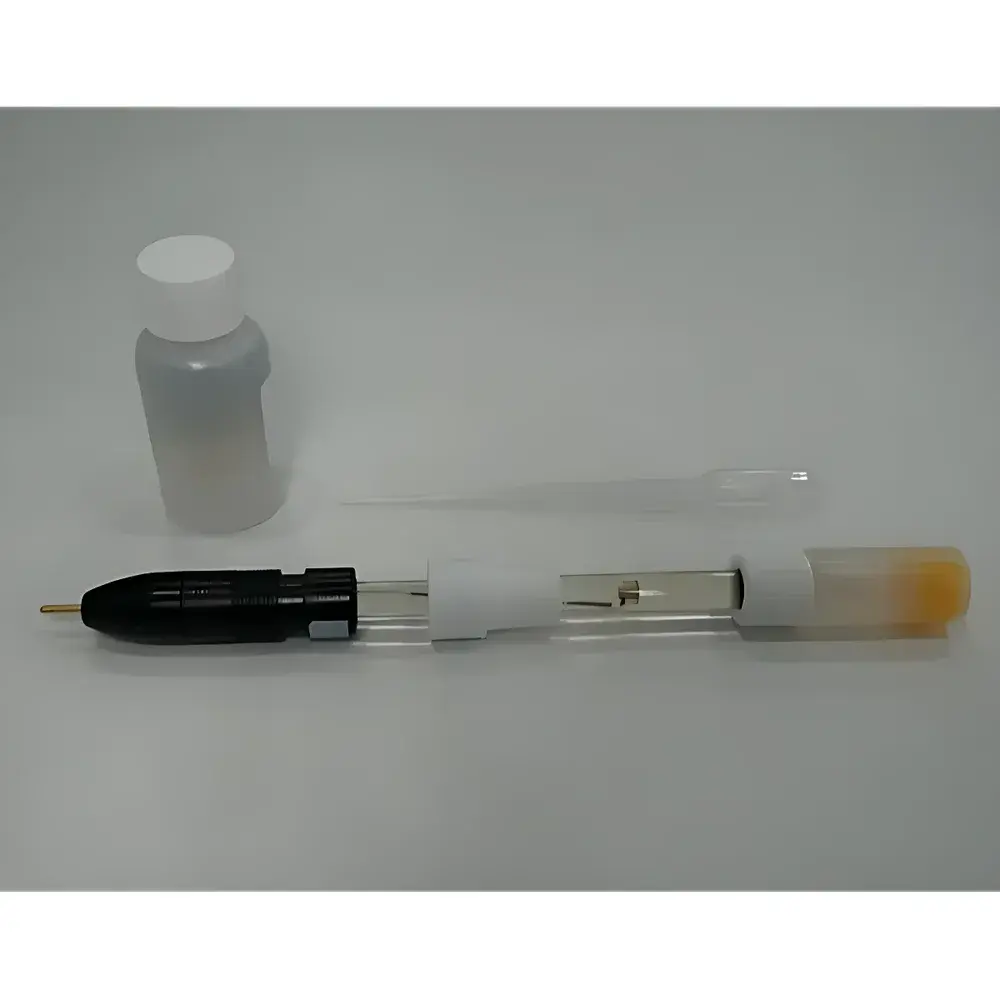
DCRREF Dual-Junction Ag/AgCl Reference Electrode by DC-Energies
| Brand | DC-Energies |
|---|---|
| Model | DCRREF |
| Electrode Type | Dual-Junction Silver/Silver Chloride (Ag/AgCl) Reference Electrode |
| Outer Junction Filling Solution | 10% (w/w) Aqueous KNO₃ |
| Inner Junction Filling Medium | Gelified Saturated KCl |
| Construction | All-Glass Body with Ceramic Frit Outer Junction and Porous Glass Inner Junction |
| Operating Temperature Range | 5–40 °C |
| Storage Condition | Upright, filled with outer solution or immersed in 10% KNO₃ |
| Compatibility | Designed for use with rotating disk electrodes (RDE), rotating ring-disk electrodes (RRDE), and standard electrochemical cells |
Overview
The DCRREF Dual-Junction Ag/AgCl Reference Electrode is a precision-engineered electrochemical reference system developed by DC-Energies for rigorous potentiometric control in kinetic and mechanistic studies. It operates on the well-established thermodynamic principle of the silver/silver chloride redox couple (Ag|AgCl|Cl⁻), delivering stable, reproducible potential output under dynamic hydrodynamic conditions—particularly during rotating electrode experiments such as those conducted with rotating disk electrodes (RDE) and rotating ring-disk electrodes (RRDE). The dual-junction architecture isolates the internal Cl⁻-rich environment from sample solutions containing interfering ions (e.g., sulfides, heavy metals, or proteins), minimizing liquid junction potential drift and preventing contamination of the inner reference element. This design ensures long-term stability and high measurement fidelity in non-aqueous, low-ionic-strength, or protein-containing electrolytes commonly encountered in fuel cell catalysis, corrosion science, and electrosynthesis research.
Key Features
- Dual-junction configuration with physically separated inner and outer electrolyte compartments to suppress cation/anion migration and mitigate junction potential instability
- Gelified saturated KCl inner filling medium provides mechanical robustness against vibration and orientation changes—critical for RDE/RRDE setups requiring precise angular alignment
- 10% (w/w) aqueous KNO₃ outer electrolyte offers low junction resistance and minimal solubility interference across pH 2–12, while avoiding chloride leaching into chloride-sensitive systems (e.g., Ag-based catalysts)
- All-glass construction with borosilicate body ensures chemical inertness toward organic solvents, strong acids/bases, and halogenated electrolytes
- Ceramic frit outer junction delivers consistent flow rate (~1–2 µL/h) and resistance to clogging during extended chronoamperometric or cyclic voltammetric scans
- Integrated Luggin capillary tip (standard 1.0 mm OD) enables optimal placement within 1–2 mm of the working electrode surface without disturbing laminar flow profiles in RDE hydrodynamics
Sample Compatibility & Compliance
The DCRREF is compatible with aqueous, mixed aqueous-organic, and anhydrous non-aqueous electrolytes (e.g., acetonitrile, DMF, propylene carbonate) when used with appropriate outer junction conditioning. Its dual-junction design conforms to ASTM E2073-22 guidelines for reference electrode selection in kinetic electrochemistry and supports GLP-compliant experimental documentation when paired with traceable calibration logs. While not certified to ISO/IEC 17025, its performance characteristics align with IUPAC-recommended practices for reference electrode validation—including open-circuit potential monitoring (< ±0.3 mV drift over 2 h), thermal coefficient < 0.1 mV/°C, and junction potential repeatability ≤ ±1.2 mV across five sequential calibrations in 0.1 M KCl.
Software & Data Management
The DCRREF functions as a passive analog sensor and requires no embedded firmware or digital interface. It integrates seamlessly with all major potentiostat platforms—including BioLogic SP-300, Pine Research WaveDriver series, Metrohm Autolab PGSTAT series, and CH Instruments CHI760E—via standard BNC or banana plug connections. When used in automated RDE workflows, its stable offset enables reliable baseline correction in software packages such as EC-Lab (BioLogic), AfterMath (Pine), NOVA (Metrohm), and Thales (Zahner). For audit-trail compliance in regulated environments, users are advised to record electrode ID, date of last outer-solution refill, and daily open-circuit potential checks in laboratory notebooks aligned with 21 CFR Part 11–capable electronic lab notebook (ELN) systems.
Applications
- Kinetic analysis of oxygen reduction reaction (ORR) and hydrogen evolution reaction (HER) using RDE/RRDE configurations
- Electrocatalyst stability assessment under accelerated stress tests (ASTs) in PEMFC and alkaline electrolyzer electrolytes
- Corrosion potential mapping of coated metal substrates in simulated seawater or acidic condensate
- Redox mechanism elucidation in synthetic organic electrochemistry, including radical ion pair lifetimes and follow-up reaction rates
- Calibration reference for in situ SECM and scanning electrochemical microscopy probe positioning
FAQ
What is the recommended storage method for the DCRREF between experiments?
Store vertically with both inner and outer chambers filled; if unused for >48 h, replace outer 10% KNO₃ solution and verify OCP against a freshly calibrated single-junction Ag/AgCl reference.
Can the DCRREF be used in non-aqueous Li-ion battery electrolytes?
Yes—provided the outer junction is pre-equilibrated with the target solvent (e.g., 1 M LiPF₆ in EC:DMC) and the inner gel remains intact; avoid prolonged exposure to HF-containing aged electrolytes.
How often should the outer junction be cleaned?
Inspect visually before each RDE run; ultrasonicate the tip in deionized water for 5 min if flow rate decreases or OCP becomes unstable beyond ±2 mV.
Is the DCRREF compatible with micro-RDE systems operating at 10,000 rpm?
Yes—the all-glass body and gelified inner electrolyte resist centrifugal displacement; ensure mechanical mounting minimizes torque-induced stress on the glass stem.
Does this electrode meet ASTM D1141-98 (Standard Practice for Seawater Simulant)?
While not certified, its 10% KNO₃ outer solution avoids chloride cross-contamination in simulated seawater testing, satisfying the functional intent of Section 7.2 regarding reference electrode isolation.
Related Products





