
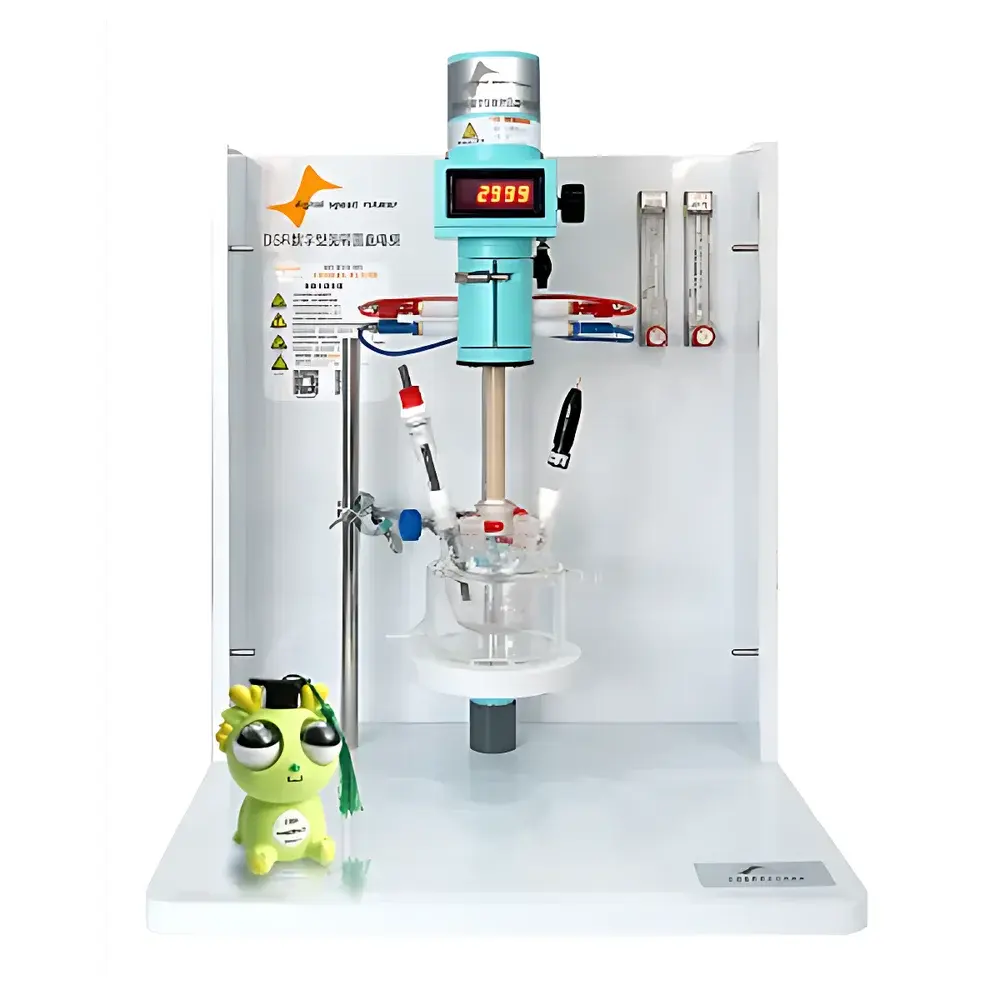
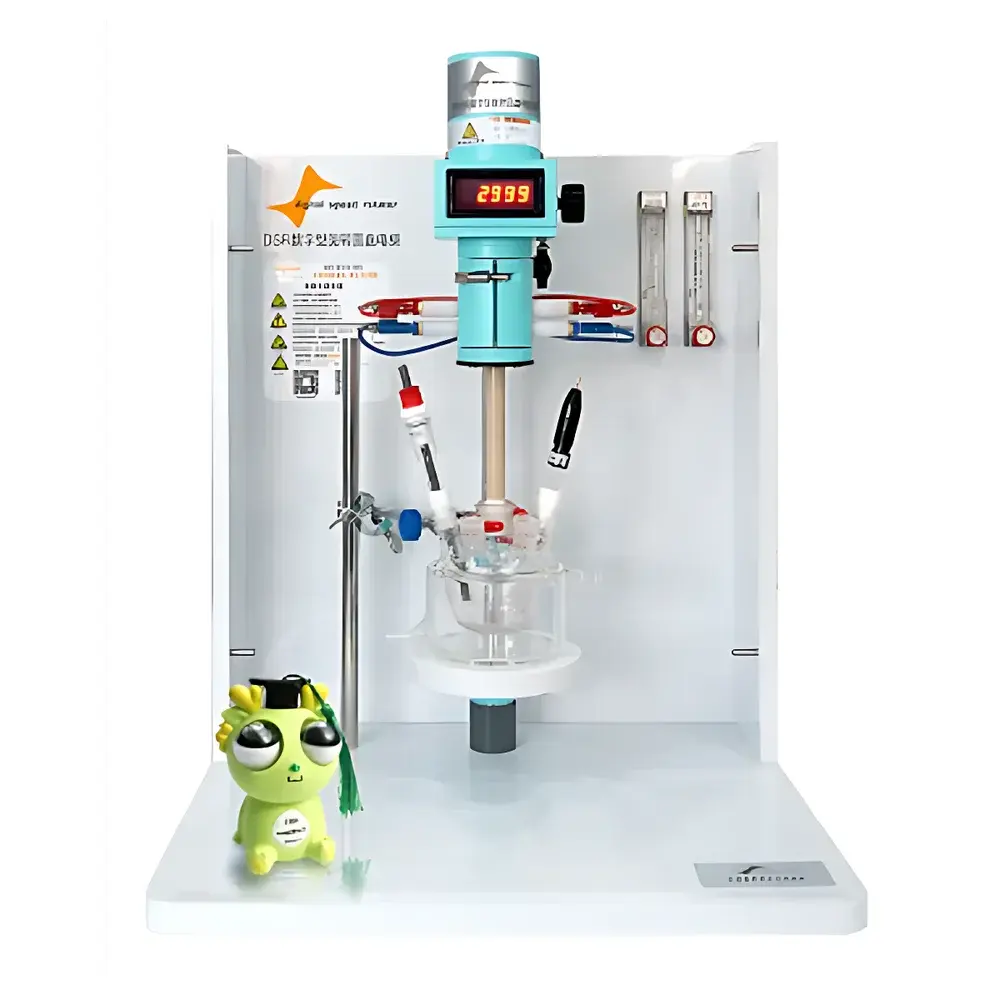
DC-Energies DSR-M Rotating Disk Electrode (RDE) and Rotating Ring-Disk Electrode (RRDE) System
| Brand | DC-Energies |
|---|---|
| Model | DSR-M |
| Origin | Hubei, China |
| Rotation Speed Range | 0–10,000 rpm |
| Motor Power | 20 W |
| Disk Electrode Material | Glassy Carbon |
| Ring Electrode Material | Platinum |
| Disk Diameter | 5.61 mm |
| Ring Inner/Outer Diameter | 6.25 mm / 7.92 mm |
| Ring-Disk Gap | ≤320 µm |
| Collection Efficiency | 37% |
| Shaft Length | 170 mm |
| Shaft Outer Diameter | 15 mm |
| Housing Material | Chemical-Resistant Polypropylene |
| Interface | Analog Voltage Input/Output (0–10 V), TTL-compatible speed control signal |
| Compliance | Designed for glovebox integration, explosion-resistant mechanical architecture |
| Temperature Range | Ambient |
Overview
The DC-Energies DSR-M Rotating Disk Electrode (RDE) and Rotating Ring-Disk Electrode (RRDE) System is a precision-engineered electrochemical hydrodynamic measurement platform designed for quantitative kinetic and mechanistic analysis of electrode processes under controlled mass transport conditions. Based on the Levich and Koutecký–Levich formalisms, the system enables rigorous determination of electron transfer kinetics, diffusion-controlled current densities, reaction intermediates, and catalytic selectivity—particularly critical in fuel cell catalyst evaluation, CO2 electroreduction, and oxygen evolution/reduction studies. Its modular, glovebox-compatible architecture supports inert-atmosphere electrochemistry, while its analog/digital interface allows seamless synchronization with potentiostats (e.g., BioLogic, Pine Research, Gamry) and data acquisition systems for time-resolved hydrodynamic perturbation experiments.
Key Features
- Wide-speed rotational control from 0 to 10,000 rpm with <1% speed accuracy at 1 rpm (1 mV/rpm default calibration); motor-driven via silver-carbon brush contact ensuring low-noise current collection and long-term stability.
- Detachable, split-body design: base unit and rotating shaft can be independently mounted or removed—enabling rapid integration into custom electrolytic cells, sealed gloveboxes, or multi-instrument setups.
- Integrated analog I/O interface: accepts external 0–10 V control signals (sine, square, or arbitrary waveforms) for dynamic speed modulation; outputs real-time tachometer voltage for oscilloscope monitoring or closed-loop process control.
- Explosion-resistant mechanical housing constructed from chemically inert polypropylene; fully compatible with anhydrous, O2-free, or Li-ion battery electrolyte environments.
- Interchangeable electrode assemblies: standardized M6 internal threading accommodates multiple disk and ring-disk configurations; U-CUP–compatible disk holder enables post-reaction product capture and reusable electrode mounting.
- High-precision RRDE geometry: disk (5.61 mm Ø glassy carbon) and concentric Pt ring (ID 6.25 mm / OD 7.92 mm) fabricated to ±0.01 mm dimensional tolerance; verified collection efficiency of 37% per ASTM D7211-18 Annex A3 methodology.
Sample Compatibility & Compliance
The DSR-M is validated for use with aqueous, non-aqueous, and ionic liquid electrolytes across standard three-electrode electrochemical cells (e.g., 50–200 mL volume). Its polypropylene base resists corrosion from strong acids (e.g., 1 M H2SO4), alkalis (e.g., 1 M KOH), and organic solvents (e.g., acetonitrile, DMF). The system meets mechanical safety requirements for Class I, Division 2 hazardous locations per UL 1203 and conforms to IEC 61000-6-2/6-3 for electromagnetic compatibility. While not certified to ISO/IEC 17025, its performance traceability aligns with GLP-compliant kinetic studies when paired with calibrated potentiostats and NIST-traceable reference electrodes (e.g., reversible hydrogen electrode, Ag/AgCl). Documentation includes factory calibration report, OEM authorization letter, and mechanical drawings for audit readiness.
Software & Data Management
The DSR-M operates as a hardware-peripheral device—no proprietary software is required. Speed setpoints and real-time rotation feedback integrate natively via analog channels into common electrochemical platforms (e.g., EC-Lab®, AfterMath®, NOVA). When used with potentiostats supporting external triggering, users implement Koutecký–Levich plots, rotating ring-disk voltammetry (RRDV), and transient chronoamperometric sequences with synchronized rotation ramps. For automated workflows, LabVIEW or Python (PyVISA) scripts can modulate speed via DAQ-generated analog signals and log tachometer output alongside current/potential data—enabling full traceability compliant with FDA 21 CFR Part 11 when deployed with electronic lab notebook (ELN) systems.
Applications
- Oxygen reduction reaction (ORR) mechanism elucidation via ring-current detection of H2O2 intermediates on Pt-, Fe–N–C-, or Co–N–C catalysts.
- CO2 electroreduction selectivity mapping: quantifying C2+ vs. C1 product distribution using ring collection of ethylene oxide or acetaldehyde derivatives.
- Hydrogen evolution reaction (HER) kinetics in alkaline media—resolving Volmer–Heyrovsky/Tafel pathways via Levich slope analysis.
- Corrosion inhibitor efficiency screening through polarization resistance shifts under controlled convection.
- Electrocatalyst stability assessment: accelerated degradation testing (ADT) with periodic rotation-induced mass transport perturbation.
- Fuel cell membrane electrode assembly (MEA) ink rheology coupling—integrated with DC ID-4000 nanosuspension dispersers for catalyst ink homogeneity validation prior to RDE coating.
FAQ
What is the recommended method for verifying collection efficiency on the DSR-M RRDE?
Perform a standard K3[Fe(CN)6] oxidation experiment in 0.1 M KNO3, recording disk current (ID) and ring current (IR) at fixed potentials. Calculate N = IR/ID and compare against the theoretical value (37%) per published geometric calibration curves.
Can the DSR-M be operated inside an argon-filled glovebox without modification?
Yes—the entire unit is mechanically sealed, uses no internal batteries or wireless components, and features a compact footprint (≤200 × 150 × 250 mm) compatible with standard glovebox antechambers and feedthrough ports.
Is the 320 µm ring-disk gap measured optically or via profilometry?
Gap uniformity is verified using white-light interferometric profilometry (Zygo NewView) on finished electrode assemblies; raw tolerance is held to ±10 µm during CNC machining and epoxy encapsulation.
Does the system support bidirectional rotation?
No—the DSR-M is unidirectional (clockwise only) to maintain consistent boundary layer development and avoid mechanical backlash in high-precision kinetic measurements.
How is speed calibration traceable?
Each unit ships with a NIST-traceable optical tachometer verification certificate (calibrated against Fluke 931 RPM Standard), documenting deviation across 100–10,000 rpm at 100-rpm intervals.




