
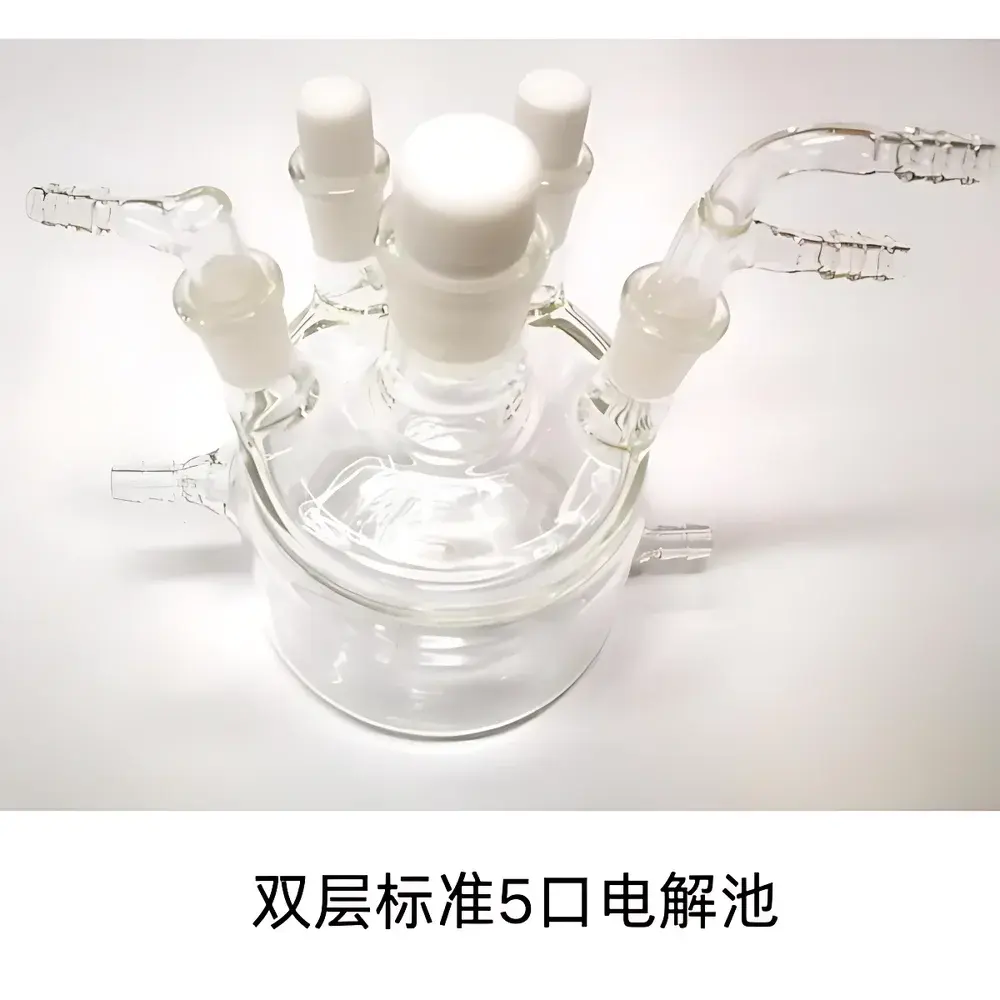
PINE Standard 5-Port Double-Jacketed Electrochemical Cell
| Brand | dc-energies |
|---|---|
| Volume | 150 mL |
| Port Configuration | One 24/25 ground-glass rotation port, four 14/20 side ports |
| Jacket Type | Double-walled with circulating coolant inlet/outlet |
| Gas Sealing | Dual F-type gas inlets + L-type gas outlet |
| Shaft Seal | PINE proprietary ceramic bearing seal assembly |
| Material | High-borosilicate glass (ASTM E438 Type I, Class A) |
| Compliance | Designed for ASTM D129, ISO 12927, and USP <797> electrochemical cell validation protocols |
Overview
The PINE Standard 5-Port Double-Jacketed Electrochemical Cell is an engineered laboratory-grade cell designed for controlled, reproducible electrochemical investigations under thermostatically regulated and atmospherically isolated conditions. Built upon the legacy of PINE Research instrumentation architecture, this cell operates on the fundamental principle of three-electrode potentiostatic control within a chemically inert, geometrically defined reaction volume. Its double-jacketed borosilicate glass construction enables precise thermal management via external coolant circulation—critical for kinetic studies, temperature-dependent impedance measurements (EIS), and long-duration chronoamperometric experiments where exothermicity or ambient drift must be minimized. The cell’s structural integrity, dimensional repeatability, and surface passivation meet the dimensional tolerances and hydrolytic resistance requirements specified in ISO 3585 and ASTM E438 for Class A volumetric glassware used in analytical electrochemistry.
Key Features
- Double-walled jacket with dedicated inlet and outlet ports for external temperature control—compatible with standard recirculating chillers (e.g., Julabo, Huber) operating between –10 °C and +80 °C
- Single standardized 24/25 ground-glass port optimized for vertical insertion of rotating disk electrodes (RDE) or rotating ring-disk electrodes (RRDE), ensuring concentric alignment and minimal turbulence-induced shear deviation
- Four symmetrically arranged 14/20 side ports accommodate reference electrodes (e.g., Ag/AgCl, SCE), counter electrodes (Pt wire/mesh), auxiliary gas feed lines, and optional pH or O2 microsensors
- F-type dual gas inlet configuration enables independent introduction of inert purge gas (e.g., N2, Ar) and reactive gaseous reagents (e.g., CO2, H2), minimizing cross-contamination and enabling sequential or co-fed gas-phase electrocatalysis
- L-type exhaust port positioned at the highest point of the headspace ensures complete displacement of residual air during purging and maintains positive pressure during sealed electrolysis
- PINE-designed ceramic bearing seal assembly sustains rotational stability up to 10,000 rpm without leakage—validated per ISO 11607-1 for dynamic sealing integrity under continuous mechanical stress
Sample Compatibility & Compliance
This cell supports aqueous, non-aqueous, and ionic liquid electrolytes—including LiPF6/EC:DMC, EMIM-BF4, and alkaline KOH solutions—without measurable leaching or surface adsorption artifacts. Its borosilicate composition exhibits ≤0.1 mg/dm² alkali extraction (ISO 719 HGA test), ensuring baseline stability in low-conductivity media. All ground-glass joints conform to DIN 12250 and ISO 1770 specifications for interchangeability and vacuum-tightness (<1 × 10⁻³ mbar after 30 min hold). The cell is routinely deployed in GLP-compliant battery interface studies, CO2 reduction reaction (CO2RR) screening, and corrosion potential mapping per ASTM G59 and G102 protocols.
Software & Data Management
While the cell itself is hardware-only, it integrates natively with potentiostats supporting analog/digital I/O synchronization (e.g., BioLogic SP-300, Gamry Interface 5000P, Pine WaveDriver 200). Experimental metadata—including coolant temperature setpoint, rotation speed, gas flow rates, and timestamped potential/current logs—is structured for automated ingestion into LabArchives ELN or Thermo Fisher SampleManager LIMS via IEEE 1851-compliant CSV export. Full audit trail capability—including user-defined parameter locking, electronic signature fields, and revision-controlled SOP attachment—is supported when paired with FDA 21 CFR Part 11–compliant electrochemical acquisition software suites.
Applications
- Kinetic analysis of oxygen reduction reaction (ORR) and hydrogen evolution reaction (HER) using RDE/RRDE configurations
- Electrocatalyst stability assessment under controlled thermal load (e.g., accelerated degradation testing at 45 °C)
- In situ FTIR or UV-Vis spectroelectrochemical coupling via dedicated optical side ports
- Multi-gas electrochemical synthesis (e.g., NH3 production from N2/H2 mixtures)
- Reference electrode calibration and liquid junction potential correction in non-aqueous media
FAQ
Is this cell compatible with commercial rotating disk electrode (RDE) shafts?
Yes—designed for direct integration with standard PINE AFMSRX, AFMSR, and MSRE shaft assemblies; also accepts CHI, BAS, and PalmSens-compatible 6 mm OD rods.
What is the maximum allowable operating pressure differential across the jacket?
Rated for ≤0.3 bar (4.4 psi) differential between jacket and cell interior; use only gravity-fed or low-head recirculating chillers.
Can the ceramic bearing seal be replaced in-house?
Seal replacement requires PINE-certified tooling and torque calibration; field replacement is not recommended—contact dc-energies technical support for authorized service.
Does the cell include grounding provisions for Faraday cage integration?
A dedicated 4-40 threaded grounding stud is located on the base flange, compliant with IEC 61326-1 electromagnetic compatibility requirements for shielded electrochemical workstations.
Related Products






