
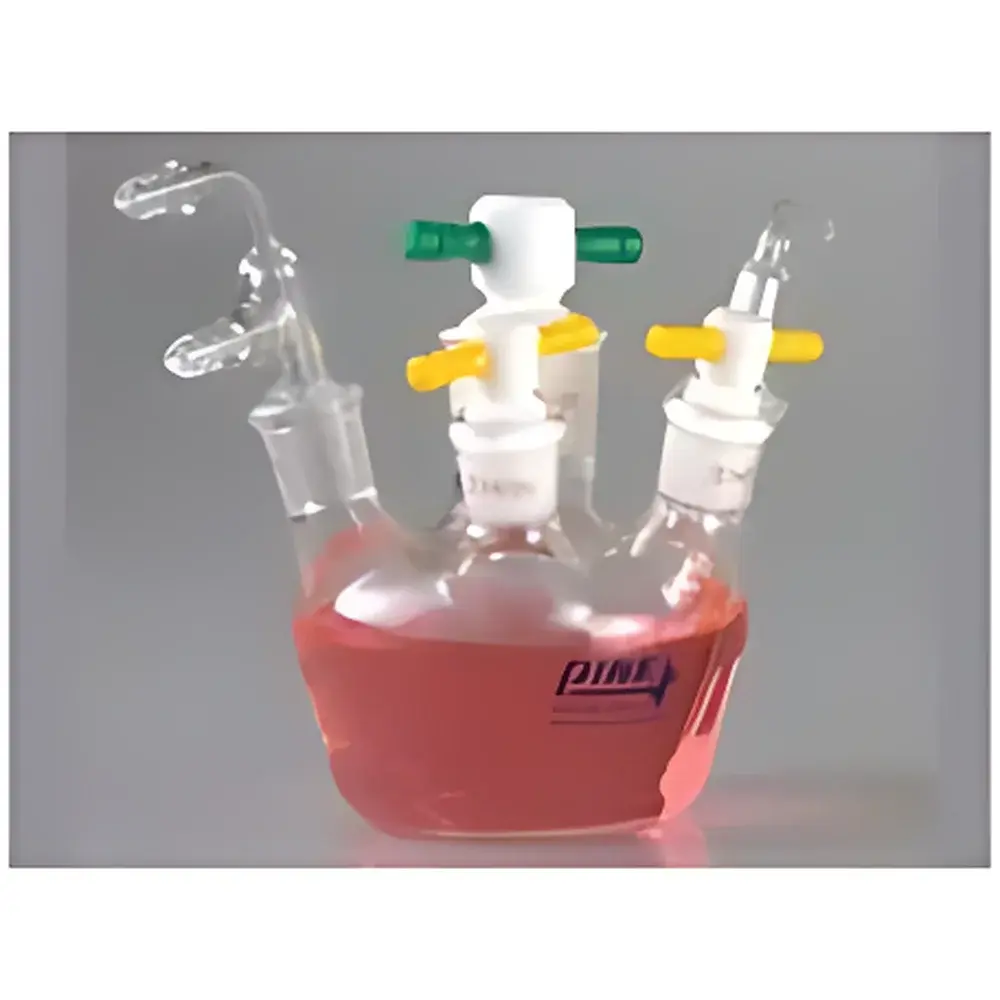
dc-energies Standard 5-Port Single-Layer Electrolytic Cell for Rotating Disk Electrode (RDE) Systems
| Brand | dc-energies |
|---|---|
| Origin | Hubei, China |
| Manufacturer Type | Authorized Distributor |
| Product Category | Domestic |
| Model | Standard 5-Port Single-Layer Electrolytic Cell |
| Instrument Type | Electrochemical Cell |
| Volume | 150 mL |
| RDE Port | 24/25 standard taper |
| Four Auxiliary Ports | 14/20 standard taper |
| Gas Inlet Configuration | Dual F-type inlet |
| Gas Outlet Configuration | L-type outlet |
| Sealing System | PINE-compatible ceramic bearing seal assembly |
| Material | High-purity borosilicate glass (3.3), ASTM E438 Type I, Class A |
Overview
The dc-energies Standard 5-Port Single-Layer Electrolytic Cell is a precision-engineered electrochemical reaction vessel designed specifically for rotating disk electrode (RDE) and rotating ring-disk electrode (RRDE) experiments under controlled gas atmosphere. Constructed from high-purity borosilicate glass (DIN ISO 3585 / ASTM E438 Type I, Class A), the cell provides exceptional thermal stability, chemical inertness against strong acids, bases, and organic solvents, and optical clarity for in situ observation. Its geometry supports rigorous hydrodynamic control in mass-transport-limited electrochemical kinetics studies—particularly relevant to oxygen reduction reaction (ORR), hydrogen evolution reaction (HER), CO₂ reduction, and catalyst stability evaluation. The single-layer design minimizes thermal gradients and simplifies temperature equilibration during isothermal measurements, while maintaining compatibility with standard potentiostat interfaces and commercial RDE drive units.
Key Features
- Five precisely dimensioned ground-glass ports: one central 24/25 standard taper port optimized for secure, low-torque insertion of RDE shafts; four peripheral 14/20 standard taper ports for auxiliary electrodes (reference, counter), gas inlets, or sampling lines.
- Dual F-type gas inlets enable independent introduction of two reactive gases (e.g., O₂ and N₂ for purge-switch protocols) or co-flow delivery of gas mixtures without cross-contamination.
- L-type gas outlet ensures laminar exhaust flow path, minimizing back-pressure buildup and facilitating integration with gas chromatography (GC) or mass spectrometry (MS) effluent lines.
- Ceramic bearing-compatible sealing interface—fully aligned with PINE Research’s proprietary RDE shaft seal geometry—maintains leak-tight integrity at rotational speeds up to 10,000 rpm under pressurized or vacuum conditions.
- Complete accessory set included: PTFE-coated glass stoppers, Viton O-rings (per ASTM D1418), threaded glass caps, and calibrated gas dispersion frits (porosity grade G3, 15–40 µm).
- Autoclavable (121°C, 2 bar) and compatible with common electrochemical cleaning protocols including piranha solution (H₂SO₄:H₂O₂, 3:1 v/v) and aqua regia (with caution and time limitation).
Sample Compatibility & Compliance
The cell accommodates aqueous, non-aqueous, and ionic liquid electrolytes across pH 0–14 and temperatures from −20°C to +80°C (with optional cooling jacket). It complies with ISO 8573-1 (compressed air purity classes) when used with certified gas manifolds and meets GLP documentation requirements for traceable experimental setup. All glass components conform to ISO 3585 for borosilicate glass 3.3 and are supplied with individual batch-certified material test reports (MTRs). No adhesives or polymer gaskets contact the electrolyte—ensuring electrochemical cleanliness and eliminating leachable organics that could interfere with low-current measurements (<1 nA).
Software & Data Management
While the cell itself is hardware-only, its standardized port configuration enables seamless integration with electrochemical workstations supporting automated gas switching (e.g., BioLogic SP-300 with EC-Lab v12.42+, Metrohm Autolab PGSTAT302N with NOVA 2.1.4). Experimental metadata—including gas composition, flow rate (via mass flow controllers), rotation speed (verified by optical tachometer), and timestamped potential/current logs—can be synchronized via TTL triggers and exported in .mpt or .txt formats compliant with ASTM E2917-21 (Standard Practice for Electrochemical Impedance Spectroscopy Data Acquisition). Audit trails meet FDA 21 CFR Part 11 requirements when paired with validated workstation software and networked storage.
Applications
- Kinetic analysis of multi-electron transfer reactions (e.g., ORR pathway discrimination via Koutecký–Levich plots)
- Electrocatalyst screening under industrially relevant gas feed conditions (e.g., PEMFC anode/cathode simulation)
- In situ FTIR or UV-Vis spectroelectrochemistry using side-arm optical access
- Stability testing of molecular catalysts under continuous gas sparging
- Corrosion rate quantification via rotating cylinder electrode (RCE) adaptation
- Electrochemical synthesis monitoring with real-time pH or dissolved O₂ sensing
FAQ
Is this cell compatible with Pine Research AFMSRCE or MSR rotators?
Yes—the central 24/25 taper port and ceramic seal interface are dimensionally identical to Pine Research’s OEM specifications.
Can the cell be used under positive pressure (e.g., 2 atm O₂)?
Yes, when assembled with Viton O-rings and tightened to torque specification (0.8–1.2 N·m), it maintains integrity up to 3 bar gauge pressure.
What is the maximum recommended rotation speed?
10,000 rpm is verified for mechanical stability; above this, centrifugal stress on the glass body requires custom validation per ASTM D790.
Are replacement seals and frits available separately?
Yes—catalog numbers for ceramic bearing kits (DC-RDE-SEAL-KIT), G3 frits (DC-FRIT-G3-1420), and Viton O-ring sets (DC-ORING-VITON-1420) are provided in the technical datasheet.
Does the cell support temperature control integration?
Yes—two 14/20 ports can be fitted with thermocouple adapters (Type K, 1 mm sheath) and a third with a jacketed inlet/outlet for external circulation chillers (recommended flow rate: 0.5–2.0 L/min).




