
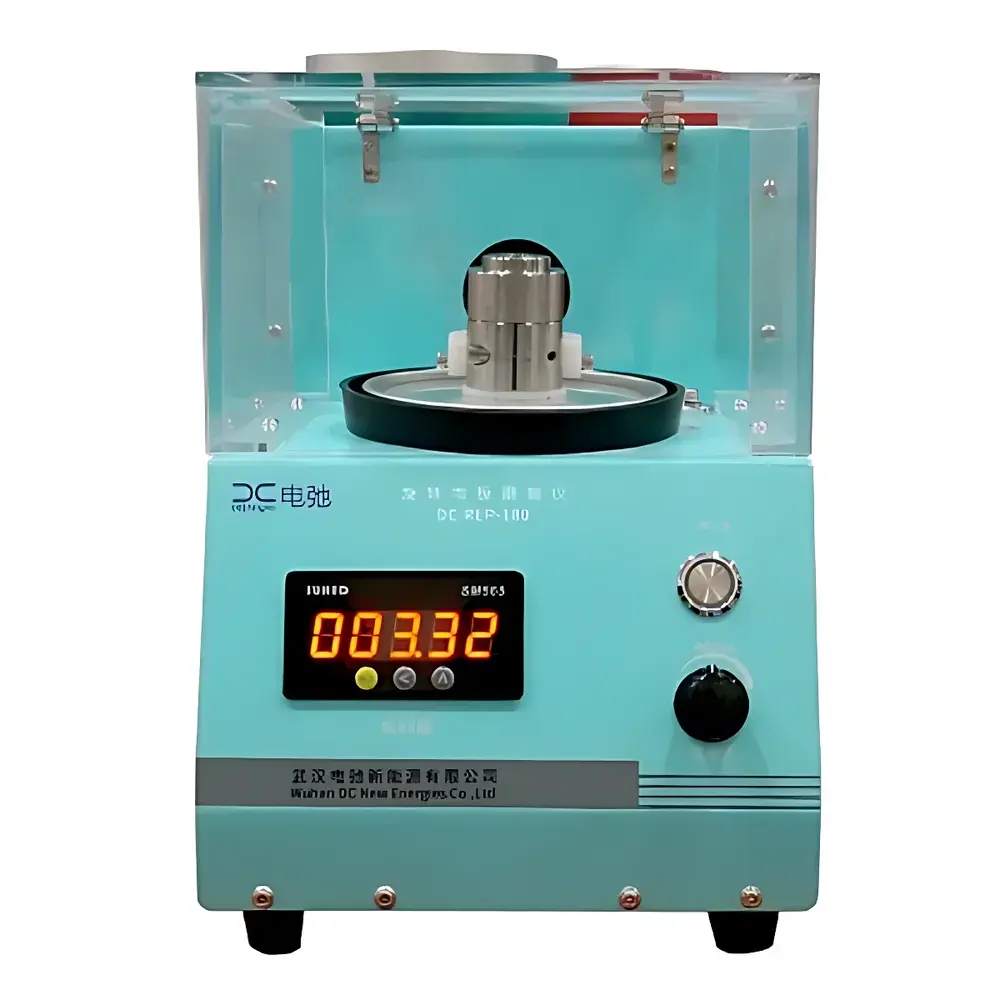
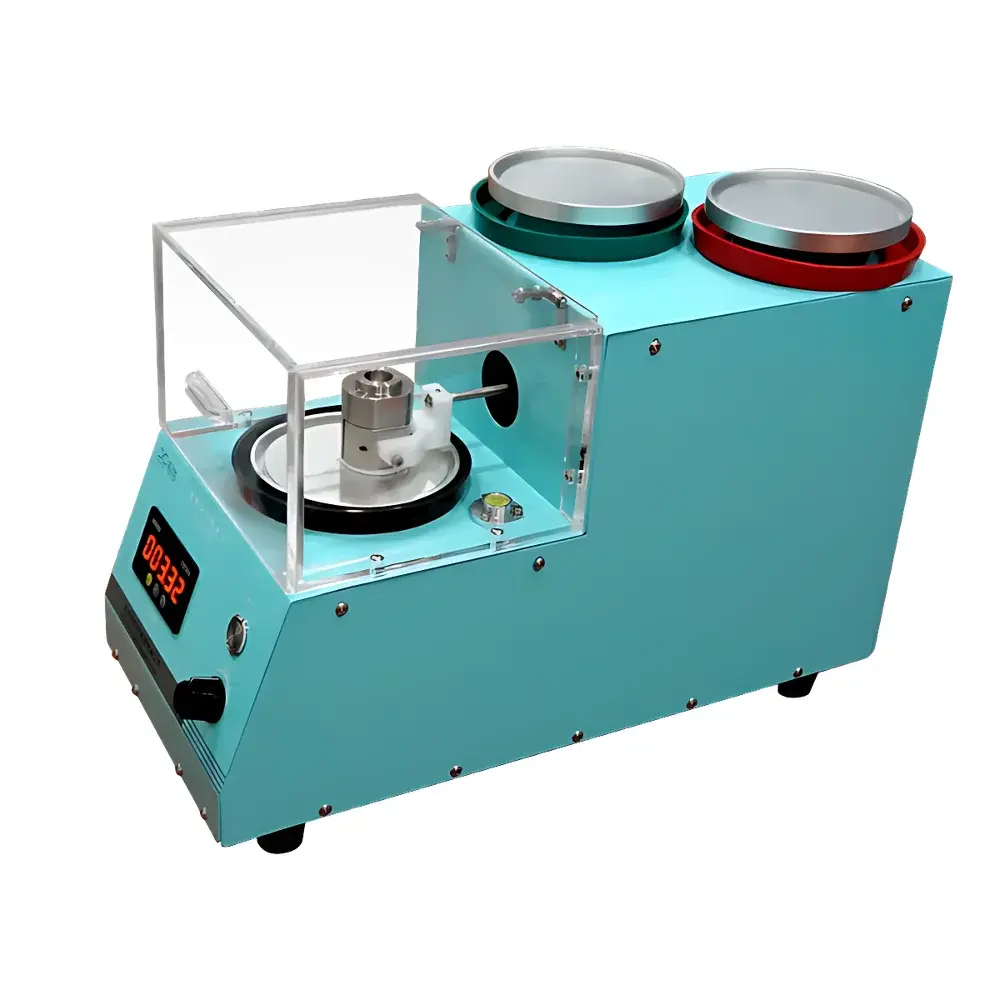
DCREP-180 Rotating Electrode Polishing Instrument by dc-energies
| Brand | dc-energies |
|---|---|
| Origin | Wuhan, Hubei, China |
| Model | DCREP-180 |
| Power Supply | AC 220 V |
| Rated Power | 25 W |
| Rotation Speed Range | 0–160 rpm |
| Polishing Disc Diameter | 70 mm |
| Sample Holder Diameter | 40 mm |
| Station Capacity | 1–2 positions (compatible with RDE and RRDE electrodes) |
Overview
The DCREP-180 Rotating Electrode Polishing Instrument is an engineered solution for reproducible, controlled surface preparation of rotating disk electrodes (RDEs) and rotating ring-disk electrodes (RRDEs) used in fundamental electrochemical research and analytical method development. Designed around the principle of mechanical abrasion under precisely regulated rotational shear, the instrument delivers uniform material removal and surface planarization—critical prerequisites for achieving well-defined diffusion-controlled current responses in voltammetric measurements. Unlike manual polishing techniques that introduce operator-dependent variability in surface roughness, tilt angle, and pressure distribution, the DCREP-180 ensures consistent electrode geometry, minimized edge rounding, and repeatable electroactive area definition—key factors influencing the accuracy of kinetic parameter extraction (e.g., electron transfer rate constants, diffusion coefficients) and catalyst activity normalization.
Key Features
- Adjustable rotational speed control (0–160 rpm) enables optimization for diverse abrasive media—including alumina slurries (0.05 µm, 0.3 µm), diamond suspensions, and silica-based polishes—without inducing thermal degradation or micro-fracturing of glassy carbon, platinum, gold, or carbon fiber electrode surfaces.
- Dual-position configuration supports simultaneous conditioning of two electrodes or sequential polishing steps (e.g., coarse → fine → final polish) within a single setup, improving throughput in high-volume electrochemical characterization workflows.
- 70 mm diameter polishing disc provides stable dynamic loading and uniform torque transmission; integrated 40 mm sample holder accommodates standard RDE shafts (6 mm OD) and custom-fitted electrode assemblies with mechanical clamping to prevent axial slippage during rotation.
- Compact benchtop footprint (W × D × H: 220 × 280 × 210 mm) and low power consumption (25 W) make it suitable for shared laboratory environments, fume hoods, and gloveboxes where space and energy efficiency are constrained.
- All structural components are constructed from corrosion-resistant stainless steel and anodized aluminum, ensuring long-term dimensional stability and compatibility with aqueous, organic, and mildly acidic/alkaline polishing electrolytes.
Sample Compatibility & Compliance
The DCREP-180 is validated for use with standard electrochemical working electrodes including but not limited to: glassy carbon RDEs (e.g., Pine Research AFM-RDE series, BASi MF-2012), Pt and Au disk/ring assemblies, carbon nanotube-modified electrodes, and screen-printed electrode substrates requiring post-fabrication surface activation. It complies with standard laboratory safety practices per IEC 61010-1 for electrical equipment used in measurement, control, and laboratory applications. While not certified to ISO/IEC 17025, its operational repeatability supports GLP-aligned documentation protocols when paired with calibrated micrometers, profilometers, and electrochemical validation standards (e.g., K₃Fe(CN)₆ redox couple in 0.1 M KCl).
Software & Data Management
The DCREP-180 operates as a standalone electromechanical system without embedded firmware or digital interface. Speed setting is performed via analog rotary potentiometer with tactile feedback and visual RPM indication (mechanical tachometer). This design eliminates software dependencies, cybersecurity vulnerabilities, and driver compatibility issues—aligning with institutional IT policies that restrict network-connected instrumentation in core analytical labs. Users maintain full traceability through manual logbook entries or integration into LIMS via standardized SOP templates referencing speed, abrasive type, dwell time, and post-polish electrochemical validation metrics (e.g., peak separation ΔEₚ, iₚ/iₚc ratio in cyclic voltammetry).
Applications
- Pre-electrolysis surface activation of RDEs prior to oxygen reduction reaction (ORR) or hydrogen evolution reaction (HER) studies.
- Regeneration of fouled electrode surfaces in biosensor calibration and environmental electroanalysis (e.g., nitrate, heavy metal detection).
- Standardization of electrode pretreatment across multi-lab collaborative projects adhering to ASTM E2792 (Standard Guide for Electrochemical Measurements in Corrosion Testing).
- Quality assurance in electrode manufacturing facilities performing incoming inspection of batch-produced RDE assemblies.
- Teaching laboratories requiring robust, low-maintenance tools for undergraduate electrochemistry modules (e.g., Levich plot generation, Koutecký–Levich analysis).
FAQ
Can the DCREP-180 accommodate non-standard electrode geometries beyond 6 mm shafts?
Yes—custom adapter sleeves and set-screw holders can be fabricated in-house using standard M4 threading; contact technical support for dimensional specifications and mechanical drawings.
Is the polishing disc compatible with water-cooled operation?
No—this unit is designed for ambient-temperature polishing only. For thermally sensitive materials, users should limit dwell time per pass and employ low-viscosity slurries with active cooling via external drip systems.
Does the instrument meet FDA 21 CFR Part 11 requirements for electronic records?
Not applicable—the DCREP-180 generates no electronic records. All operational parameters are manually recorded, satisfying audit requirements for paper-based or hybrid GLP workflows.
What maintenance schedule is recommended for long-term reliability?
Inspect bearing play and belt tension every 500 operating hours; replace polishing disc substrate after ~2,000 rpm-hours of cumulative use to maintain flatness tolerance ≤ ±2 µm over 70 mm diameter.
Can the same unit be used for both RDE and RRDE polishing without cross-contamination risk?
Yes—dedicated polishing pads and separate abrasive reservoirs per electrode type are strongly advised; the dual-station layout facilitates physical segregation of coarse/fine polishing zones.





