
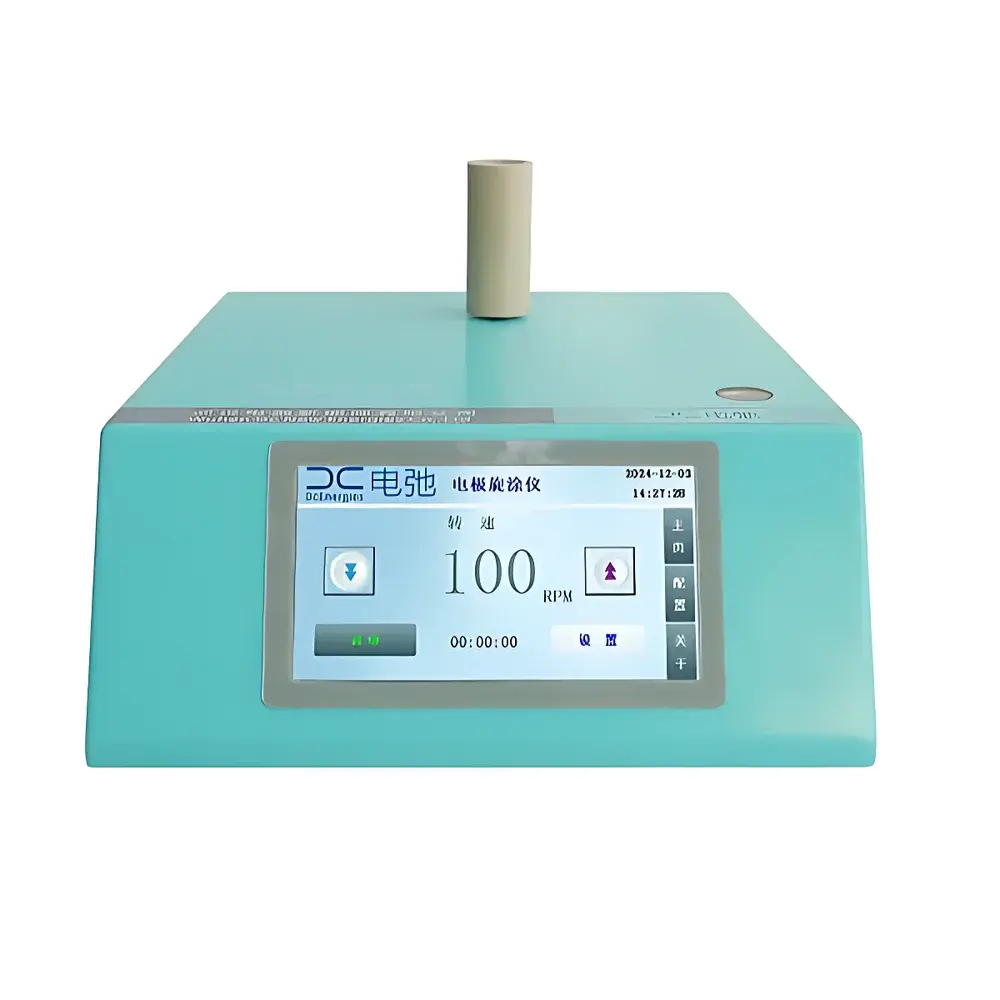
DCESC-1000 Electrode Spin Coater for RDE/RRDE Applications
| Brand | DC-Energies |
|---|---|
| Origin | Hubei, China |
| Model | DCESC-1000 |
| Rotation Speed | 50–800 rpm |
| Timer Function | Yes |
| Display | 4.3-inch capacitive touchscreen |
| Mounting | Single-station, precision-threaded spindle interface |
| Leveling | Integrated bubble level |
| Dimensions (W×D×H) | 100 mm × 265 mm × 213 mm |
| Power Input | AC 220 V, 50/60 Hz |
| Electrode Compatibility | Standard RDE/RRDE shafts (e.g., Pine Research, BASi, Metrohm, CHI) |
Overview
The DCESC-1000 Electrode Spin Coater is a precision-engineered benchtop instrument designed specifically for reproducible catalyst ink deposition onto rotating disk electrodes (RDE) and rotating ring-disk electrodes (RRDE). Unlike conventional static drop-casting methods—prone to coffee-ring effects, thickness gradients, and poor inter-experimental consistency—the DCESC-1000 employs controlled rotational shear forces to achieve uniform, thin-film catalyst layers via solvent-driven radial dispersion. Its operation follows established fluid dynamics principles governing spin coating: centrifugal acceleration counteracts capillary and surface tension forces, enabling controlled solvent evaporation and particle redistribution during rotation. This physical mechanism ensures consistent catalyst loading (µgcat/cm²), critical for quantitative electrochemical kinetics studies including oxygen reduction reaction (ORR), hydrogen evolution reaction (HER), and CO₂ reduction (CO₂RR). The device integrates seamlessly into standard electrochemical workflows without interfering with RDE host instrumentation (e.g., potentiostats from BioLogic, Gamry, or PalmSens), supporting parallel electrode preparation while preserving primary testing infrastructure.
Key Features
- Precision rotational control across 50–800 rpm with ±2 rpm repeatability, calibrated for low-speed stability essential for viscous catalyst inks (e.g., Pt/C, NiFe-LDH, or MOF-derived composites).
- Single-station modular design featuring a CNC-machined aluminum spindle mount with standardized 6-mm threaded interface—compatible with common RDE shafts (Pine Research type-A/B, BASi MF-2020, Metrohm PGSTAT series).
- Integrated digital leveling system (dual-axis bubble level) ensures orthogonal alignment between electrode surface and rotation axis, minimizing film eccentricity and thickness deviation.
- 4.3-inch industrial-grade capacitive touchscreen with intuitive GUI: programmable timer (0–300 s, 1-s resolution), real-time rpm display, and tactile feedback for glove-compatible operation in fume hoods or gloveboxes.
- Compact footprint (100 × 265 × 213 mm) optimized for shared lab spaces; EMI-shielded AC 220 V power supply compliant with IEC 61000-6-3 emission standards.
Sample Compatibility & Compliance
The DCESC-1000 accommodates standard RDE/RRDE geometries: disk diameters of 3 mm, 5 mm, and 6 mm (typical for kinetic analysis per ASTM D7212 and ISO 13477); ring-disk gap widths ≥10 µm; and shaft lengths up to 120 mm. It supports aqueous and organic-phase inks (e.g., Nafion/water/isopropanol blends, DMF-based transition metal complexes) without cross-contamination risk due to non-contact rotation. While not a regulated medical device, its mechanical design adheres to ISO 14971 risk management principles for laboratory equipment. All firmware operations retain timestamped logs—supporting GLP-compliant documentation when paired with validated LIMS or ELN systems.
Software & Data Management
The DCESC-1000 operates autonomously via embedded firmware; no PC connection is required for routine use. However, optional RS-232 or USB-C serial output enables integration with LabVIEW, Python (pySerial), or MATLAB for automated protocol sequencing in high-throughput catalyst screening. Timestamped operational records—including start time, set rpm, duration, and completion status—are stored internally (non-volatile memory, 10,000-cycle retention) and exportable as CSV for audit trails. Firmware updates follow secure signed-binary protocols aligned with NIST SP 800-193 guidelines for firmware integrity verification.
Applications
- Preparation of uniform catalyst films for rotating disk electrode voltammetry (RDE-V) and rotating ring-disk electrode voltammetry (RRDE-V) per ASTM G102 and ISO 17475.
- Standardized electrode fabrication in PEM fuel cell catalyst development (e.g., Pt-alloy ORR activity benchmarking per DOE Hydrogen Program targets).
- Reproducible immobilization of enzymatic or biohybrid electrocatalysts on glassy carbon or gold RDEs for biosensor validation studies.
- Quality control in academic and industrial electrocatalysis labs requiring >95% inter-electrode thickness uniformity (measured via SEM cross-section or profilometry).
- Training platforms in electrochemistry teaching laboratories where hands-on RDE methodology and ink deposition physics are emphasized.
FAQ
Is the DCESC-1000 compatible with RRDE electrodes featuring dual collectors?
Yes—it accepts standard RRDE shafts with integrated ring-disk assemblies; the spindle interface maintains coaxial alignment critical for ring collection efficiency calibration.
Can the rotation speed be ramped or programmed in multi-step profiles?
No—the current firmware supports only fixed-speed operation per run; multi-step protocols require external serial triggering via optional TTL/RS-232 interface.
What is the maximum ink volume recommended per deposition cycle?
For optimal uniformity, 5–15 µL is advised depending on ink viscosity and target loading; excessive volumes (>20 µL) may cause edge bead formation or splashing at >600 rpm.
Does the unit include calibration documentation traceable to national standards?
A factory calibration certificate (rpm accuracy ±2 rpm at 100/500/800 rpm) is provided; users may perform in-house verification using optical tachometers compliant with ISO 16063-11.
Is the touch interface operable with nitrile gloves in inert-atmosphere gloveboxes?
Yes—the capacitive screen responds reliably to standard lab-grade nitrile and latex gloves; ambient temperature range is rated 10–40 °C, suitable for nitrogen-purged enclosures.




