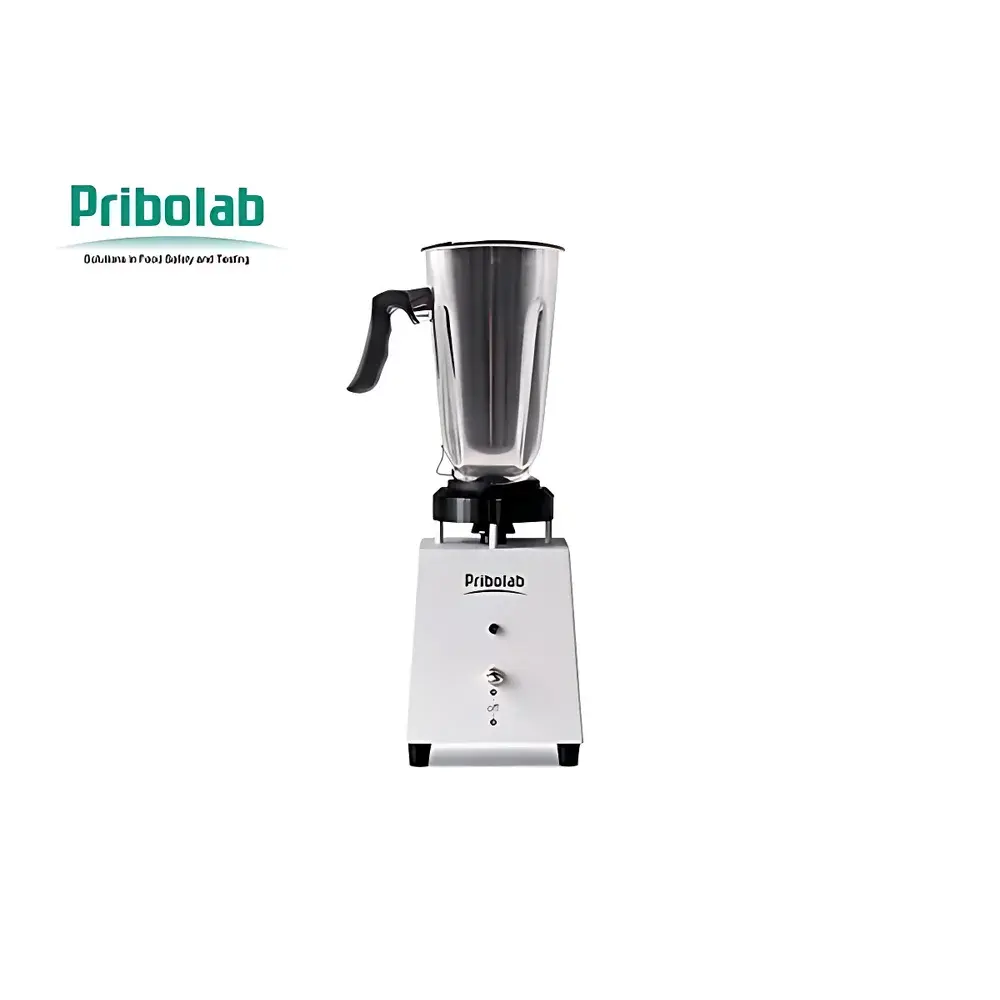
Pribolab PRB-2100S High-Speed Homogenizer
| Brand | Pribolab |
|---|---|
| Model | PRB-2100S |
| Construction | All-metal housing with 316 stainless steel homogenizing cup |
| Max. Speed | ≥22,000 rpm (dual-range: 11,000 / 22,000 rpm) |
| Capacity | 1.1 L |
| Power Supply | 230 VAC, 50–60 Hz |
| Dimensions (H) | 35.5 cm (base) / 40.5 cm (with cup) |
| Weight | 3.8 kg |
| Operating Temp. | 5–35 °C |
| Relative Humidity | 20–80 % RH |
| Compliance | CE certified |
| Cup Material | Electropolished 316 stainless steel with solvent-resistant dual-layer lid (ethylene–styrene copolymer) |
| Base Coating | Epoxy resin-coated aluminum alloy |
| Switch Type | Single-pole toggle switch |
Overview
The Pribolab PRB-2100S High-Speed Homogenizer is a laboratory-grade mechanical homogenization system engineered for rapid, reproducible sample disruption and solvent-assisted extraction—particularly in regulatory-compliant mycotoxin analysis workflows. It operates on the principle of high-shear rotor-stator homogenization: a precision-balanced stainless steel blade assembly rotates at controlled speeds within a sealed, corrosion-resistant cup, generating intense turbulent flow, cavitation, and mechanical shear forces that simultaneously fracture cellular matrices, disperse particulates, and accelerate mass transfer between solid and liquid phases. Designed to meet pharmacopoeial (e.g., USP , EP 2.2.27) and national standard (e.g., GB 5009 series) requirements for food and feed testing, the PRB-2100S delivers consistent particle size reduction and analyte release within 2–3 minutes—critical for minimizing degradation of thermolabile or oxidation-prone toxins such as aflatoxins, ochratoxin A, and deoxynivalenol.
Key Features
- Two-speed motor control (11,000 rpm and ≥22,000 rpm) enables method-specific optimization: lower speed for heat-sensitive or viscous samples; higher speed for rapid cell lysis and complete matrix homogenization.
- All-metal construction with electropolished 316 stainless steel homogenizing cup ensures long-term resistance to aggressive organic solvents (e.g., acetonitrile, chloroform, ethyl acetate) commonly used in QuEChERS and AOAC multiresidue methods.
- Ergonomic, handle-integrated cup design facilitates safe handling under glove-box or biosafety cabinet conditions—supporting GLP-aligned workflows.
- Epoxy-resin-coated aluminum base provides structural rigidity and electrical insulation while resisting chemical splash and routine lab cleaning agents.
- CE-marked electromagnetic compatibility and safety compliance confirm adherence to IEC 61000-6-3 (EMI) and IEC 61000-6-2 (immunity) standards.
- No internal lubricants or plastic wetted components—eliminates risk of extractable contamination during trace-level toxin analysis.
Sample Compatibility & Compliance
The PRB-2100S accommodates heterogeneous solid and semi-solid matrices including cereal grains, nut meals, dried herbs, animal tissues, microbial pellets, and pharmaceutical excipients. Its sealed cup geometry and solvent-compatible materials support validated protocols for ISO/IEC 17025-accredited laboratories performing mycotoxin testing per AOAC Official Method 2005.02, EN 14123-1:2021, and China’s GB 5009.22–2016. The absence of gaskets or elastomeric seals eliminates potential sources of silicone or phthalate leaching—essential for LC-MS/MS quantification at sub-ppb levels. For sterile applications (e.g., microbiological media preparation or cell therapy raw material processing), the cup and lid undergo autoclaving at 121 °C for 20 min without dimensional deformation or surface passivation loss.
Software & Data Management
As a standalone electromechanical instrument, the PRB-2100S does not incorporate embedded firmware or digital connectivity. Its operation relies exclusively on manual toggle-switch actuation—ensuring deterministic, repeatable runtime without software validation overhead. This architecture aligns with FDA 21 CFR Part 11 Annex 11 expectations for “low-risk” equipment where electronic records are not generated. Laboratories implementing electronic lab notebooks (ELN) or LIMS may log usage parameters (speed setting, duration, sample ID) manually or via barcode-scanned run sheets—fully auditable under GLP/GMP documentation practices. No calibration certificate is required per ISO/IEC 17025 Clause 6.5.2, though periodic verification of rotational speed (via handheld tachometer) and cup integrity (visual inspection for pitting or thread wear) is recommended every 500 operating hours.
Applications
- Mycotoxin Analysis: Primary homogenization step in multi-analyte extraction protocols for cereals, spices, and oilseeds—enabling full recovery of bound and free toxin forms.
- Pharmaceutical R&D: Disruption of lyophilized biologics, homogenization of tablet blends prior to dissolution testing, and preparation of suspension-based dosage forms.
- Clinical & Diagnostic Labs: Rapid lysis of tissue biopsies and blood clots for nucleic acid or protein biomarker isolation—compatible with downstream qPCR and ELISA workflows.
- Food Safety Testing: Emulsification of cheese, meat paste, and infant formula for uniform contaminant distribution prior to immunoaffinity cleanup.
- Biomanufacturing: Sterile blending of culture media components, homogenization of yeast/bacterial biomass for intracellular enzyme extraction, and preparation of vaccine adjuvant suspensions.
FAQ
Is the PRB-2100S suitable for use inside a laminar flow hood or biosafety cabinet?
Yes—the compact footprint (≤20 cm × 20 cm base), low acoustic emission (<72 dB at 1 m), and absence of external ventilation requirements permit safe operation under Class II A2 containment conditions.
Can the stainless steel cup be cleaned in an ultrasonic bath?
Yes—electropolished 316 SS is fully compatible with aqueous alkaline or acidic ultrasonic cleaning solutions; avoid halogenated solvents to prevent pitting.
What maintenance is required to ensure long-term performance?
Inspect blade sharpness and cup threading quarterly; replace blade assembly after 1,000 cycles or visible dulling; verify motor housing integrity annually per ISO 5388 mechanical safety guidelines.
Does the instrument comply with ISO 13485 for medical device manufacturing environments?
While not certified to ISO 13485, its CE marking, solvent-resistant materials, and sterile-capable design support integration into ISO 13485-compliant production processes when validated per QSR 820.72.
Is there a recommended torque specification for lid tightening?
Tighten the dual-layer lid to hand-tight plus one-quarter turn only—over-torquing may deform the ethylene–styrene seal ring and compromise solvent containment.
Related Products