
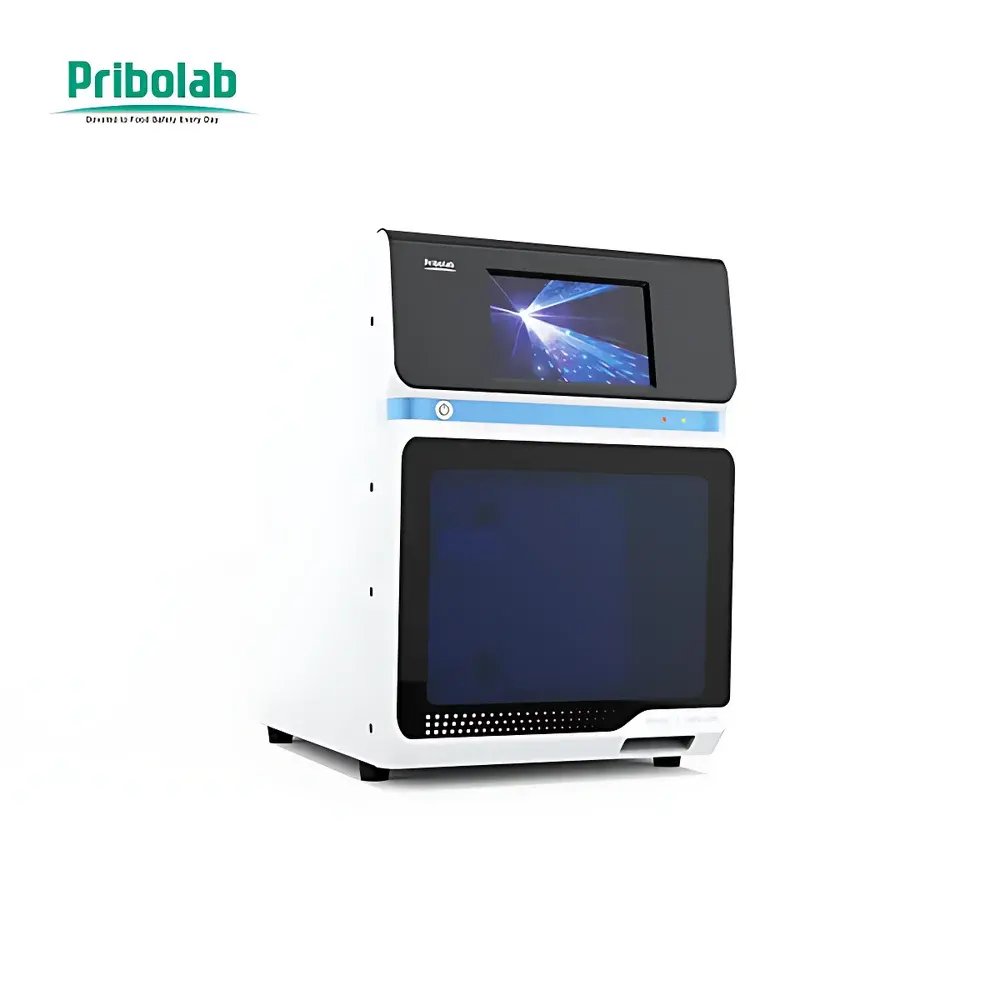
Pribolab MDS-3100 Multi-Mode Photochemical and Electrochemical Post-Column Derivatization System
| Brand | Pribolab |
|---|---|
| Origin | Shandong, China |
| Model | MDS-3100 |
| Temperature Range | Ambient +5 °C to 150 °C |
| Derivatization Reagent Flow Rate | 0.01–9.999 mL/min |
| Reaction Coil Volume | 1 mL |
| Material Construction | PEEK fluidic path |
| Flow Accuracy | ≤0.5% |
| Flow RSD | ≤0.1% |
| Safety Features | Backflow prevention valve, overpressure protection (500 psi), overtemperature cutoff (150 °C), leak detection shutdown, inert gas pressurized reagent reservoir (optional) |
| Compliance | Designed for GLP/GMP-compliant HPLC workflows |
Overview
The Pribolab MDS-3100 is an integrated, dual-mode post-column derivatization system engineered for high-reproducibility trace analysis in regulated HPLC environments. It uniquely combines electrochemical reagent-based derivatization and UV/VIS photochemical activation within a single platform, utilizing independent dual-flow channels that enable rapid, software-controlled switching between derivatization modes without hardware reconfiguration. The system operates on the principle of on-line chemical modification—converting analytes lacking native chromophores or fluorophores into detectable derivatives immediately after chromatographic separation but prior to detection. This approach significantly enhances sensitivity (e.g., sub-ppb detection of aflatoxin B₁ and G₁), improves selectivity in complex matrices, and extends the functional scope of standard UV or fluorescence detectors. Its architecture adheres to fundamental requirements of column effluent compatibility, low dead volume (<15 µL per flow path), and thermally stable reaction coil management—critical for kinetic control in time-sensitive derivatization reactions such as OPA, iodine, or UV-induced cyclization.
Key Features
- Dual-mode operation: Simultaneous support for reagent-driven (electrochemical or chemical) and photochemical derivatization via programmable flow-path selection—eliminating manual tubing swaps and reducing method transfer time.
- High-precision fluidics: Dual independently controllable PEEK syringe pumps with built-in pulse dampeners; flow accuracy ±0.5% and repeatability RSD ≤0.1% across full range (0.01–9.999 mL/min).
- Thermally regulated reaction module: Heated reaction coil (ambient +5 °C to 150 °C, ±0.5 °C stability) housed in insulated stainless-steel block with PID feedback control—optimized for temperature-dependent reactions including thiazoline formation (for β-lactams) and photoinduced ring closure (e.g., aflatoxins).
- Modular, service-oriented design: Tool-free access to pump heads, reaction coils, and UV lamp housing; standardized 1/16″ PEEK fittings; optional dual-coil configuration for parallel method development.
- Comprehensive safety architecture: Integrated backflow prevention valve (prevents reagent ingress into analytical column during pressure drop); mechanical overpressure relief at 500 psi; thermal cutoff at 150 °C; real-time leak detection with automatic system halt; optional inert-gas pressurized reagent reservoir using oxygen-impermeable Saran™ tubing.
Sample Compatibility & Compliance
The MDS-3100 supports derivatization of diverse compound classes requiring enhanced detectability in regulatory testing: carbamates (e.g., carbaryl, aldicarb), glyphosate and its metabolite AMPA, guanidines (e.g., streptomycin), bipyridyl herbicides (paraquat, diquat), taurine, ionophore antibiotics (monensin, salinomycin), sulfonamides (sulfamethoxazole, sulfadiazine), paralytic shellfish toxins (saxitoxin, neosaxitoxin), mycotoxins (aflatoxins B₁/G₁, fumonisins, trichothecenes), vitamins (B₁, B₆), barbiturates, amino acids, and peptides. It is validated for use in methods aligned with AOAC Official Method 2005.08 (aflatoxins), EN 15662:2018 (pesticide residues), USP <232>/<233> (elemental impurities), and FDA’s BAM Chapter 11 (shellfish toxins). All fluidic contact materials meet USP Class VI biocompatibility standards; system design facilitates 21 CFR Part 11–compliant audit trails when paired with validated LIMS or CDS software.
Software & Data Management
Control is implemented via Windows-based Pribolab DerivaSoft™ v3.x, supporting both local touchscreen operation (10.1″ capacitive display) and remote PC interface. The software provides synchronized gradient timing with HPLC pumps, event-triggered derivatization start/stop, real-time flow and temperature monitoring with configurable alarms, and automated sequence-based method switching. Raw instrument parameters—including pump status, coil temperature logs, UV lamp intensity decay curves, and pressure readings—are timestamped and exportable in CSV or .dx format. Audit trail functionality records all user actions, parameter changes, and system events with immutable timestamps—fully compliant with ALCOA+ principles for GLP and GMP laboratories.
Applications
The MDS-3100 delivers robust performance across regulated analytical domains: food safety (EU MRL enforcement for carbamates and mycotoxins), clinical toxicology (quantification of paraquat in serum), pharmaceutical QC (sulfonamide impurity profiling per ICH Q2(R2)), environmental monitoring (glyphosate in surface water per EPA Method 548.1), and feed testing (ionophore antibiotics in animal rations). Its photochemical mode enables reagent-free aflatoxin B₁/G₁ derivatization—reducing solvent consumption, eliminating post-run column washing cycles, and minimizing carryover risk. In amino acid analysis, OPA/ninhydrin dual-derivatization protocols achieve LODs <10 pmol on-column with retention time RSD <0.3% over 100 injections. For veterinary drug screening, it supports multi-residue workflows compliant with EC 37/2010 and Chinese GB 29690–2013.
FAQ
Can the MDS-3100 be integrated with third-party HPLC systems from Agilent, Waters, or Shimadzu?
Yes—the system uses standard 1/16″ PEEK connections and accepts TTL or RS-232 trigger signals for synchronized derivatization initiation; no proprietary interface hardware is required.
Is UV lamp output intensity monitored in real time?
Yes—integrated photodiode sensor continuously measures 254 nm irradiance; data is logged and used for predictive lamp replacement alerts.
What is the maximum allowable backpressure when operating the reaction coil at 150 °C?
The system maintains safe operation up to 400 bar (5800 psi) at elevated temperatures; pressure transducers are calibrated per ISO 17025-accredited procedures.
Does the system support gradient-compatible derivatization for LC-MS applications?
While primarily optimized for UV/FLD detection, the MDS-3100’s low-metal, PEEK-only flow path and volatile reagent compatibility (e.g., OPA in borate buffer) allow integration with ESI-MS interfaces—provided post-derivatization solvent composition remains MS-friendly.
How is calibration traceability maintained for flow and temperature modules?
Factory calibration certificates (NIST-traceable) are supplied for each pump and temperature sensor; annual recalibration services include verification against primary standards per ISO/IEC 17025 requirements.
Related Products




