
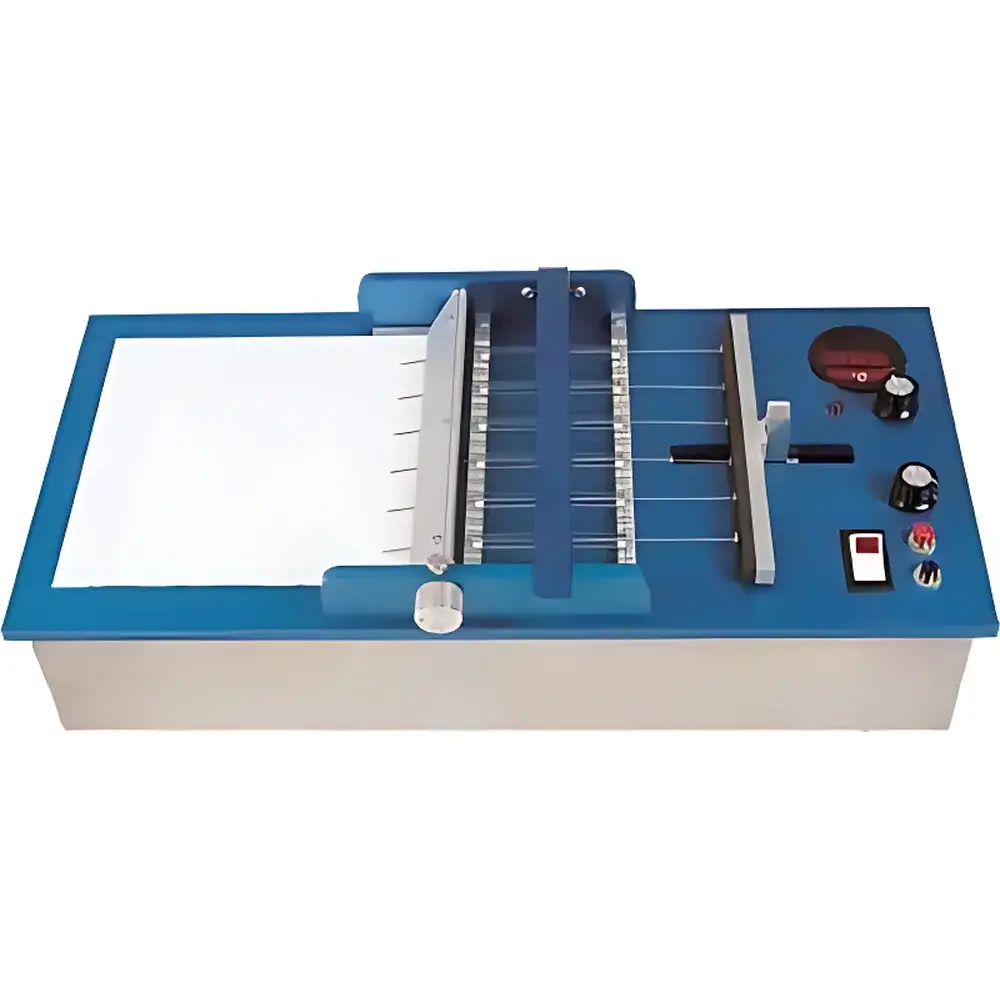
15test Automated Contact Spotter for Thin-Layer Chromatography
| Origin | Beijing, China |
|---|---|
| Manufacturer Type | Authorized Distributor |
| Product Origin | Domestic (China) |
| Model | 15test |
| Pricing | Available Upon Request |
Overview
The 15test Automated Contact Spotter is a precision-engineered instrument designed specifically for reproducible, high-throughput sample application in thin-layer chromatography (TLC) workflows. It employs contact-based capillary deposition—where a calibrated stainless-steel or fused-silica spotting tip physically touches the stationary phase—to deliver discrete, uniform circular spots with minimal diffusion and edge fringing. Unlike non-contact methods (e.g., spray or piezoelectric dispensing), this approach ensures consistent sample volume transfer (typically 0.1–5 µL per spot) across heterogeneous TLC plates—including silica gel, alumina, and cellulose layers—without requiring solvent optimization or plate pre-treatment. The system integrates a motorized X-Y stage with ±5 µm positional repeatability and supports standard TLC plates up to 200 × 200 mm. Its built-in programmable heating stage (0–200 °C, digital PID control) enables real-time plate preconditioning to reduce solvent front distortion and enhance resolution of thermally labile mycotoxins such as aflatoxins, trichothecenes, and ochratoxins.
Key Features
- Motorized X-Y translation stage with precision stepper motors and optical encoders for sub-millimeter spot placement accuracy
- Adjustable contact pressure and dwell time to accommodate varied sorbent layer hardness (e.g., 20 µm silica vs. 250 µm preparative plates)
- Digital temperature-controlled heating platform (0–200 °C, ±1 °C stability) with independent display and ramp/soak programming
- Modular spotting tip interface supporting interchangeable tips (0.1 mm, 0.2 mm, 0.3 mm inner diameter) for optimized spot size (1–4 mm diameter)
- Onboard memory for up to 99 method protocols—including spot coordinates, volume, spacing, and heating profile
- RS-232 and USB connectivity for integration with LIMS or custom scripting environments (Python-compatible API available)
Sample Compatibility & Compliance
The 15test spotter is validated for use with certified reference standards and complex biological extracts relevant to food safety and regulatory testing. It demonstrates robust performance with solvent systems commonly employed in mycotoxin analysis—including chloroform:methanol (95:5), ethyl acetate:hexane:formic acid (70:20:10), and toluene:acetone (9:1)—and maintains spot integrity under high-humidity conditions (up to 80% RH). All components contacting samples are chemically inert (316 stainless steel, PTFE, borosilicate glass), minimizing adsorption or carryover. The instrument complies with ISO/IEC 17025 requirements for method validation in accredited laboratories and supports GLP-compliant documentation when paired with audit-trail-enabled software. While not FDA 21 CFR Part 11-certified out-of-the-box, its firmware architecture permits integration with third-party electronic lab notebook (ELN) systems that provide full signature, versioning, and change-control capabilities.
Software & Data Management
The 15test is operated via intuitive Windows-based control software featuring drag-and-drop plate layout design, batch parameter assignment, and real-time monitoring of tip position, temperature, and cycle status. Each run generates a timestamped log file (.csv) containing spot coordinates, applied volume, heating setpoint, and system diagnostics—enabling traceability per ISO 17025 clause 7.7. Raw data files are compatible with common chromatography data systems (CDS), including OpenLab CDS and Chromeleon, for downstream alignment with densitometric quantification. Optional software modules include automated calibration verification (using dye-labeled standards), QC flagging for outlier spot diameters (>±10% deviation), and export templates aligned with AOAC Official Method® reporting formats for mycotoxin analysis (e.g., AOAC 2005.02 for aflatoxins).
Applications
This spotter is routinely deployed in regulatory and contract laboratories performing multi-mycotoxin screening per harmonized protocols (e.g., EU Commission Regulation (EC) No 401/2006 and GB 5009.22–2016). Key applications include: quantitative TLC-densitometry of aflatoxin B₁/B₂/G₁/G₂/M₁/M₂ in corn, peanut, and dairy matrices; semi-quantitative detection of zearalenone and deoxynivalenol in cereal grains using immunoaffinity-purified extracts; and method development for emerging toxins such as enniatins and beauvericin. Its thermal control capability is particularly advantageous for stabilizing labile analytes like citrinin and patulin during spotting—reducing degradation artifacts observed on ambient-temperature plates. The system also supports QC/QA functions, including parallel spotting of reference materials (e.g., CRM 118a for aflatoxins) alongside unknowns to monitor inter-run precision.
FAQ
What is the minimum spot-to-spot distance achievable without cross-contamination?
The recommended minimum center-to-center spacing is 8 mm for 2 mm-diameter spots on standard 200 µm silica plates; tighter spacing (down to 5 mm) is feasible with low-viscosity solvents and optimized dwell time.
Can the 15test be used with HPTLC plates?
Yes—its adjustable Z-axis travel accommodates plates up to 2 mm thick, including 100 µm and 200 µm HPTLC layers.
Is cleaning validation required between different mycotoxin standards?
A three-cycle wash with methanol followed by air-drying is sufficient for carryover reduction below 0.1% (verified by blank spotting and UV densitometry).
Does the heating stage affect solvent evaporation rate during spotting?
Controlled pre-heating (e.g., 60 °C for 2 min) reduces post-spotting solvent migration by ~40% compared to ambient conditions, improving spot roundness and Rf reproducibility.
Are replacement spotting tips supplied with traceable calibration certificates?
All tips are manufactured to ISO 8503-2 surface roughness specifications and shipped with individual dimensional inspection reports (diameter, taper angle, tip radius).
Related Products




