
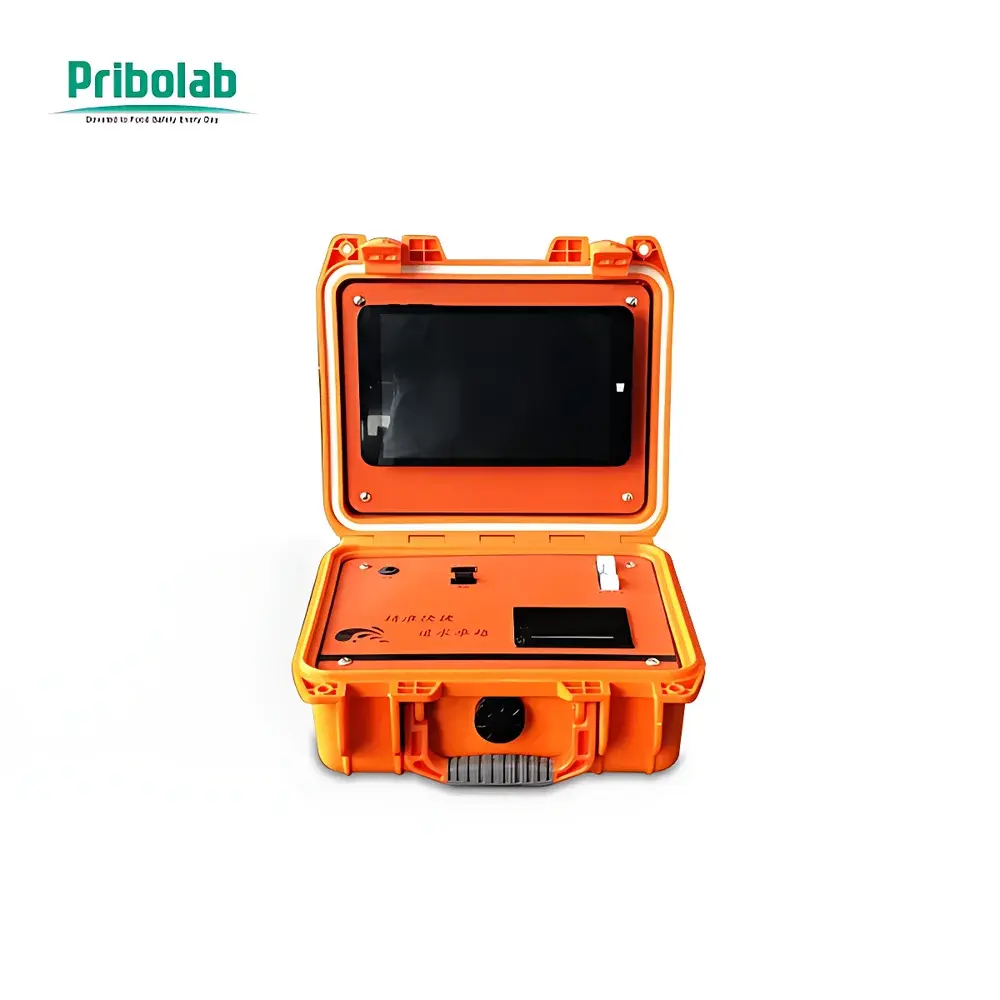
Pribolab LFR-I Colloidal Gold Quantitative Analyzer
| Brand | Pribolab |
|---|---|
| Model | LFR-I |
| Origin | Shandong, China |
| Sensor Type | 12-MP Hardware CMOS |
| Image Resolution | 1600 × 1200 |
| Detection Channel | Single-Channel |
| Interface | USB 2.0 |
| Operating Temperature | ≤40 °C |
| Relative Humidity | ≤85% RH |
| Power Supply | USB-powered |
| Dimensions (L×W×H) | 350 mm × 150 mm × 100 mm |
| Operating System | Windows 10 |
| Display | 8.0-inch High-Resolution Color Touchscreen (Chinese UI) |
| Data Output | Integrated Thermal Printer (Chinese Sample Name & Lab ID Support) |
Overview
The Pribolab LFR-I Colloidal Gold Quantitative Analyzer is a dedicated optical densitometer engineered for the quantitative interpretation of lateral flow immunoassay (LFIA) strips based on colloidal gold nanoparticle labeling. It operates on the principle of reflectance photometry—capturing high-fidelity digital images of test and control lines on commercially available rapid immunochromatographic test cassettes, then converting pixel intensity values into concentration estimates via pre-calibrated dose-response curves. Designed for routine screening in food safety laboratories, feed mills, grain inspection facilities, and regulatory testing units, the LFR-I supports standardized quantification of mycotoxins—including aflatoxin B1, deoxynivalenol (DON), zearalenone (ZEN), ochratoxin A (OTA), fumonisins (FB1/FB2), and T-2 toxin—in complex matrices such as cereals, animal feed, edible oils, and processed food products. Its architecture prioritizes operational robustness, minimal user intervention, and traceable measurement outcomes under ambient laboratory conditions.
Key Features
- 12-megapixel hardware CMOS imaging sensor with fixed-focus optics optimized for consistent line intensity capture across diverse lateral flow strip formats
- 8.0-inch capacitive touch display with full Chinese graphical user interface (GUI), enabling intuitive navigation without external peripherals
- Integrated thermal printer supporting automatic generation of audit-ready reports with embedded Chinese sample identifiers, operator name, date/time stamp, and quantitative results
- USB 2.0 host interface for direct connection to Windows 10–based PCs; no additional drivers required for plug-and-play operation
- Embedded calibration management system allowing storage and recall of multiple assay-specific calibration curves, each traceable to reference standards
- On-device Chinese input capability via touchscreen keyboard or stylus, ensuring unambiguous sample annotation and chain-of-custody documentation
Sample Compatibility & Compliance
The LFR-I is compatible with all standard colloidal gold–based lateral flow test kits conforming to ISO 20343:2020 (immunoassay performance criteria) and AOAC Official Method of Analysis® (OMA) guidelines for rapid mycotoxin detection. It does not perform extraction or sample preparation; rather, it serves as a readout platform for validated commercial assays. Instrument validation protocols support alignment with GLP-compliant workflows, including instrument qualification (IQ/OQ), user-defined calibration verification intervals, and manual logbook entries for maintenance history. While the device itself is not FDA 510(k)-cleared, its use in regulated environments adheres to data integrity principles outlined in FDA 21 CFR Part 11 when paired with appropriate procedural controls (e.g., password-protected user accounts, electronic signature implementation at the host PC level).
Software & Data Management
Data acquisition and analysis are managed through a dedicated Windows 10 application that provides real-time image preview, auto-line detection, background correction, and curve-fitting using four-parameter logistic (4PL) regression. Raw image files (TIFF format), calibration metadata, and result spreadsheets (CSV/XLSX) are timestamped and stored locally. The software supports batch processing of up to 96 samples per session and exports structured data compatible with LIMS integration via configurable API endpoints. Audit trail functionality records all parameter changes, calibration events, and report generation actions—enabling retrospective review during internal audits or regulatory inspections. All Chinese-language annotations are preserved in UTF-8 encoding to ensure fidelity during cross-platform data exchange.
Applications
- Routine surveillance of mycotoxin contamination in corn, wheat, barley, soybean meal, and finished feed formulations
- Pre-shipment verification for export-oriented agri-food enterprises subject to EU Commission Regulation (EC) No. 1881/2006 limits
- On-site screening at grain elevators and wholesale markets where rapid turnaround (<10 min/sample) is operationally critical
- Method transfer support for laboratories transitioning from qualitative dipstick tests to semi-quantitative field-deployable systems
- Training platforms for technical staff in regional food safety agencies requiring standardized LFIA interpretation protocols
FAQ
Does the LFR-I require external calibration standards for each test kit?
Yes—each lateral flow assay must be calibrated using the manufacturer-provided reference standards before quantitative analysis. The instrument stores calibration curves per kit lot number.
Can the LFR-I operate independently without a Windows PC?
No—the device functions exclusively as a USB peripheral; full analytical capability requires connection to a Windows 10 host running the proprietary software.
Is the thermal printer capable of generating bilingual (Chinese/English) reports?
The current firmware supports Chinese-only reporting. English output requires manual post-processing or third-party template customization.
What is the recommended maintenance schedule for the optical module?
Visual inspection and lens cleaning with lint-free wipes and isopropyl alcohol are advised weekly; no scheduled recalibration is required unless physical impact or environmental exposure compromises image consistency.
How does the LFR-I handle variability in strip lot-to-lot performance?
Users must load new calibration curves corresponding to each test kit lot; the software enforces version control by prompting for lot-specific curve import prior to sample analysis.



