
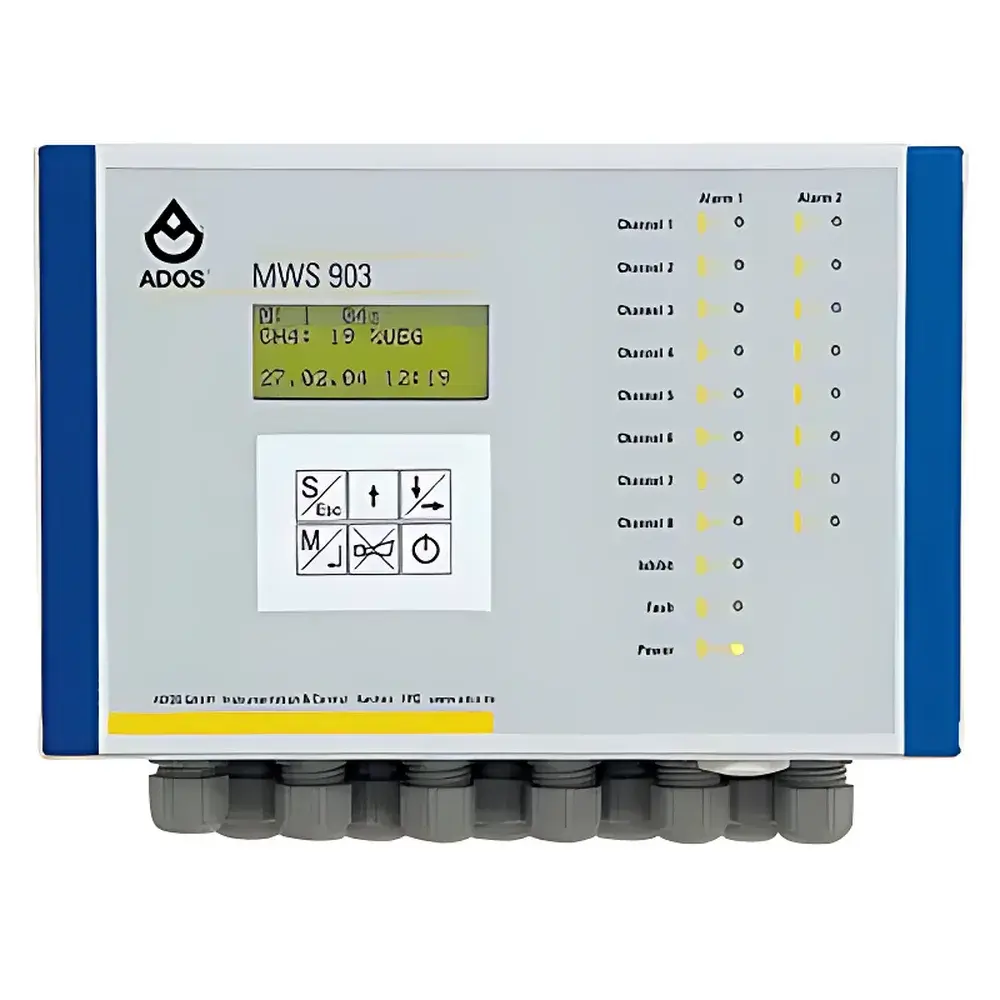
ADOS MWS903 Multi-Channel Gas Alarm Controller
| Brand | ADOS |
|---|---|
| Origin | Germany |
| Model | MWS 903 |
| Sensor Inputs | 8 (2-wire or 3-wire, e.g., LCTR 903) |
| Power Supply | 24 V DC / 200 mA |
| Operating Temperature | −10 to +40 °C |
| Digital Input | 1 (alarm mute) |
| Digital Outputs | up to 12 alarm relays + 1 fault relay + 1 alarm label relay (all floating changeover contacts, 250 V AC / 4 A max) |
| Analog Output | 4–20 mA |
| Communication Interface | RS232 |
| Main Power Options | 230 V AC / 50 Hz |
| Enclosure Dimensions | 240 × 160 × 90 mm |
| Weight | ~2 kg |
| Ingress Protection | IP54 per DIN 40050 |
| Display | 4-line LCD with real-time value, 30-min average, and error messages |
| Keypad | 6-key menu-driven interface |
| Adjustable Alarm Thresholds | 2 independent setpoints per channel (5–100% of full scale) |
Overview
The ADOS MWS903 Multi-Channel Gas Alarm Controller is a CE-certified, DIN-rail and wall-mountable safety instrument engineered for continuous ambient air monitoring in industrial, commercial, and laboratory environments. Designed in accordance with EN 50194, EN 61000-6-2/-6-4, and IEC 61508 (SIL 2 capable when integrated with certified sensors), the MWS903 functions as a central evaluation and alarm management unit for up to eight analog gas sensors—supporting both 2-wire and 3-wire configurations (e.g., ADOS LCTR 903 series transmitters). It employs linear voltage-to-current conversion and digital signal conditioning to process sensor outputs, enabling precise detection and threshold-based response for hazardous, combustible, toxic, and asphyxiant gases. Its architecture supports fail-safe operation: sensor fault detection, open/short-circuit monitoring, and automatic diagnostics ensure system integrity under continuous duty. The controller does not perform gas analysis itself but serves as a certified interface between field sensors and facility-wide safety systems—including ventilation control, audible/visual alarms, emergency shutdown logic, and SCADA integration.
Key Features
- Eight configurable analog inputs compatible with standard 4–20 mA gas transmitters, including electrochemical, catalytic bead, infrared, and metal oxide semiconductor (MOS) sensors
- Dual independent alarm thresholds per channel, adjustable from 5% to 100% of sensor full-scale range—enabling low-level warning and high-level critical action differentiation
- Twelve programmable floating-changeover relay outputs (250 V AC / 4 A), plus dedicated fault, alarm, and label relays—each electrically isolated for compatibility with external sirens, strobes, dampers, and PLCs
- Real-time 4-line backlit LCD display showing instantaneous concentration, 30-minute moving average, sensor status, and diagnostic codes—navigated via intuitive 6-key membrane keypad
- RS232 serial interface for local data logging, configuration backup, and connection to printers or host PCs; supports ASCII command protocol for OEM integration
- Low-power design (24 V DC / 200 mA typical) with optional dual-voltage mains input (230 V AC / 50 Hz or 115 V AC / 60 Hz), facilitating deployment in diverse power infrastructures
- IP54-rated polycarbonate enclosure rated for indoor use in environments ranging from −10 °C to +40 °C—suitable for garages, tunnels, LPG stations, cold rooms, and chemical production areas
Sample Compatibility & Compliance
The MWS903 interfaces with certified gas sensors detecting O₂, CO, CO₂, NO₂, H₂S, NH₃, ClO₂, O₃, HCl, CH₄, C₂H₂, C₃H₈, C₄H₁₀, C₄H₁₀O, C₇H₈, C₈H₁₀, SF₆, He, N₂O, C₂H₈O, and LPG across defined ranges (e.g., 0–300 ppm CO; 0–100% LEL CH₄; 0–25% vol O₂). Sensor selection must comply with EN 45544-1 (toxic gases), EN 60079-29-1 (combustible gases), and EN 50104 (oxygen deficiency). When paired with ADOS LCTR 903-series transmitters, the complete system meets ATEX Category 2G (Zone 1) and IECEx requirements for use in potentially explosive atmospheres. All relay outputs are rated per EN 61000-6-2 (immunity) and EN 61000-6-4 (emission), and the unit supports audit-ready event logging for GLP/GMP-aligned facilities where traceability of alarm events and maintenance interventions is required.
Software & Data Management
Configuration and calibration verification are performed locally via the front-panel keypad and LCD—no proprietary software required. The RS232 port enables ASCII-based readout of live values, alarm history (timestamped entries), and system diagnostics using terminal emulation (e.g., PuTTY or Tera Term). Logged data may be exported for CSV import into LIMS or CMMS platforms. While the MWS903 lacks built-in Ethernet or cloud connectivity, its relay and 4–20 mA outputs are fully compatible with third-party SCADA systems (e.g., Siemens Desigo, Honeywell Experion) supporting Modbus RTU gateways. Event timestamps adhere to ISO 8601 format, and all relay activations include duration tagging—supporting root-cause analysis during incident investigations per ISO 45001 and OSHA 1910.120 compliance frameworks.
Applications
The MWS903 is deployed where multi-gas hazard awareness and coordinated response are critical: HVAC-integrated air quality supervision in parking structures and road tunnels; leak detection and purge control in LPG/CNG refueling stations; oxygen depletion and solvent vapor monitoring in pharmaceutical cleanrooms and coating booths; refrigerant tracking in cold storage facilities; and combustion byproduct surveillance (CO, NO₂) in boiler rooms and industrial heating systems. Its modular input architecture allows phased expansion—starting with O₂/CO monitoring in laboratories and scaling to 8-channel toxic gas surveillance in polymer synthesis plants. In cryogenic applications, it supports He leak detection in vacuum systems; in food processing, it verifies N₂O levels in packaging lines—all without requiring recalibration across gas types.
FAQ
Does the MWS903 include gas sensors, or must they be purchased separately?
The MWS903 is a controller-only device. Sensors (e.g., ADOS LCTR 903 series) must be selected and ordered separately based on target gas, required range, and environmental classification.
Can alarm thresholds be configured remotely via RS232?
No—thresholds, relay assignments, and display settings are configured exclusively via the front-panel keypad. RS232 supports only read-only data export and diagnostic query.
Is the MWS903 suitable for outdoor installation?
It is rated IP54, which protects against dust ingress and water splashes from any direction—but is intended for indoor or sheltered enclosures. Outdoor deployment requires an additional weatherproof cabinet meeting IP65 or higher.
What documentation is provided for validation in regulated environments?
Factory calibration certificates, EU Declaration of Conformity (EN 50194, EN 61000), and relay contact life cycle test reports are supplied. For FDA 21 CFR Part 11 compliance, external electronic loggers must be used—MWS903 itself does not support user authentication or electronic signatures.
How is sensor fault detection implemented?
The controller continuously monitors loop current, detects open-circuit (>22 mA), short-circuit (<3.6 mA), and out-of-range signals, triggering the dedicated fault relay and displaying “Err” with channel-specific code on the LCD.







