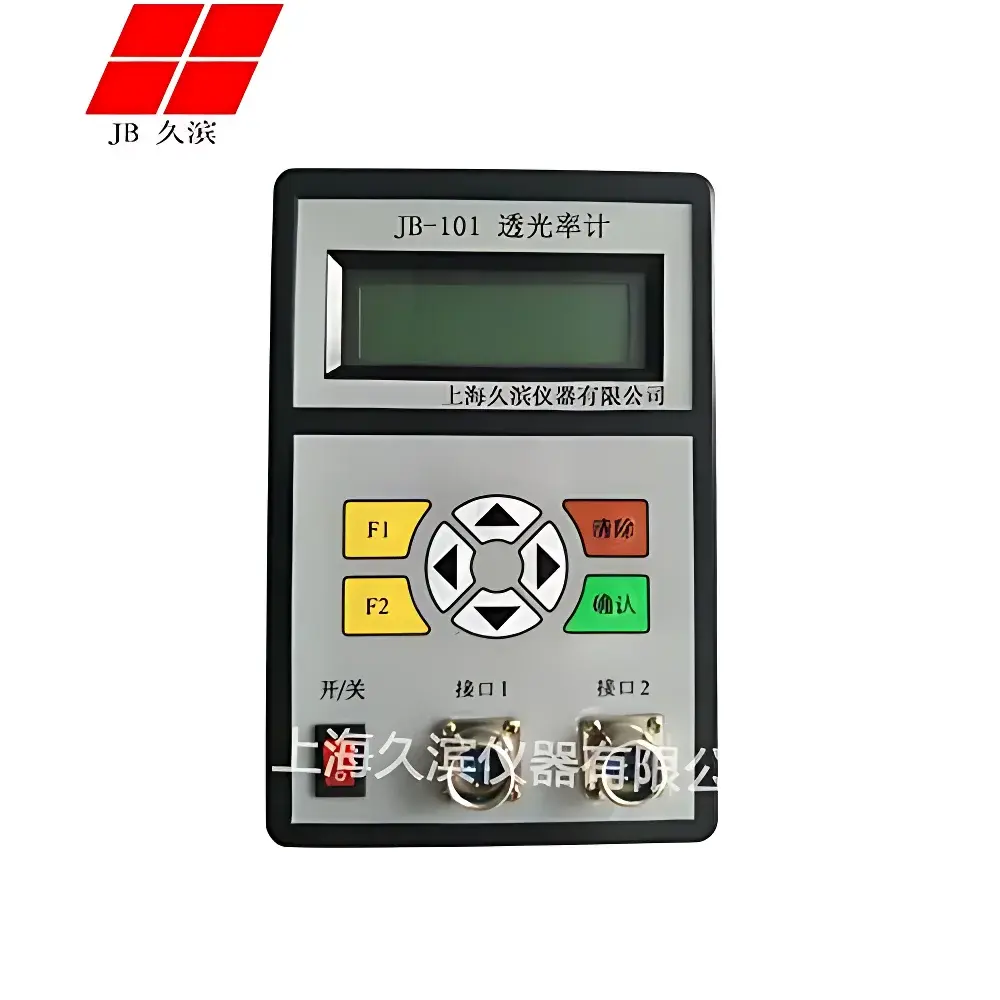
JB-101 Transmittance Meter by Jiubin Instruments
| Brand | Jiubin Instruments |
|---|---|
| Origin | Shanghai, China |
| Manufacturer Type | Authorized Distributor |
| Product Origin | Domestic (China) |
| Model | JB-101 |
| Pricing | Available Upon Request |
| Measurement Principle | Photometric Detection (Visible Light, 380–780 nm) |
| Operating Temperature | 5–40 °C |
| Storage Temperature | −10–45 °C |
| Relative Humidity Limit | ≤85 % RH |
| Measurement Range | 0.0–100.0 % T |
| Resolution | 0.1 % T |
| Accuracy | ±2.0 % T (at 23 ±5 °C, 50 ±10 % RH) |
| Maximum Sample Thickness | 10 mm |
| Display | Dot-Matrix LCD with Real-Time Readout |
| Data Storage | Internal Memory for Multiple Test Records |
| Calibration | Built-in Self-Calibration Function |
| Interface | RS-232 Serial Port (Optional External Thermal Printer Support) |
Overview
The JB-101 Transmittance Meter by Jiubin Instruments is a compact, benchtop photometric instrument engineered for quantitative determination of visible light transmittance (T%) across flat, transparent, or semi-transparent planar substrates. It operates on the fundamental principle of comparative photometry: a stabilized tungsten-halogen or LED-based light source emits broadband visible radiation (380–780 nm), which passes through the test sample and is detected by a silicon photodiode sensor. The ratio of transmitted irradiance to incident irradiance—normalized against an air or quartz reference—is computed and displayed as percent transmittance. Designed specifically for routine quality control in industrial and manufacturing environments, the JB-101 delivers repeatable, traceable measurements without requiring optical alignment or user-adjusted apertures. Its fixed-path geometry ensures consistent beam collimation and detector acceptance angle, minimizing edge effects and angular dependency—critical for compliance with ISO 9050:2003 (Glass in building — Determination of light transmittance, solar direct transmittance, total solar energy transmittance, ultraviolet transmittance and related properties) and ASTM E971–22 (Standard Practice for Measuring Light Transmittance of Transparent Materials).
Key Features
- High-resolution dot-matrix LCD display providing real-time, stable readouts with 0.1 % T resolution and ±2.0 % T accuracy under controlled ambient conditions (23 ±5 °C, 50 ±10 % RH)
- Integrated self-calibration routine enabling rapid verification and adjustment using internal reference optics—no external calibration standards required for daily operation
- Compact, ergonomic housing (W × D × H ≈ 160 × 85 × 45 mm) optimized for integration into production lines, QC labs, or mobile inspection stations
- Non-contact, single-beam measurement architecture with fixed 10 mm maximum sample thickness clearance—suitable for float glass, laminated automotive glazing, architectural panels, and coated substrates
- RS-232 serial interface compliant with EIA/TIA-232-F specifications, supporting bidirectional communication with PCs or PLCs for automated data logging and SPC analysis
- Onboard memory capable of storing ≥50 independent measurement records with timestamp and sample ID fields (user-assigned via keypad input)
Sample Compatibility & Compliance
The JB-101 is validated for use with homogeneous, optically isotropic planar materials including soda-lime silicate glass, borosilicate glass, acrylic (PMMA), polycarbonate (PC), and PET films. It accommodates samples up to 10 mm thick with parallel surfaces and surface roughness <0.1 µm Ra. Measurements comply with key regulatory and industry frameworks: ISO 9050:2003 Annex A (reference method for visible transmittance), EN 410:2011 (Glass in building — Determination of luminous and solar characteristics), and JIS R 3212:2017 (Transmittance testing of architectural glass). While not FDA 21 CFR Part 11–compliant out-of-the-box, audit trails and electronic signatures may be implemented via third-party data acquisition software interfacing through the RS-232 port.
Software & Data Management
The JB-101 operates autonomously but supports optional PC-based data management via standard terminal emulation (e.g., PuTTY, Tera Term) or custom LabVIEW/Python scripts using pySerial. Raw output includes ASCII-formatted strings containing measurement value, unit (%T), timestamp, and status flags (e.g., “CAL_OK”, “LOW_BATT”). For regulated environments, users may integrate the device into GLP/GMP workflows by pairing it with validated data capture platforms that enforce user access controls, change logs, and electronic signature requirements. No proprietary software is bundled; all communication protocols are openly documented in the operator manual.
Applications
- Automotive OEM and Tier-1 suppliers verifying AS-1/AS-2 glazing compliance per SAE J576 and FMVSS No. 205
- Glass fabricators performing incoming inspection of float glass batches against contractual T% tolerances (e.g., ≥89.5 % for clear 6 mm annealed glass)
- Architectural fenestration QA teams validating low-e coating performance and solar heat gain coefficient (SHGC) proxy metrics
- R&D laboratories screening UV-blocking additives or anti-reflective coatings during formulation development
- Aftermarket tint film installers documenting pre- and post-installation visible light transmission for regulatory reporting (e.g., state-level vehicle window tint laws)
FAQ
What is the spectral response range of the JB-101?
The instrument is optimized for the CIE photopic luminosity function (380–780 nm) and uses a matched filter-photodiode assembly to approximate the V(λ) curve within ±3 % deviation per CIE 15:2018.
Can the JB-101 measure transmittance of curved or textured surfaces?
No—it requires optically flat, parallel-surface samples. Curved, frosted, or etched substrates introduce scatter and vignetting errors beyond its specified accuracy limits.
Is NIST-traceable calibration available?
Jiubin Instruments provides factory calibration certificates traceable to national standards (SIT, China); end-users may arrange third-party recalibration against NIST SRM 930e filters through accredited metrology labs.
Does the device support statistical process control (SPC) output formats?
Yes—via RS-232, it outputs ASCII data streams compatible with common SPC software (e.g., Minitab, InfinityQS) when paired with appropriate interface drivers and parsing logic.
How often should self-calibration be performed?
Recommended before each measurement session or after ambient temperature shifts exceeding ±5 °C; full recalibration is advised annually or after physical impact or extended storage.