
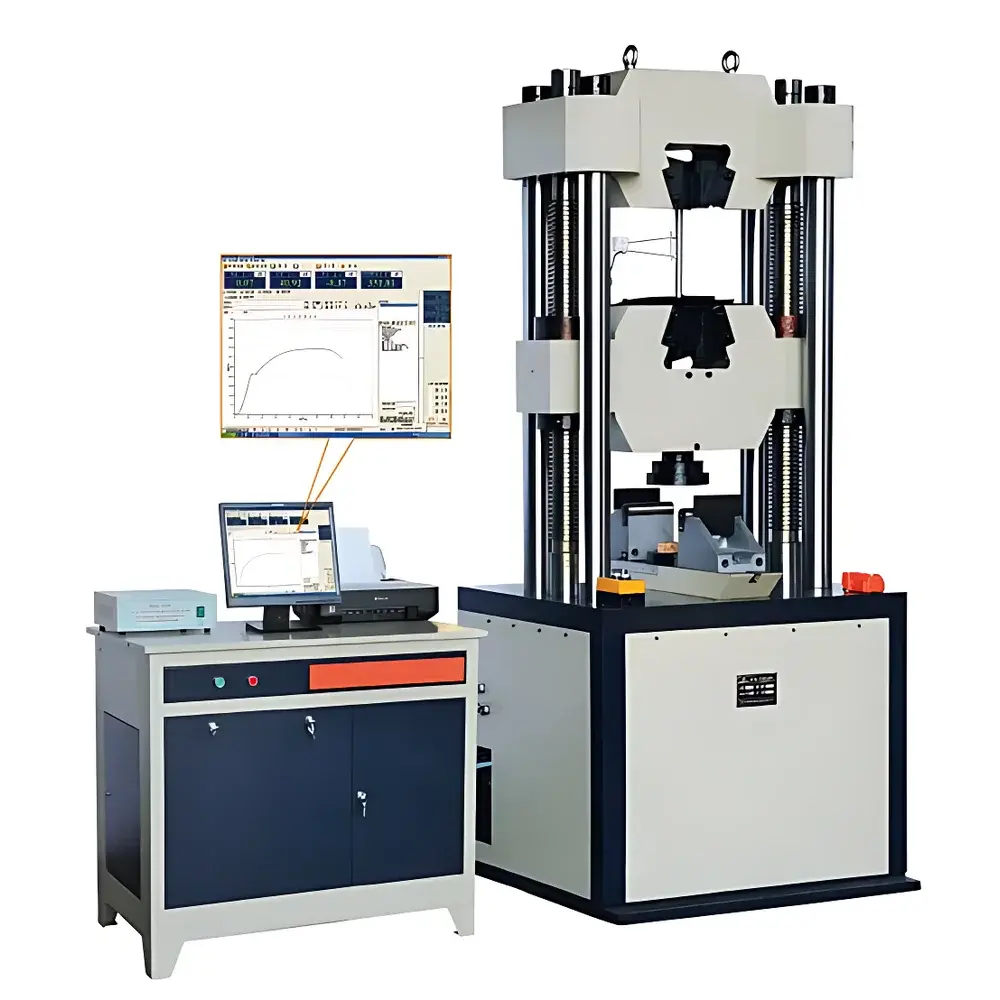
JB/WAW-1000D Jiubin Electro-Hydraulic Servo Universal Testing Machine
| Brand | Jiubin Instruments |
|---|---|
| Origin | Shanghai, China |
| Model | JB/WAW-1000D |
| Maximum Test Load | 1000 kN |
| Force Measurement Range | 50–1000 kN |
| Force Accuracy | ≤ ±1% of reading |
| Force Resolution | 0.01 kN |
| Displacement Resolution | 0.01 mm |
| Deformation Measurement Accuracy | 0.01 mm |
| Max Tensile Space | 750 mm |
| Max Compression Space | 380 mm |
| Piston Stroke | 150 mm |
| Round Specimen Grip Range | Φ13–Φ40 mm |
| Flat Specimen Thickness Capacity | 0–15 mm |
| Flat Specimen Max Width | 75 mm |
| Compression Plate Diameter | φ160 mm |
| Bend Support Span | 450 mm |
| Bend Roller Width | 140 mm |
| Bend Roller Diameter | Φ40 mm |
| Max Piston Speed | 50 mm/min |
| Clamping Method | Automatic Hydraulic Clamping |
| Host Dimensions (W×D×H) | 900×710×2200 mm |
| Control Cabinet Dimensions (W×D×H) | 1000×700×1400 mm |
| Compliance | GB/T 228.1–2021 (Metallic Materials — Tensile Testing) |
Overview
The JB/WAW-1000D Jiubin Electro-Hydraulic Servo Universal Testing Machine is a high-capacity, load-frame-based mechanical testing system engineered for precision static mechanical characterization of metallic and non-metallic materials under tension, compression, bending, and shear loading conditions. It operates on the principle of closed-loop electro-hydraulic servo control, where digital command signals from the controller modulate a high-bandwidth servo valve to regulate hydraulic flow into a bottom-mounted actuator cylinder—ensuring accurate force and displacement tracking across wide dynamic ranges. Designed for structural integrity validation and material property quantification in R&D, quality assurance, and certification laboratories, the system meets the functional and metrological requirements of GB/T 228.1–2021 (equivalent to ISO 6892-1:2019) for metallic tensile testing at ambient temperature, and supports method development aligned with ASTM E8/E8M, ASTM E9, ASTM E290, and ISO 15630 series standards.
Key Features
- Bottom-mounted hydraulic actuator architecture ensures stable load train alignment and minimizes frame deflection during high-load testing up to 1000 kN.
- Dual-range high-precision load cell (50–1000 kN) with ≤ ±1% indication error and 0.01 kN resolution enables traceable force measurement across low- and high-force regimes.
- Integrated automatic hydraulic clamping system provides consistent grip pressure and eliminates manual intervention during specimen loading.
- Modular software platform supports user-defined test procedures—including multi-step ramp-hold cycles, conditional branching, and real-time parameter override—without requiring code-level modification.
- Open Excel-based reporting engine allows full customization of output templates, column sequencing, unit formatting, and pass/fail threshold logic per test standard.
- Two-tier user permission model (Administrator and Tester) enforces role-based access control for method editing, calibration logging, and result export—supporting internal audit readiness.
- High-resolution optical encoder (0.01 mm displacement resolution) and clip-on extensometer (YYU-25/50, supplied) enable simultaneous measurement of macroscopic deformation and localized strain for modulus and yield determination.
Sample Compatibility & Compliance
The JB/WAW-1000D accommodates a broad spectrum of specimen geometries: round bars (Φ13–Φ40 mm), flat strips (up to 15 mm thick × 75 mm wide), compression cylinders (φ160 mm platen), and three-point bend configurations (450 mm support span, Φ40 mm rollers). Its mechanical design conforms to ISO 7500-1:2018 (static calibration of testing machines) and supports verification against national metrological standards. Software workflows are structured to align with GLP and GMP documentation practices, including electronic signature support, audit trail logging of all test modifications, and immutable result archiving—facilitating compliance with FDA 21 CFR Part 11 where electronic records are required. All default test methods reference GB/T 228.1–2021; users may import or author custom methods compliant with ASTM, ISO, or EN specifications.
Software & Data Management
The embedded Windows-based control software features a deterministic real-time kernel for synchronized acquisition of force, displacement, and strain at configurable sampling rates (up to 1 kHz). Raw data is stored in binary format with metadata embedding (operator ID, environmental conditions, calibration certificate IDs). Export options include CSV, XML, and native .JBT files compatible with third-party analysis tools (e.g., MATLAB, Python pandas). The system maintains a hierarchical database of test methods, material profiles, and calibration histories—all searchable by date, operator, or specimen batch. Audit logs record timestamped entries for every action affecting test execution or data integrity, including login/logout events, parameter changes, and report generation. Backup and restore functions support scheduled local or network-attached storage replication.
Applications
This system serves as a primary mechanical testing platform in metallurgical process development labs evaluating hot-rolled steel yield strength and uniform elongation; in aerospace component QA departments verifying titanium alloy compressive behavior per AMS 2300; in civil engineering material centers assessing high-strength concrete fracture toughness via wedge-splitting; and in university mechanics labs conducting comparative viscoelastic studies on polymer composites under controlled strain-rate protocols. Its robust architecture and open API facilitate integration into automated test cells with robotic specimen handlers and vision-based dimensional verification systems.
FAQ
What standards does the JB/WAW-1000D natively support?
It ships with preconfigured test methods for GB/T 228.1–2021, GB/T 7314–2017 (compression), and GB/T 232–2010 (bending). Users may extend compliance to ASTM E8, ISO 6892-1, or EN 10002-1 via custom method definition.
Is the system suitable for cyclic or fatigue testing?
No—the JB/WAW-1000D is designed exclusively for quasi-static loading. For dynamic or high-cycle fatigue applications, refer to Jiubin’s dedicated servo-hydraulic fatigue testing systems (e.g., PLG series).
Can third-party extensometers be integrated?
Yes—the system provides analog voltage input channels and TTL synchronization triggers compatible with LVDT, video, or laser extensometers meeting ASTM E83 Class B2 or ISO 9513 Class 1 requirements.
What maintenance intervals are recommended for the hydraulic power unit?
Oil filtration and level verification every 500 operational hours; full hydraulic oil replacement and servo valve inspection every 2,000 hours or biannually—whichever occurs first—per ISO 4406:2017 cleanliness class recommendations.
Does the software support multi-language UI or report localization?
The interface is English-only; however, all report templates, field labels, and units are fully editable via Excel, enabling localized terminology and regulatory unit conventions (e.g., MPa vs. ksi, mm vs. in) without software recompilation.



