
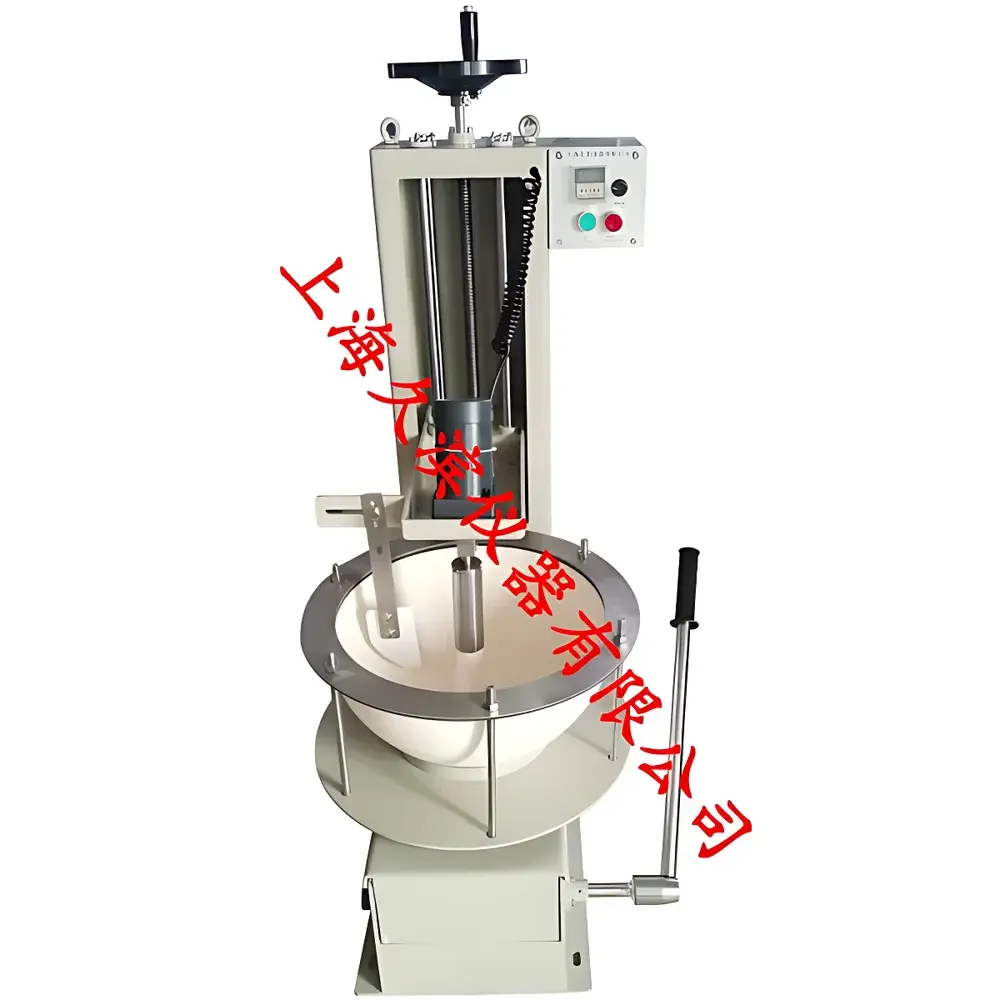
Jiubin JB-400 Electric Ceramic Mortar Grinder
| Brand | Jiubin |
|---|---|
| Model | JB-400 |
| Type | Mortar Grinder |
| Sample Compatibility | Hard & Brittle Solids |
| Maximum Batch Capacity | 5000 g |
| Output Particle Size | 0.01–0.5 mm (10–500 µm) |
| Mortar Bowl Diameter | 400 mm |
| Pestle Rotation Speed | 1–180 rpm (adjustable) |
| Mortar Rotation Speed | 10 rpm |
| Pestle Motor Power | 120 W |
| Mortar Motor Power | 60 W |
| Grinding Time Range | 1–999 min (programmable) |
| Bowl & Pestle Material | Alumina (99.5% Al₂O₃) |
| Dimensions (L×W×H) | 600 × 690 × 1110 mm |
| Net Weight | 18 kg |
| Voltage | 220 V, 50/60 Hz |
Overview
The Jiubin JB-400 Electric Ceramic Mortar Grinder is a precision-engineered laboratory grinding instrument designed for controlled, low-contamination size reduction of hard, brittle, and temperature-sensitive solid materials. It operates on the principle of mortar-and-pestle attrition—where rotational motion of both the alumina mortar bowl and the spring-loaded alumina pestle generates compressive shear forces across the entire grinding zone. Unlike high-energy ball mills or jet mills, this system avoids impact-driven fragmentation, minimizing amorphization, thermal degradation, and metallic contamination. Its geometry ensures uniform stress distribution and eliminates dead zones, enabling reproducible particle size distributions (PSD) with narrow span values. The JB-400 is particularly suited for applications requiring micron-level fineness (10–500 µm), with extended grinding durations capable of achieving sub-micron consistency under optimized conditions.
Key Features
- High-purity 99.5% alumina (Al₂O₃) mortar bowl and pestle—resistant to chemical corrosion, thermal shock, and mechanical wear; ideal for ultra-trace analysis and inert material processing.
- Dual independent motor control: pestle rotation (1–180 rpm, stepless adjustment) and fixed-speed mortar rotation (10 rpm) enable precise tuning of shear intensity and residence time.
- Spring-loaded pestle mechanism maintains constant normal force against the concave mortar base, ensuring consistent pressure regardless of sample volume or wear state.
- Programmable digital timer (1–999 minutes) with automatic shutdown and audible alert—supports unattended operation while maintaining process traceability.
- Low thermal generation design: combined low-power motors (120 W + 60 W) and efficient heat dissipation minimize sample temperature rise (<5 °C typical rise over 30 min), preserving thermolabile compounds.
- Compact footprint (600 × 690 × 1110 mm) and lightweight construction (18 kg) facilitate integration into ISO Class 5–7 cleanrooms or regulated QC laboratories.
Sample Compatibility & Compliance
The JB-400 accommodates coarse feed particles (typically ≤5 mm) and delivers consistent output in the 10–500 µm range, suitable for downstream analytical techniques including laser diffraction (ISO 13320), SEM imaging, XRD phase analysis, and BET surface area measurement. It complies with general laboratory safety standards (IEC 61010-1) and supports GLP/GMP workflows through repeatable parameter logging (time, speed, batch ID). While not intrinsically compliant with FDA 21 CFR Part 11, its programmable settings and manual logbook interface align with audit-ready documentation practices required for pharmaceutical excipient milling (USP , EP 2.9.12) and ceramic raw material homogenization (ASTM C778).
Software & Data Management
The JB-400 features a stand-alone microcontroller-based interface with LED display and tactile membrane keys—no external PC or proprietary software required. All operational parameters (grinding duration, pestle speed) are stored in non-volatile memory and can be recalled as user-defined presets. For laboratories implementing electronic lab notebooks (ELN) or LIMS integration, optional RS-232 serial output (available upon request) enables timestamped export of start/stop events and runtime data. Calibration records, maintenance logs, and SOP adherence documentation can be maintained per ISO/IEC 17025:2017 clause 7.7 requirements.
Applications
- Preparation of reference standards for X-ray fluorescence (XRF) and inductively coupled plasma (ICP-OES/MS) analysis—where elemental contamination from steel media must be avoided.
- Milling of dental ceramics, zirconia powders, and bioglass composites prior to sintering or rheological slurry formulation.
- Homogenization of pharmaceutical active ingredients (APIs) and excipients for dissolution testing (USP ) without polymorphic transition.
- Particle size conditioning of battery cathode precursors (e.g., LiCoO₂, NMC) to improve electrode coating uniformity.
- Processing of food-grade mineral additives (e.g., calcium carbonate, talc) where metal leaching and organoleptic integrity are critical.
- Research-scale grinding of geological samples (quartz, feldspar, basalt) for geochemical fingerprinting and isotopic analysis.
FAQ
What types of materials are compatible with the JB-400?
Hard, brittle, and non-fibrous solids—including oxides, carbides, nitrides, minerals, pharmaceuticals, and ceramics. Avoid ductile metals, elastomers, or hygroscopic salts unless pre-dried.
Can the JB-400 achieve nanoscale particle sizes?
While primarily designed for micrometer-range output (10–500 µm), extended grinding cycles (>600 min) under inert atmosphere and cryogenic assistance may yield sub-500 nm fractions—however, quantification requires post-grinding laser diffraction or TEM validation.
Is the alumina bowl replaceable, and what is its expected service life?
Yes—the 400 mm diameter bowl is a field-replaceable component. Under standard use (≤5 batches/day, abrasive-free samples), service life exceeds 2,000 operating hours; wear inspection is recommended every 500 hours via profilometry or visual groove assessment.
Does the JB-400 support regulatory audit trails for GMP environments?
It provides manual parameter logging capability. For full 21 CFR Part 11 compliance, third-party data acquisition systems with electronic signatures and audit trail modules must be integrated externally.
What maintenance procedures are recommended?
Monthly inspection of pestle spring tension and bowl/pestle surface integrity; quarterly lubrication of motor shaft bearings using food-grade silicone grease; annual calibration of timer accuracy against NIST-traceable stopwatch.



