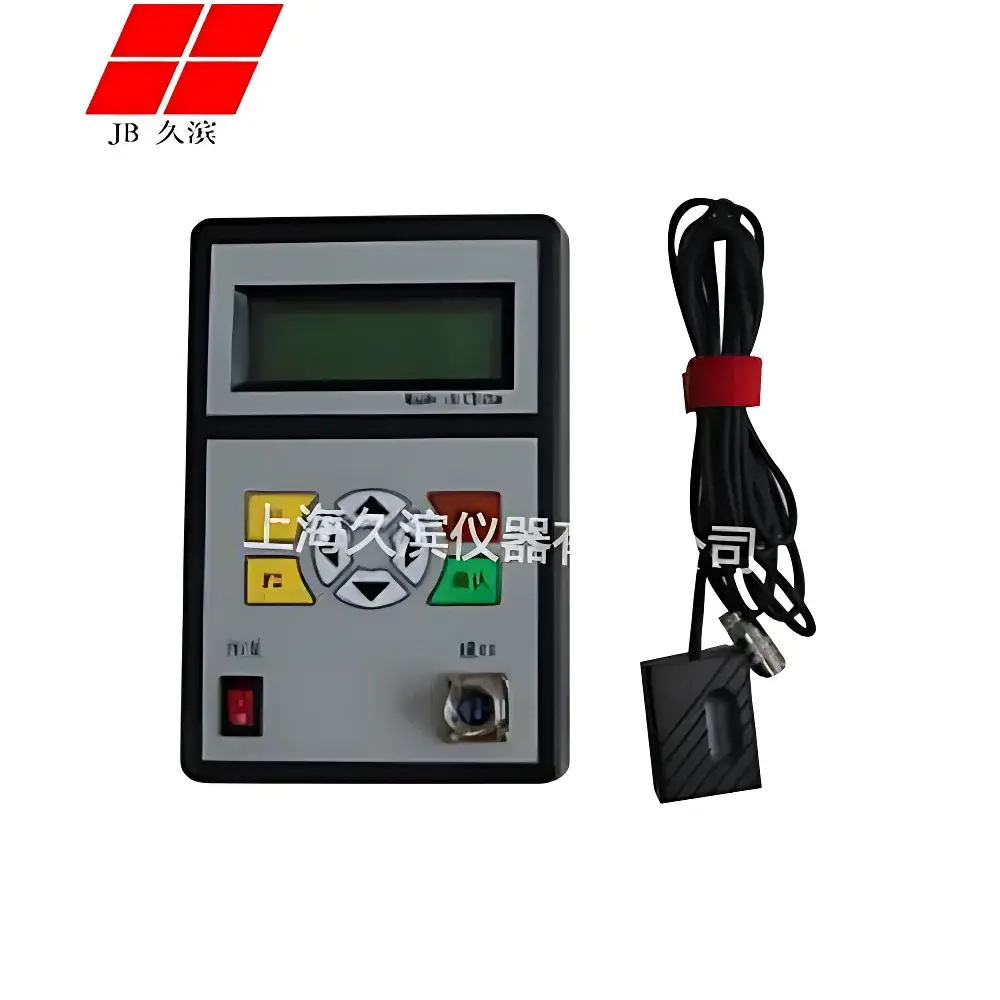
JB-130A Vibration-Based Engine Tachometer
| Brand | Jiubin Instruments |
|---|---|
| Origin | Shanghai, China |
| Manufacturer Type | Authorized Distributor |
| Country of Origin | China |
| Model | JB-130A |
| Pricing | Upon Request |
| Power Supply | 8.4 V Ni-Cd Rechargeable Battery |
| Measurement Range | 0–9999 rpm |
| Resolution | 1 rpm |
| Accuracy | ±3% of reading |
| Interface | Standard 9-pin RS232 (TXD on pin 3, RXD on pin 2, GND on pin 5) |
| Operating Environment | Ambient temperature 0–45 °C, relative humidity 30–90% RH, atmospheric pressure 86.0–106.0 kPa, low electromagnetic interference and mechanical shock required |
Overview
The JB-130A Vibration-Based Engine Tachometer is a portable, battery-powered rotational speed measurement instrument engineered for precision and reliability in demanding automotive test environments. Unlike optical or magnetic pickup tachometers, the JB-130A employs contact-based vibration sensing coupled with Fast Fourier Transform (FFT) digital signal processing to extract fundamental rotational frequency from engine block vibrations. This non-intrusive method eliminates the need for reflective tape, proximity sensors, or direct shaft coupling—making it especially suitable for rapid, on-vehicle diagnostics during emission testing, maintenance validation, and R&D bench trials. Designed for compatibility with both spark-ignition (SI) and compression-ignition (CI) engines—including gasoline, diesel, LPG, and dual-fuel variants—the device supports cylinder counts ranging from 4 to 12, enabling broad applicability across passenger vehicles, light-duty trucks, and small industrial power units.
Key Features
- Contact-mode vibration transduction using integrated piezoelectric sensor element, optimized for low-amplitude, high-frequency engine harmonics.
- Real-time FFT spectral analysis engine with automatic peak-hold detection of dominant rotational order, minimizing misreads under transient load conditions.
- Dot-matrix LCD display with native Chinese character support and bilingual prompt guidance—ensuring intuitive operation for technicians without advanced instrumentation training.
- Onboard 8.4 V Ni-Cd rechargeable battery providing up to 8 hours of continuous measurement at room temperature, with status indicator and low-battery warning.
- RS232 serial interface compliant with EIA/TIA-232-F standards, supporting bidirectional communication for integration into automated test systems, including those used in I/M (Inspection & Maintenance) facilities and OEM validation labs.
- Ruggedized ABS housing rated IP54 for dust resistance and limited water splashing protection, suitable for workshop and roadside use.
Sample Compatibility & Compliance
The JB-130A is validated for use on internal combustion engines with rigid mounting structures that transmit measurable torsional and reciprocating vibration signatures—particularly effective on inline and V-type configurations where crankshaft harmonics propagate reliably through engine mounts and cylinder blocks. It is not intended for electric motor speed monitoring or gearmotor applications lacking characteristic combustion-induced vibration spectra. While not certified to ISO 16750 (road vehicle environmental conditions) or SAE J1113 (EMC), its operational envelope complies with typical workshop ambient requirements per ISO 13373-1 (condition monitoring — vibration monitoring). The device supports traceable calibration via external reference tachometer inputs and meets basic functional safety expectations for handheld diagnostic tools under IEC 61010-1 (measurement category CAT II, pollution degree 2).
Software & Data Management
The JB-130A operates as a standalone instrument but enables data export via its RS232 port for post-processing in third-party software environments such as MATLAB, LabVIEW, or custom Python-based logging utilities. Communication protocol follows ASCII text framing with timestamped RPM values and status flags (e.g., “OK”, “LOW SIG”, “OVER RANGE”). No proprietary driver or cloud platform is required; configuration parameters—including baud rate and output format—are fixed per hardware design to ensure deterministic behavior in regulated testing workflows. Audit trails are maintained externally by host systems, and when deployed within GLP/GMP-aligned laboratories, the unit may be included in equipment qualification protocols (IQ/OQ) as a secondary speed verification tool alongside primary calibrated dynamometers.
Applications
- Regulatory emissions testing: Dual-idle speed verification per EPA 40 CFR Part 86 and China GB 18285–2018 for gasoline vehicles.
- Smoke opacity correlation: Synchronization of engine speed with filter smoke number (FSN) acquisition during loaded acceleration tests (e.g., ISO 8178-4).
- Pre-test diagnostics: Rapid validation of idle stability, governor response, and throttle actuator function prior to full-cycle dynamometer runs.
- Aftermarket service: On-site troubleshooting of erratic idle, hunting, or unexpected RPM dropouts in repair bays without disassembly.
- Academic research: Low-cost rotational baseline acquisition for combustion phasing studies, knock detection algorithms, and NVH (noise, vibration, harshness) correlation experiments.
FAQ
Does the JB-130A require physical attachment to the engine?
Yes—it uses a spring-loaded contact probe to couple vibration energy directly from the engine block or cylinder head surface. Optimal placement is near the front timing cover or rear flywheel housing.
Can it measure speed during cranking or starter engagement?
No. The FFT algorithm requires stable combustion-induced harmonic content; cranking speeds fall outside its validated operating range and lack the periodic signature needed for reliable extraction.
Is the RS232 interface compatible with modern USB-equipped PCs?
Yes, when used with an industry-standard USB-to-RS232 adapter (FTDI or CP2102 chipset recommended), provided COM port settings match the device’s fixed 9600/8-N-1 configuration.
What calibration documentation is supplied?
Each unit ships with a factory verification report listing sensitivity, linearity deviation, and temperature drift coefficients measured against NIST-traceable reference tachometers. Field recalibration is not user-serviceable.
How does ambient temperature affect measurement accuracy?
Within the specified 0–45 °C range, thermal drift is compensated via onboard thermistor feedback; accuracy degrades beyond ±3% only if ambient exceeds 45 °C or falls below 0 °C for extended periods.