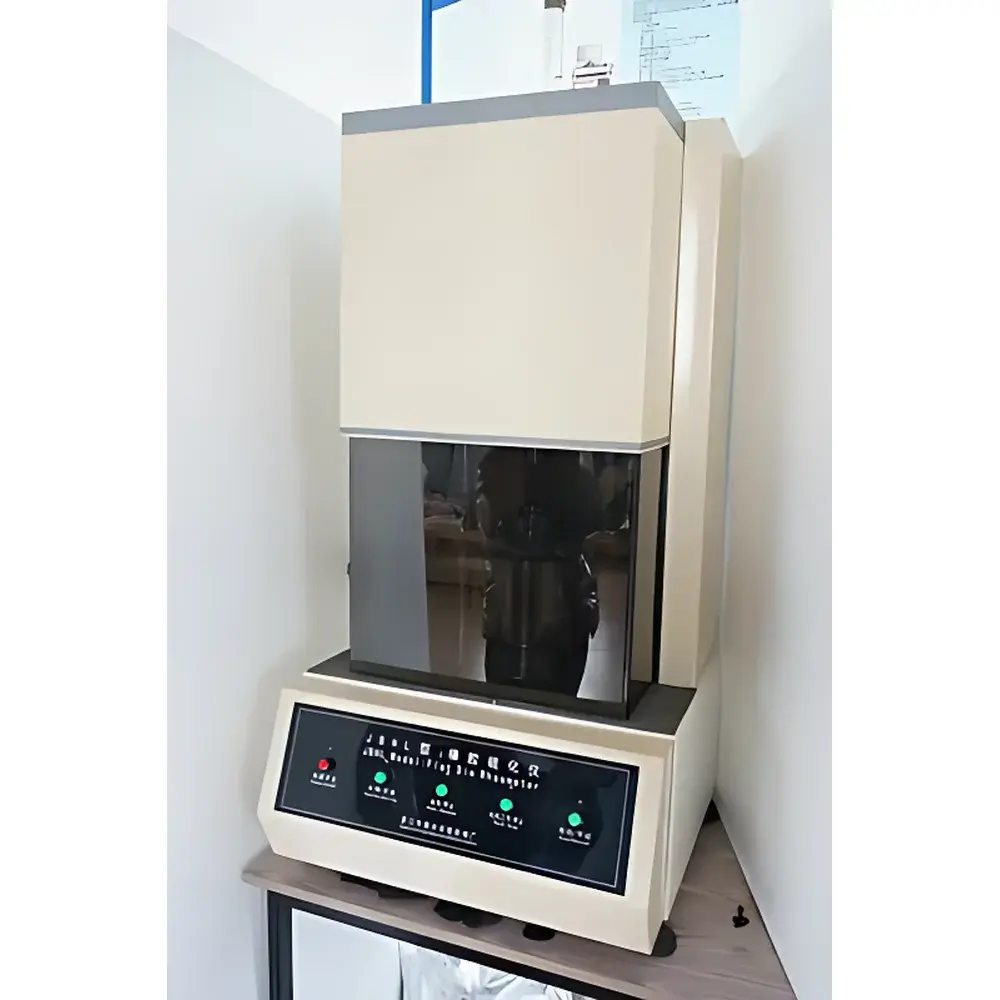
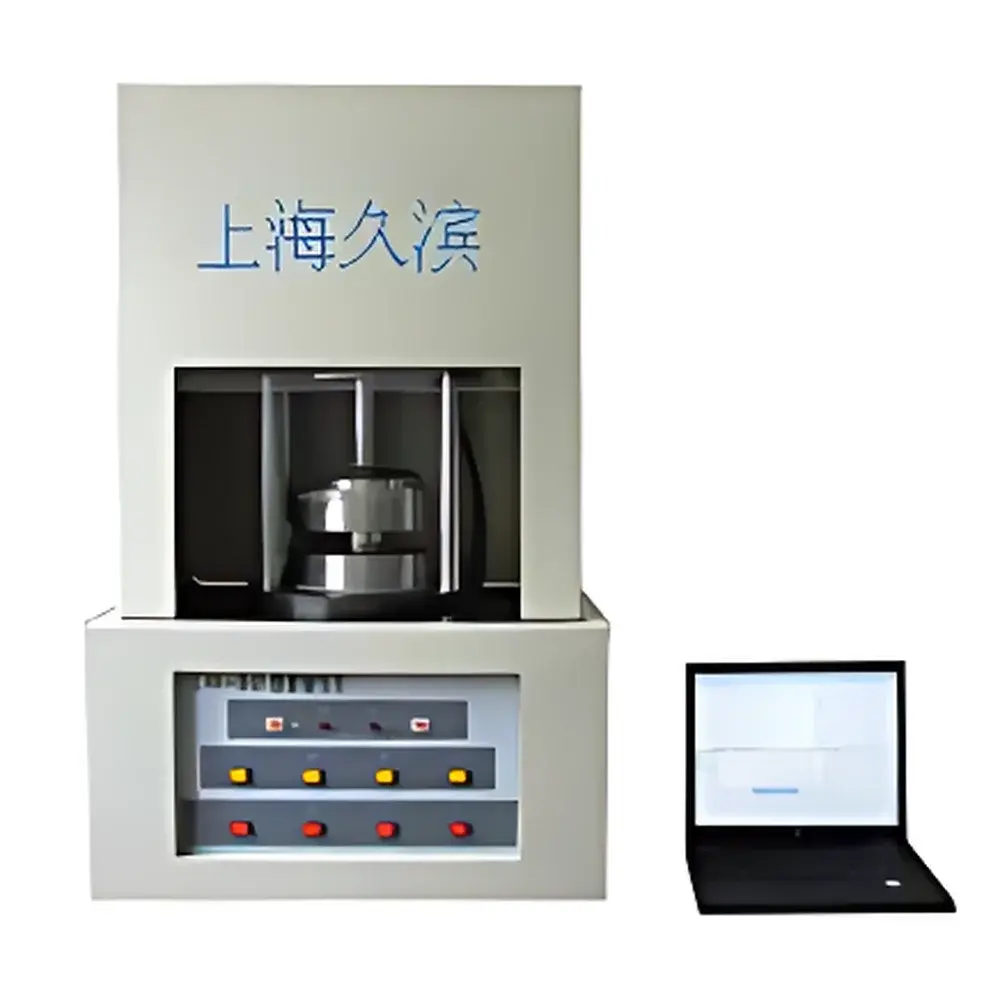
Jiubin JB-2000E Advanced Oscillating-Disk Curemeter (Rotorless Vulcanizer)
| Brand | Jiubin |
|---|---|
| Model | JB-2000E |
| Origin | Shanghai, China |
| Temperature Range | Ambient to 200 °C |
| Temperature Accuracy | ±0.15 °C |
| Torque Resolution | 1/500,000 |
| Torque Accuracy | ±0.3% |
| Sampling Rate | 200 Hz |
| Oscillation Frequency | 1.67 Hz (100 cycles/min) |
| Oscillation Amplitude | ±1° ±0.03° (standard), optional ±0.5° or ±3° |
| Heat-up Time | <2 min 40 s (ambient → 170 °C, ±0.3 °C) |
| Temperature Recovery After Closure | ≤30 ±3 s |
| Pressure Requirement | ≥4.5 kg/cm² (65 psi) |
| Dimensions (L×W×H) | 65 × 59 × 148 cm |
| Net Weight | 250 kg |
Overview
The Jiubin JB-2000E Advanced Oscillating-Disk Curemeter is a precision-engineered rotorless vulcanizer designed for quantitative characterization of rubber compound cure kinetics under controlled thermal and dynamic shear conditions. It operates on the principle of oscillatory shear rheometry in a sealed cavity: a rubber specimen is compressed between two precisely aligned mold halves, with the lower die executing a small-amplitude angular oscillation (±1° standard) at a fixed frequency (1.67 Hz). This induces a time-varying shear strain, and the resulting torque response—measured via a high-fidelity load cell—is directly related to the evolving storage modulus (G′) of the material during vulcanization. The instrument records real-time torque versus time data, generating the characteristic cure curve used to determine critical process parameters including scorch time (ts1, ts2), optimal cure time (t10, t50, t90), minimum and maximum torque (ML, MH), and cure rate indices (Vc1, Vc2). Its design conforms rigorously to ISO 6502, ASTM D5289, and GB/T 16584 standards, ensuring metrological traceability and inter-laboratory comparability.
Key Features
- Alpha-equivalent sealed cavity architecture with dual-material elastomeric sealing system, eliminating leakage pathways and ensuring exceptional torque repeatability (CV <0.5% across replicate runs).
- High-stability temperature control system featuring Omron PID controllers and real-time thermal compensation, delivering ±0.15 °C accuracy over the full 20–200 °C operating range.
- Ultra-high-resolution torque transduction using a U.S.-sourced load cell with 0.001 N·m sensitivity and 0.3% full-scale accuracy, calibrated traceably to NIST standards.
- Dynamic thermal recovery performance: cavity temperature re-stabilizes within ≤30 ±3 seconds after mold closure, critical for minimizing thermal lag artifacts in early-cure detection.
- Modular oscillation drive with non-servo motor actuation, engineered for long-term mechanical stability and minimal harmonic distortion at 1.67 Hz.
- Integrated pressure monitoring via high-accuracy piezoresistive sensor (±0.3% FS), enabling concurrent assessment of vulcanization-induced volumetric changes.
- 19-inch industrial-grade LCD workstation with dedicated acquisition software supporting USB 2.0 interface, multi-language UI (English, Simplified/Traditional Chinese), and audit-ready data export.
Sample Compatibility & Compliance
The JB-2000E accommodates standard 38 mm diameter × 11.4 mm thick rubber specimens per ISO 6502 and ASTM D5289. Its sealed cavity design ensures compatibility with sulfur-cured natural rubber (NR), styrene-butadiene rubber (SBR), ethylene propylene diene monomer (EPDM), nitrile rubber (NBR), and silicone elastomers—including formulations containing fillers, plasticizers, accelerators, and blowing agents. The instrument meets essential regulatory requirements for quality-controlled environments: its software supports user-level access control, electronic signature capability, and full audit trail generation compliant with FDA 21 CFR Part 11 principles. All hardware components—including NSK precision bearings, Delixi pneumatic actuators, and military-grade circuitry—adhere to IEC 61000-4 electromagnetic compatibility standards and operate safely within Class II cleanroom ambient specifications (≤85% RH, 24 ±3 °C).
Software & Data Management
The embedded acquisition platform provides synchronized real-time visualization of torque, temperature, and pressure curves with configurable time-base scaling and overlay functionality. Raw datasets are stored in vendor-neutral CSV format with embedded metadata (operator ID, sample ID, test date/time, calibration stamp). Comparative analysis tools allow side-by-side overlay of up to eight cure curves with color-coded differentiation and statistical summary (mean, SD, CV%) for key parameters. Export modules support direct integration with LIMS systems via ODBC and generate PDF reports containing full traceability: calibration certificates, environmental logs, and raw waveform snapshots. Software validation documentation—including IQ/OQ protocols and version-controlled release notes—is available upon request for GLP/GMP-regulated laboratories.
Applications
This curemeter serves as a primary tool in rubber formulation development, incoming raw material verification, and in-process quality assurance. It enables precise optimization of accelerator packages and sulfur ratios; quantification of scorch safety margins for high-temperature processing; evaluation of reversion resistance in EPDM compounds; and correlation of rheological cure profiles with final physical properties (e.g., tensile strength, elongation at break, compression set). In R&D settings, it supports structure–property studies of novel bio-based elastomers and nanocomposite systems. Production labs deploy it for batch release testing against established torque-time acceptance criteria, reducing reliance on destructive post-cure mechanical testing.
FAQ
What standards does the JB-2000E comply with?
It fully satisfies ISO 6502:2017, ASTM D5289-17, GB/T 16584-1996, and UNI 6729 requirements for rotorless cure measurement.
Can the instrument measure compounds with high filler loading?
Yes—the sealed cavity design and high-torque sensor (up to 20 N·m) accommodate highly filled compounds, including carbon-black–reinforced NR and silica-filled TPSiV formulations.
Is remote monitoring supported?
Local network connectivity is enabled via Ethernet port; remote desktop access is permitted through secure IT-administered protocols, though cloud-based telemetry is not implemented.
How often does the system require recalibration?
Torque and temperature sensors are factory-calibrated with NIST-traceable references; annual recalibration is recommended, with interim verification using certified reference standards provided in the accessory kit.
Does the software support automated pass/fail decision logic?
Yes—users can define custom tolerance windows for t90, MH–ML, and scorch time; the system flags deviations in real time and logs them to the audit trail.