
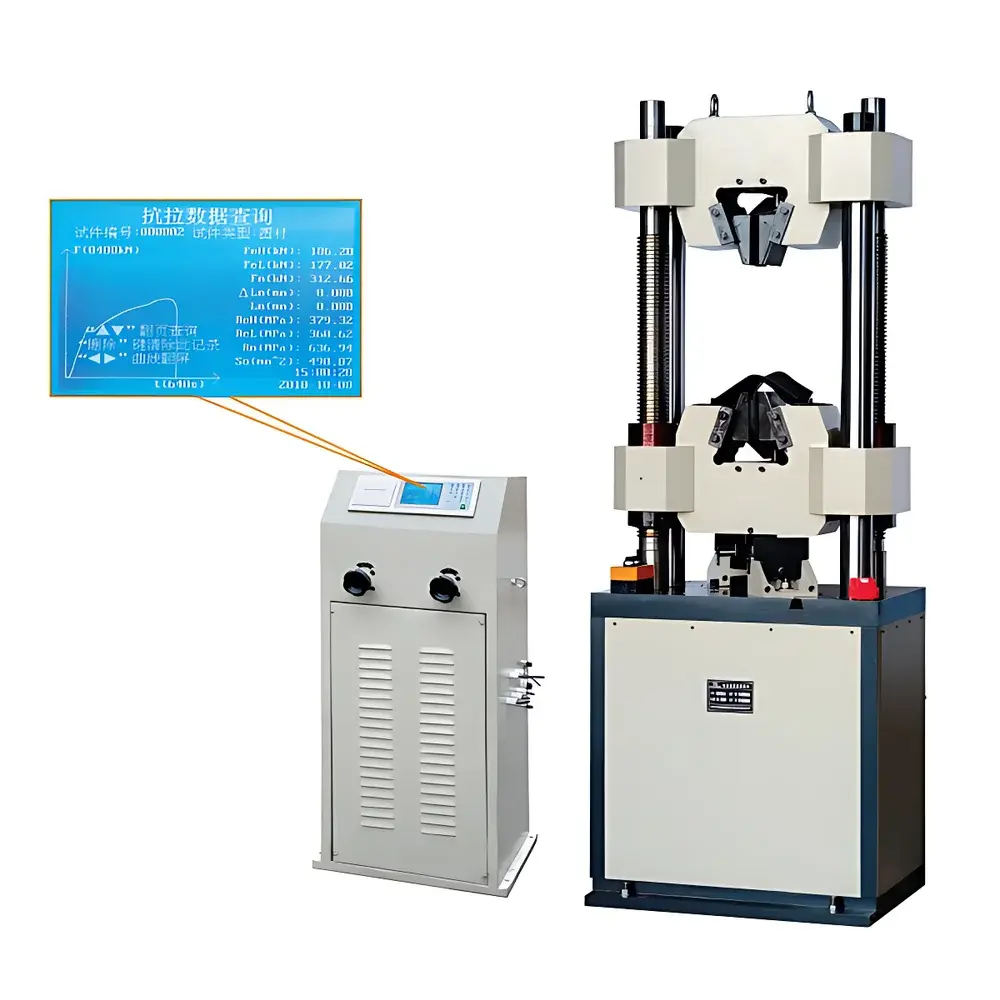
JB/WE-1000B Digital Hydraulic Universal Testing Machine
| Brand | Jiubin Instruments |
|---|---|
| Origin | Shanghai, China |
| Model | JB/WE-1000B |
| Type | Hydraulic Universal Testing Machine |
| Max. Test Force | 1000 kN |
| Force Range | 50–1000 kN |
| Force Accuracy | ≤ ±1% of reading |
| Force Resolution | 0.01 kN |
| Tensile Space | 700 mm |
| Compression Space | 380 mm |
| Piston Stroke | 150 mm |
| Round Specimen Clamping Diameter | Φ13–Φ40 mm |
| Flat Specimen Clamping Thickness | 0–15 mm |
| Flat Specimen Jaw Width | 75 mm |
| Compression Platen Diameter | φ160 mm |
| Bend Span (Two-Point) | 450 mm |
| Bend Roller Width | 140 mm |
| Bend Roller Diameter | Φ40 mm |
| Piston Speed | 50 mm/min |
| Clamping Method | Hydraulic |
| Host Dimensions (W×D×H) | 890×660×2200 mm |
| Control Cabinet Dimensions (W×D×H) | 1000×700×1400 mm |
Overview
The JB/WE-1000B Digital Hydraulic Universal Testing Machine is an oil-cylinder-underneath configured mechanical testing system engineered for high-load static mechanical property evaluation of metallic and non-metallic materials. It operates on the principle of hydraulic force generation and electronic load measurement, delivering controlled uniaxial loading in tension, compression, bending, and—when equipped with optional shear fixtures—shear modes. Designed for field-deployable use in construction supervision, prefabricated component quality assurance, and civil engineering laboratories, its low-profile structural layout (2200 mm total height) and compact footprint facilitate installation in constrained environments such as on-site QA/QC trailers or small-scale municipal testing facilities. The machine complies with fundamental mechanical testing methodology standards including ASTM E4 (Standard Practices for Force Verification of Testing Machines), ASTM E8/E8M (Tension Testing of Metallic Materials), ASTM C39 (Compressive Strength of Cylindrical Concrete Specimens), and ISO 6892-1 (Metallic Materials — Tensile Testing — Part 1: Method of Test at Room Temperature).
Key Features
- Hydraulic actuation with dual-range load sensing: full-scale capacity of 1000 kN, with operational range from 50 kN to 1000 kN to ensure high signal-to-noise ratio across low- and high-force regimes.
- Digital force transducer (calibrated宁波Zhenhai sensor) integrated into the load train, offering a resolution of 0.01 kN and traceable accuracy ≤ ±1% of reading per ASTM E4 verification protocols.
- Oil-cylinder-underneath architecture minimizes overall equipment height (2200 mm) and center-of-gravity elevation, enhancing stability during high-force compression tests and simplifying specimen handling in field conditions.
- Hydraulic clamping system provides uniform gripping pressure across round (Φ13–Φ40 mm) and flat (0–15 mm thick × 75 mm wide) specimens, reducing slippage risk and improving repeatability in tensile yield and ultimate strength determinations.
- Integrated LCD control interface displays real-time force–time curves, peak load, yield point detection (for materials exhibiting distinct yield plateaus), and user-input parameters including specimen ID and cross-sectional area.
- Onboard micro-printer enables immediate hardcopy output of test reports compliant with internal QA documentation requirements; data export via RS232 interface supports integration into LIMS or custom reporting platforms.
Sample Compatibility & Compliance
The JB/WE-1000B accommodates standardized and non-standard specimens across multiple material classes. Metallic specimens conforming to ASTM E8/E8M (round bars, flat plates) and ISO 6892-1 are routinely tested for Rm, ReL, A5, and A10. Non-metallic applications include concrete cylinders (ASTM C39), cement mortar prisms (ASTM C109), polymer tapes and chains (ASTM D882, D638), welded wire fabric (ASTM A185), and structural timber components (ASTM D143). Optional shear fixtures enable evaluation per ASTM D5379 (V-Notch Shear Test), while bending attachments support ASTM D790 (flexural properties of plastics) and ASTM C78 (flexure of concrete). All mechanical configurations meet GLP-aligned documentation practices, with audit-ready calibration records traceable to CNAS-accredited reference laboratories.
Software & Data Management
The system employs embedded firmware—not PC-dependent software—enabling standalone operation without external computing hardware. Test parameters (specimen ID, dimensions, test mode) are entered via numeric keypad; results are stored internally with timestamp and operator ID fields. Data retention supports ≥500 test records. Calibration coefficients and verification logs are password-protected and modifiable only by authorized personnel using service-level access codes. While native data export is limited to printed reports and RS232 ASCII dumps, third-party SCADA or LabVIEW drivers may be deployed for automated data ingestion into enterprise quality systems. The firmware architecture satisfies basic FDA 21 CFR Part 11 readiness criteria for electronic record integrity, including immutable timestamps and operator identification—though full Part 11 compliance requires supplementary procedural controls (e.g., documented change management, backup validation).
Applications
- Mechanical verification of reinforcing steel (rebar) batches per ASTM A615/A615M prior to concrete placement.
- Compressive strength validation of precast concrete elements (beams, columns, panels) under site QA protocols.
- Tensile qualification of structural welds and base metals in bridge fabrication and offshore platform construction.
- Flexural performance assessment of roofing tiles, masonry units, and fiber-reinforced cement boards per EN 1304, ASTM C158.
- Quality surveillance of industrial fasteners, anchor bolts, and lifting chains used in heavy equipment assembly.
- Educational use in civil and materials engineering labs for hands-on demonstration of stress–strain behavior, modulus determination, and failure mode analysis.
FAQ
What standards does the JB/WE-1000B comply with for force verification?
It meets ASTM E4 Class 1 requirements for force verification, with annual calibration traceable to national metrology institutes.
Can the machine perform cyclic or fatigue testing?
No—it is designed exclusively for static monotonic loading. Fatigue evaluation requires servo-hydraulic systems with closed-loop displacement/strain control.
Is the hydraulic oil system maintenance-intensive?
The system uses ISO VG 46 anti-wear hydraulic oil; routine filtration and annual fluid replacement are recommended per OEM guidelines to maintain piston seal longevity and pressure stability.
How is yield strength determined for non-ferrous alloys lacking a clear yield plateau?
The system supports offset method calculation (0.2% offset) via manual post-test curve analysis; automatic offset detection is not implemented in the embedded firmware.
Does the machine support ASTM E23 Charpy impact testing?
No—impact testing requires separate pendulum-type impact testers (e.g., ASTM E23-compliant machines); this unit performs only quasi-static loading modes.



