
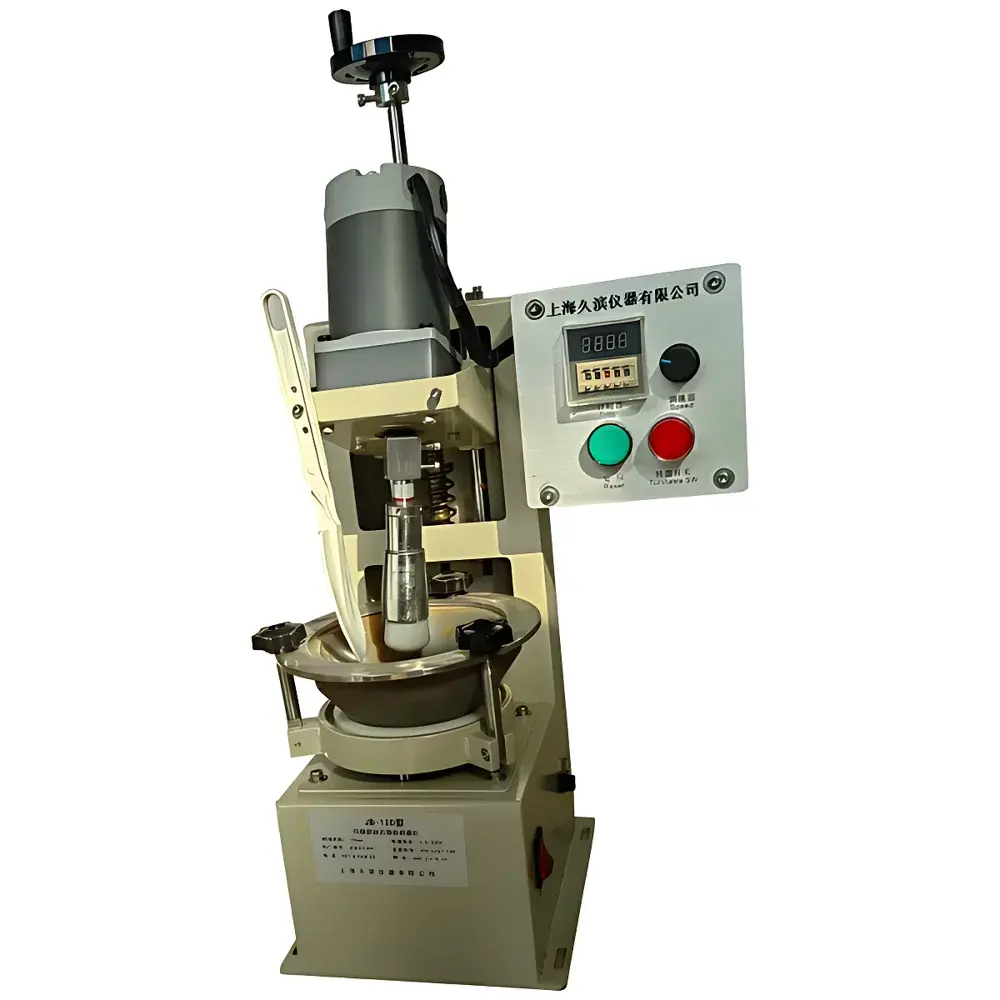
Jiubin JB-160 Agate Mortar-Type Ultrafine Grinder
| Brand | Jiubin |
|---|---|
| Origin | Shanghai, China |
| Model | JB-160 |
| Grinding Chamber Diameter | 160 mm |
| Grinding Chamber Depth | 50 mm |
| Batch Capacity | 300 g |
| Feed Particle Size | < 15 mm |
| Final Particle Size | down to micrometer (µm) range, sub-micron achievable |
| Pestle Rotation Speed | 1–150 rpm (adjustable) |
| Mortar Rotation Speed | 10 rpm |
| Pestle Motor Power | 60 W |
| Mortar Motor Power | 40 W |
| Grinding Time Range | 1–999 min (programmable) |
| Dimensions (L×W×H) | 500 × 500 × 920 mm |
| Weight | 40 kg |
| Voltage | 220 V, 50/60 Hz |
| Grinding Media Material | Natural Agate |
| Compliance | Designed for GLP-compliant laboratories |
Overview
The Jiubin JB-160 Agate Mortar-Type Ultrafine Grinder is a precision-engineered laboratory grinding instrument designed for controlled, reproducible size reduction of hard and brittle solid samples. It operates on the principle of orthogonal rotational shear—where a high-purity agate mortar rotates slowly (10 rpm) while an agate pestle rotates rapidly (1–150 rpm) along a conical trajectory, maintaining constant contact pressure via an integrated compression spring mechanism. This dual-motion geometry generates uniform compressive and shearing forces across the entire sample bed, enabling efficient comminution without localized overheating or mechanical degradation. Unlike planetary ball mills or vibratory grinders, the JB-160 eliminates impact-induced amorphization and cross-contamination risks by confining all material within a sealed, chemically inert agate chamber. Its design targets applications requiring trace-level purity, phase integrity preservation, and narrow particle size distribution—particularly in semiconductor feedstock preparation, pharmaceutical micronization, and reference material certification.
Key Features
- Monolithic natural agate grinding components (mortar and pestle), rated Mohs 7 hardness, non-porous, acid-resistant, and metal-ion-free—ensuring zero contamination in ultra-trace analysis.
- Independent dual-motor drive system: low-speed mortar rotation (10 rpm) synchronized with variable-speed pestle rotation (1–150 rpm), enabling precise control over shear rate and residence time.
- Spring-loaded pestle assembly maintains consistent normal force against the mortar base, guaranteeing uniform stress distribution regardless of sample volume or density variation.
- Programmable digital controller with 1–999 minute timer, real-time status display, and automatic shutdown—fully compliant with GLP documentation requirements for audit trails.
- Compact footprint (500 × 500 × 920 mm) and self-contained operation—no external cooling, vacuum, or anchoring required; operates on standard 220 V AC power.
- No-loss sample containment: 100% of input material remains within the mortar throughout grinding and post-processing handling, critical for high-value or regulated substances (e.g., APIs, nuclear standards).
Sample Compatibility & Compliance
The JB-160 accepts dry, free-flowing, or moderately cohesive solids with initial particle size ≤15 mm. It is validated for materials ranging from ultra-hard abrasives (e.g., synthetic diamond, silicon carbide) to temperature-sensitive organics (e.g., lactose, caffeine, epoxy resins). Due to its non-metallic construction and absence of grinding media, it meets ASTM D7263-21 criteria for contaminant-free sample preparation prior to XRD, SEM-EDS, or ICP-MS analysis. The device supports ISO/IEC 17025-accredited labs in fulfilling clause 7.2.2 (sample integrity) and aligns with USP particulate matter testing protocols where representative sub-sampling of micronized batches is required. All electrical components conform to IEC 61010-1 safety standards for laboratory equipment.
Software & Data Management
The JB-160 utilizes an embedded microcontroller-based interface with non-volatile memory storage for up to 20 user-defined grinding protocols. Each run logs timestamp, set parameters (speed, duration), and motor current draw—exportable via USB to CSV for integration into LIMS or ELN platforms. While no proprietary software suite is provided, the device outputs structured metadata compatible with FDA 21 CFR Part 11-compliant systems when paired with validated third-party data acquisition modules. Audit trail functionality includes operator ID entry (via optional RFID badge reader), change history, and electronic signature support for SOP-driven environments.
Applications
- Preparation of certified reference materials (CRMs) for particle size distribution validation—especially where agglomeration or electrostatic charging must be avoided.
- Micronization of active pharmaceutical ingredients (APIs) for dissolution enhancement studies under GMP Annex 15 guidelines.
- Homogenization of electronic-grade powders (e.g., GaAs, SiC, LiCoO₂) prior to sintering or thin-film deposition process qualification.
- Reduction of geological specimens (e.g., quartz, feldspar) for geochemical analysis without introducing Fe/Ni contamination from steel media.
- Production of food-grade micro-powders (e.g., matcha, cocoa, spices) meeting EU Regulation (EC) No 1333/2008 labeling thresholds for nanomaterial declaration.
FAQ
Is the JB-160 suitable for wet grinding?
No—the device is engineered exclusively for dry grinding. Introduction of solvents or slurries may compromise agate surface integrity and void the warranty.
Can it achieve true nanoscale particles (≤100 nm)?
While sub-micron output (<1 µm) is routinely achieved, consistent nanoparticle generation requires multi-stage processing (e.g., sequential grinding + ultrasonic dispersion) and is highly dependent on material brittleness and fracture mechanics.
How often does the agate mortar require replacement?
Under typical lab usage (≤5 batches/day), agate components exhibit service life exceeding 5 years with no measurable wear—verified by profilometry per ISO 4287 after 2,000 operational hours.
Does the unit comply with CE or UL certification?
It carries CCC (China Compulsory Certification) and meets EMC immunity requirements per GB/T 18268.26; CE marking is available upon request for EU-market configurations with updated power supply modules.
What maintenance procedures are recommended?
Daily wipe-down with ethanol; quarterly inspection of spring preload torque (0.8 ± 0.1 N·m) and pestle concentricity using dial indicator (runout tolerance: ≤0.05 mm). No lubrication required.



