
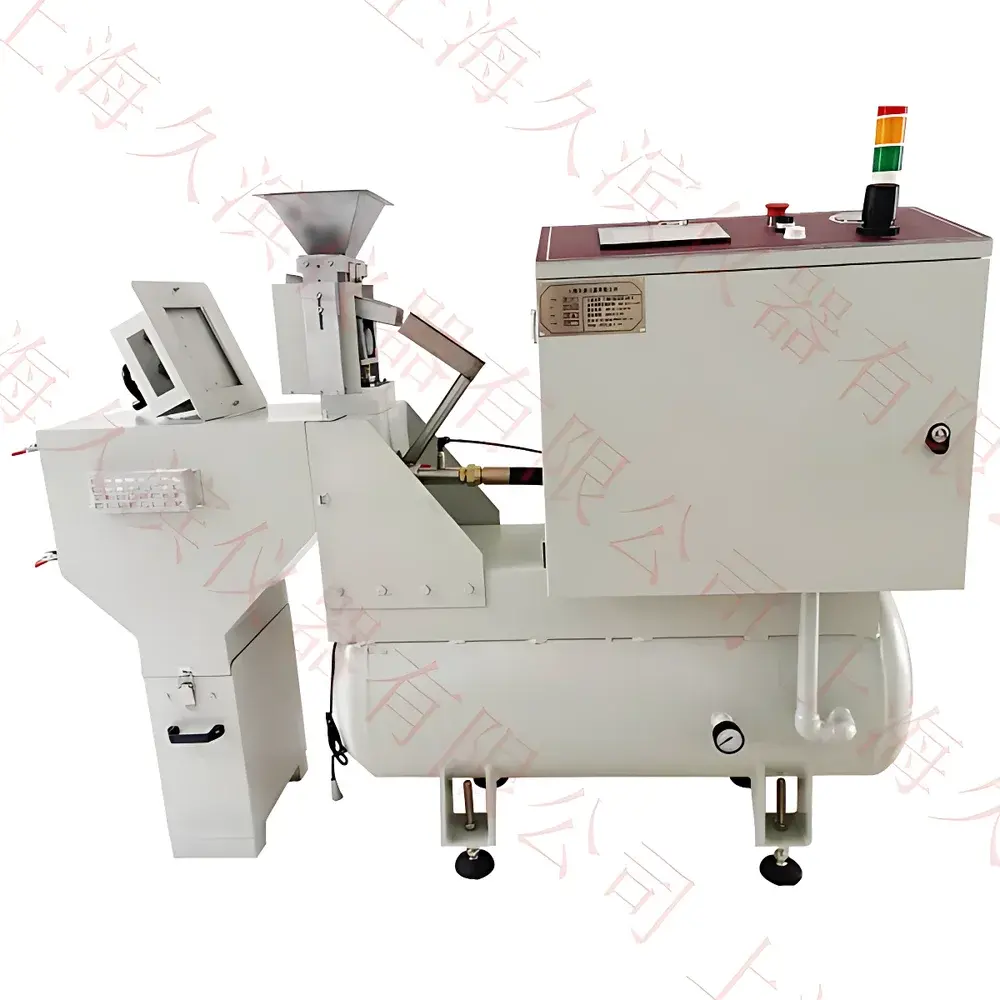
Jiubin JB-JM5 Gravel Impact Resistance Tester
| Brand | Jiubin |
|---|---|
| Origin | Shanghai, China |
| Manufacturer Type | Authorized Distributor |
| Country of Origin | China |
| Model | JB-JM5 |
| Price Range | USD 9,800 – 16,800 |
| Operating Pressure Range | 0–0.8 MPa (adjustable) |
| Test Temperature | Ambient (optional low-/high-temperature chamber available) |
| Air Hose Internal Diameter | 20 mm / 15 mm |
| Air Reservoir Volume | 136 L |
| Nozzle Tube Internal Diameter | 30 mm / 53 mm |
| Specimen Orientation | 45°, 54°, or 90° for flat samples |
| Sound Pressure Level | ≤120 dB(A) (hearing protection required) |
| Duty Cycle | Continuous operation capable |
| Impact Media | Gravel, crushed stone, calibrated abrasive particles |
| Feed Rate Control | Electromagnetic vibratory feeder |
| Airflow Pressure Regulation | Manual needle valve |
| Required External Compressor | ≥2 m³/min at 0–0.8 MPa |
Overview
The Jiubin JB-JM5 Gravel Impact Resistance Tester is an engineered laboratory system designed to simulate and quantify the mechanical degradation of automotive and industrial surface coatings, substrates, and composite laminates under high-velocity gravel impact conditions. Based on the standardized principle of pneumatic particle acceleration—where compressed air propels calibrated aggregate through a precision nozzle—the instrument replicates real-world road-debris strike events encountered during vehicle operation. This enables objective evaluation of coating adhesion, interlayer cohesion, substrate brittleness, and edge chipping resistance in accordance with internationally recognized durability protocols. The tester supports both flat-panel and complex-geometry specimens via configurable angular orientation (45°, 54°, or 90°) and optional 3D test enclosures, making it suitable for R&D validation, supplier qualification, and production-line quality assurance across OEM and Tier-1 supply chains.
Key Features
- Adjustable impact pressure range (0–0.8 MPa) ensures reproducible energy delivery across diverse material classes—from soft elastomeric coatings to hardened polymer composites.
- Dual-nozzle configuration (30 mm and 53 mm internal diameter) permits optimization of particle velocity distribution and impact density for thin-film versus bulk-material testing.
- 136-liter air reservoir stabilizes pressure pulsation during continuous operation, minimizing variability between successive impact cycles.
- Electromagnetically driven vibratory feeder delivers precise, repeatable gravel feed rates—critical for statistical robustness in ASTM D3170/D3170M-compliant testing sequences.
- Modular angular fixture system accommodates standard flat specimens at industry-specified angles (45° per SAE J400, 54° per ISO 20567-1), while the optional 3D test chamber enables evaluation of curved body panels, wheel hubs, and non-planar components.
- Integrated acoustic enclosure reduces ambient noise emission; operator safety compliance requires hearing protection per OSHA 29 CFR 1910.95 when operating at maximum pressure settings.
Sample Compatibility & Compliance
The JB-JM5 accommodates specimens up to 300 × 300 mm (flat) or fully enclosed within the 3D chamber (max. Ø400 mm × H500 mm). Compatible substrates include steel, aluminum, magnesium alloys, thermoplastic and thermoset composites, tempered glass, and multi-layer coated systems (e.g., e-coat + primer + basecoat + clearcoat). Test methodology aligns with key international standards including SAE J400 (Chips Resistance of Painted Automotive Surfaces), ISO 20567-1 (Paints and Varnishes — Evaluation of Stone-Chip Resistance), and ASTM D3170/D3170M (Standard Test Method for Chip Resistance of Coatings). When integrated with documented calibration records and operator training logs, the system supports GLP-compliant reporting and audit readiness for IATF 16949 and ISO/IEC 17025 environments.
Software & Data Management
While the JB-JM5 operates as a hardware-controlled benchtop system, its pneumatic and feed subsystems are designed for seamless integration with third-party data acquisition platforms (e.g., National Instruments DAQmx, LabVIEW, or custom SCADA interfaces). All manual controls—including pressure regulation, feed rate adjustment, and cycle timing—are labeled with SI-unit markings and calibrated reference points to ensure traceability. Optional digital upgrade kits provide RS-485 Modbus RTU output for remote parameter logging, cycle counting, and pass/fail threshold monitoring. Audit trails, user access control, and electronic signature capability can be implemented via externally hosted LIMS or QMS platforms compliant with FDA 21 CFR Part 11 requirements.
Applications
- Quantitative assessment of chip resistance in automotive wheel hub coatings under simulated highway debris impact.
- Evaluation of intercoat adhesion loss in multi-layer paint systems following accelerated gravel exposure.
- Determination of critical brittle thickness in tempered glass or polycarbonate glazing used in exterior lighting assemblies.
- Validation of anti-chip tape performance on underbody components subjected to gravel-laden airflow.
- Comparative testing of UV-stabilized polyurethane versus acrylic topcoats for off-road vehicle applications.
- Correlation studies between lab-scale gravel impact damage and field-service failure modes in Tier-1 component qualification.
FAQ
What compressed air specifications are mandatory for stable JB-JM5 operation?
A minimum supply of 2 m³/min at 0.8 MPa is required. Air must be oil-free, dried to ≤−40°C dew point, and filtered to ≤1 µm to prevent nozzle clogging and regulator drift.
Can the JB-JM5 be used for non-automotive applications such as wind turbine blade coatings?
Yes—its adjustable impact energy, wide specimen geometry support, and compatibility with alternative media (e.g., silica sand, basalt chips) make it applicable to aerospace, renewable energy, and heavy equipment coating validation.
Is calibration certification included with the instrument?
Factory calibration certificates for pressure transducers and feed-rate verification are provided. On-site recalibration services and ISO/IEC 17025-accredited calibration documentation are available upon request.
How is specimen damage quantified post-test?
The system does not include automated image analysis; however, it is fully compatible with external digital microscopy, ISO 4628-2 chipping rating scales, and ASTM D714 blister grading protocols for standardized damage classification.




