
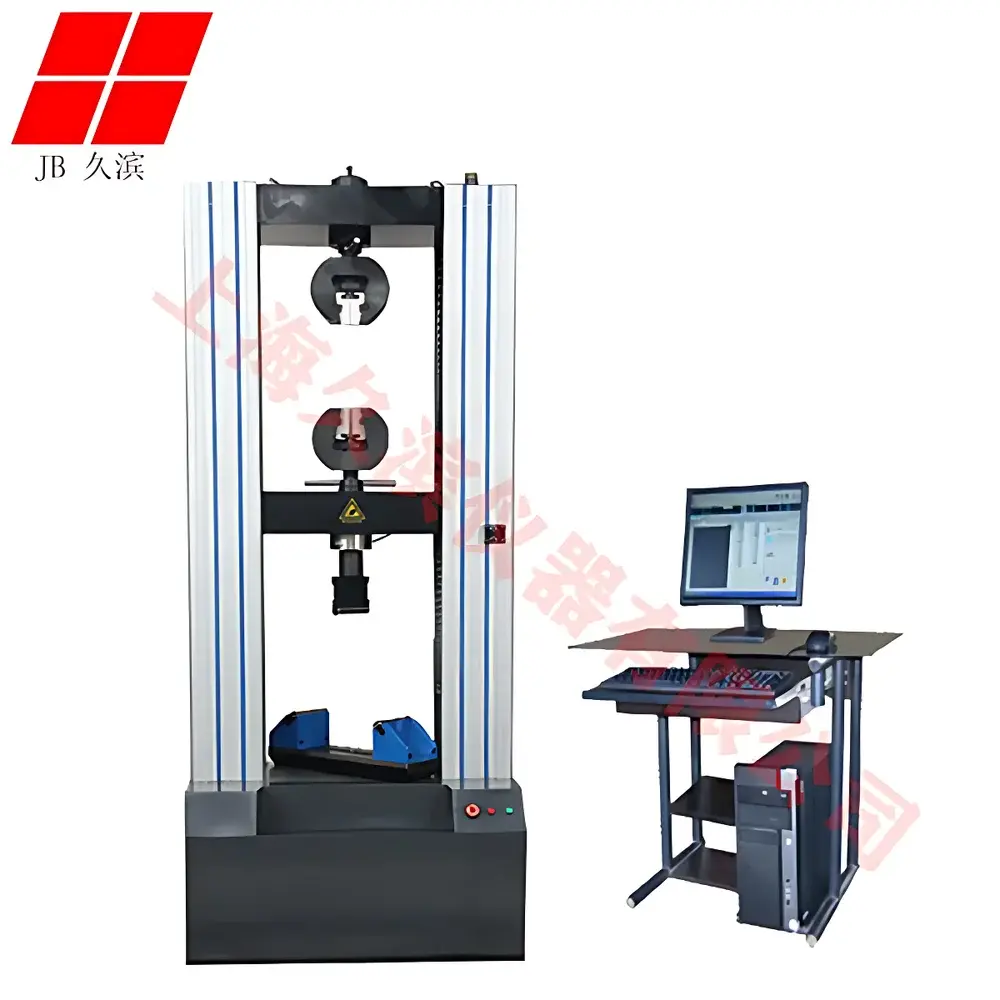
Jiubin JB-119A Electronic Universal Testing Machine
| Brand | Jiubin |
|---|---|
| Model | JB-119A |
| Type | Electromechanical Universal Testing Machine |
| Max Test Load | 300 kN |
| Accuracy Class | 0.5 |
| Force Measurement Range | 0.4–100% FS |
| Force Accuracy | ±0.5% of indicated value |
| Crosshead Speed Range | 0.01–200 mm/min |
| Effective Tensile Space | 650 mm (customizable) |
| Test Zone Width | 480 mm |
| Overload Protection | Auto-stop at 5–10% over full scale (configurable) |
| Software | Windows-based MaxTest v7.2 (bilingual: EN/CN) |
| Dimensions (L×W×H) | 670 × 455 × 1750 mm |
| Power Supply | 380 V / 50 Hz |
| Weight | 1500 kg |
Overview
The Jiubin JB-119A Electronic Universal Testing Machine is a high-stiffness, dual-column electromechanical system engineered for static mechanical property evaluation of metallic materials and structural components in accordance with ISO 6892-1, ASTM E8/E21, and GB/T 228.1 standards. It operates on the principle of controlled displacement actuation via a precision ball-screw-driven crosshead, coupled with closed-loop load and position feedback using strain-gauge-based load cells and optical encoder-based displacement sensing. Designed for laboratory and quality control environments, the JB-119A delivers repeatable force application across tension, compression, bending, and shear configurations — supporting both routine compliance testing and advanced material characterization workflows.
Key Features
- High-rigidity dual-column frame constructed from reinforced cast iron and hardened steel guideways, minimizing deflection under 300 kN maximum load
- 0.5-class force measurement accuracy per ISO 7500-1, validated across 0.4–100% of full scale (FS), ensuring traceability to national metrological standards
- Programmable crosshead speed from 0.01 mm/min (creep/relaxation testing) to 200 mm/min (high-speed rupture assessment), with speed stability ≤±0.2% of setpoint
- Integrated overload protection circuitry that halts motion upon detection of 5–10% over full-scale load — configurable via software interface to align with safety protocols
- Modular grip system compatible with wedge-action, hydraulic, and pneumatic fixtures (not included), enabling rapid transition between specimen geometries (rods, plates, weldments)
- Thermally stable load cell housing and low-drift signal conditioning electronics for long-duration tests under ambient lab conditions (20 ± 5°C, RH < 80%)
Sample Compatibility & Compliance
The JB-119A accommodates metallic specimens up to 480 mm wide and 650 mm in effective gauge length — suitable for standard tensile bars (e.g., ASTM E8 round/flat coupons), notched impact blanks, and machined weld test coupons. Its mechanical architecture conforms to ISO 5893 for testing machine classification and meets structural requirements outlined in ISO 7500-1 for calibration verification. All hardware and firmware are designed to support GLP-compliant documentation: test logs include timestamped operator ID, environmental metadata (optional external sensor input), and digital signatures. While the base configuration does not include FDA 21 CFR Part 11-compliant audit trails, optional software modules enable electronic record integrity, user access control, and change history logging for regulated manufacturing QA/QC applications.
Software & Data Management
MaxTest v7.2 is a Windows-native, multi-language (English/Chinese) control and analysis platform. It supports real-time acquisition of force, displacement, and extensometer data at up to 100 Hz sampling rate. The software provides automated test sequencing (predefined or user-scripted), live stress-strain curve rendering, modulus calculation (tangent/secant/Chord), yield point determination (0.2% offset, ISO proof strength), and ultimate tensile strength reporting. Raw data exports to CSV, Excel, and XML formats; test reports comply with ISO 14289-1 (PDF/A-1a) archival standards. Calibration certificates and instrument verification records can be embedded directly into report headers, facilitating internal audits and third-party accreditation reviews.
Applications
- Tensile property validation of carbon steels, stainless alloys, aluminum extrusions, and titanium forgings per ASTM E8 and GB/T 228.1
- Compression testing of cast iron, sintered metals, and high-strength bolt assemblies
- Bending modulus and fracture toughness estimation of welded joints and clad metal plates
- Proof load verification for fasteners, springs, and structural brackets in automotive and aerospace Tier-1 supplier labs
- Material qualification for ASME Section II, EN 10027, and MIL-STD-1553B component certification programs
- Periodic verification of production line mechanical testers via reference specimen interlaboratory comparison
FAQ
Is the JB-119A compliant with ISO 17025 calibration requirements?
Yes — when paired with an accredited external calibration service and documented uncertainty budgets, the system satisfies Clause 6.5 of ISO/IEC 17025:2017 for equipment verification.
Can the machine be integrated with an existing LIMS or MES platform?
MaxTest supports OPC UA and TCP/IP socket communication protocols; custom API wrappers are available for enterprise-level data ingestion.
What extensometer options are supported?
Standard compatibility includes clip-on axial extensometers (10–50 mm gauge length) and non-contact video extensometry systems (via optional USB camera module).
Does the system include factory calibration documentation?
Each unit ships with a NIST-traceable load cell calibration certificate, mechanical alignment report, and software version verification log.
Is remote diagnostics or firmware update capability available?
Firmware updates are delivered via encrypted USB media; remote desktop-assisted troubleshooting is supported under signed maintenance agreements.



