
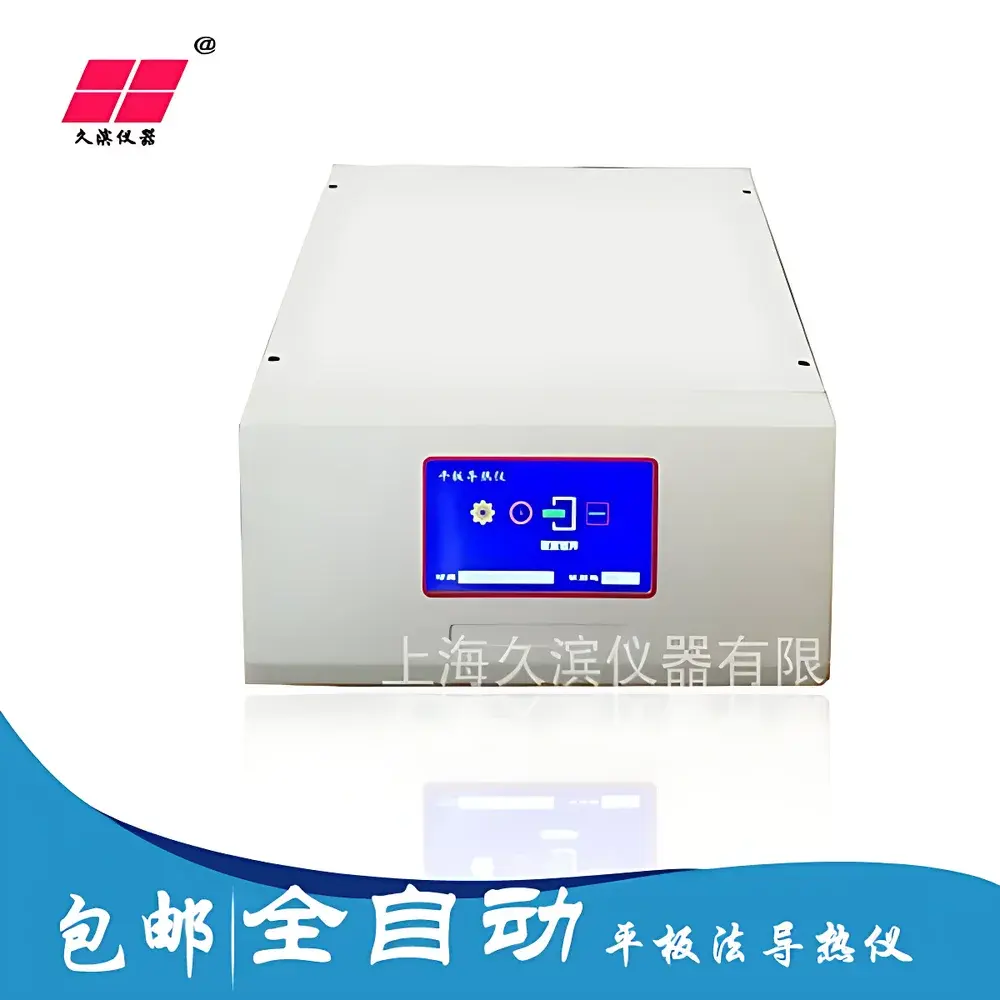
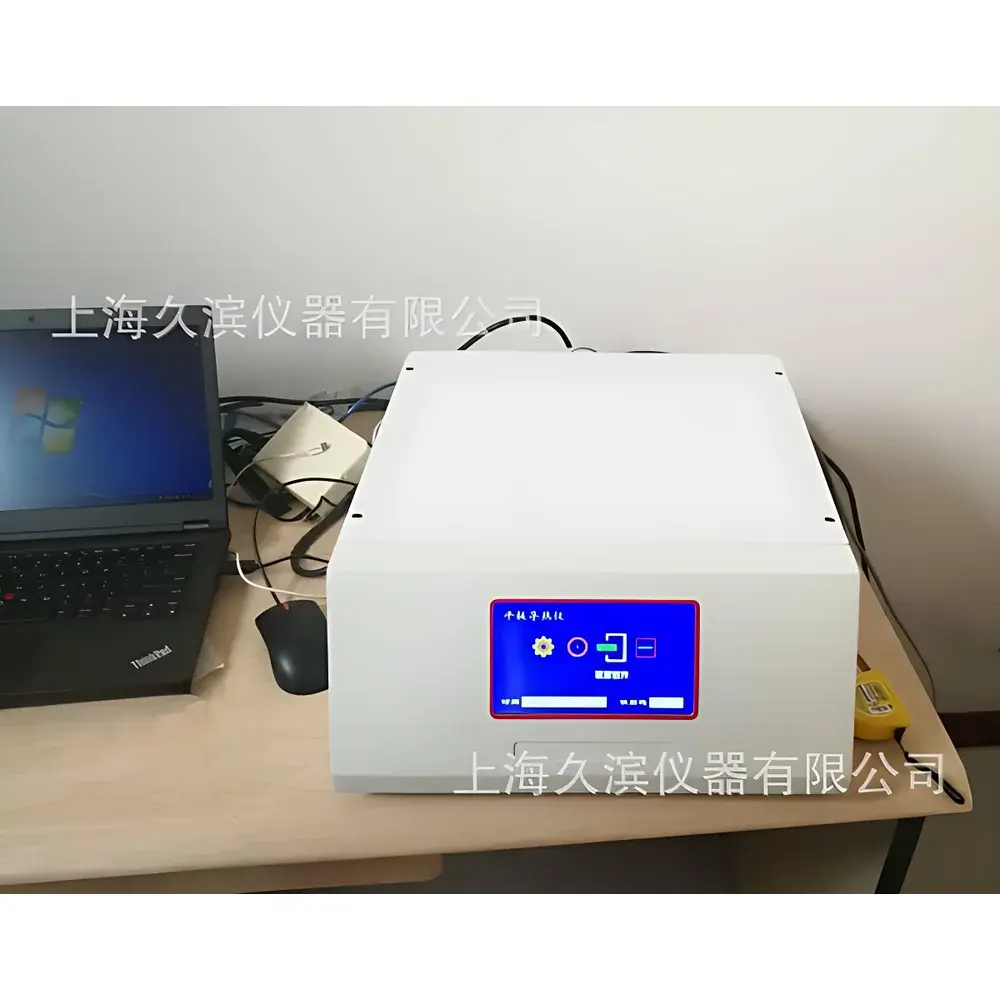
JB-P Automated Guarded Hot Plate Thermal Conductivity Analyzer by Jiubin Instruments
| Brand | Jiubin Instruments |
|---|---|
| Model | JB-P |
| Measurement Principle | Guarded Hot Plate Method (ASTM C177, ISO 8302) |
| Thermal Conductivity Range | 0.010–5.000 W/(m·K) |
| Accuracy | ±3% |
| Repeatability | ±3% |
| Dimensions (L×W×H) | 552 × 550 × 760 mm |
| Origin | Shanghai, China |
| Instrument Type | Guarded Hot Plate Thermal Conductivity Analyzer |
Overview
The JB-P Automated Guarded Hot Plate Thermal Conductivity Analyzer is a precision instrument engineered for steady-state thermal conductivity measurement of low-to-moderate conductivity solid materials—particularly rigid and semi-rigid foams, insulation boards, elastomers, and composite panels. It operates on the guarded hot plate principle (defined in ASTM C177 and ISO 8302), where a centrally heated test specimen is sandwiched between a guarded hot plate and a cooled cold plate under controlled temperature gradients. The guard ring surrounding the primary heater eliminates lateral heat loss, ensuring one-dimensional vertical heat flow through the sample. This configuration delivers high reproducibility and traceable results essential for quality control, R&D validation, and regulatory compliance in building materials, aerospace composites, and packaging development laboratories.
Key Features
- Automated temperature control system with dual PID-regulated hot and cold plates, enabling stable ΔT maintenance from 5 K to 40 K across standard test configurations.
- Integrated guard ring with independent thermal regulation ensures >98% axial heat flux uniformity, meeting ASTM C177 requirement for guard efficiency.
- High-resolution platinum resistance thermometers (Pt100) embedded in both plates and specimen surfaces provide direct, contact-based temperature monitoring with ±0.05 °C resolution.
- Motorized sample positioning stage and programmable clamping force (0–20 kPa adjustable) minimize interfacial contact resistance variability between measurements.
- Rugged steel frame with thermal isolation mounts reduces environmental drift; chamber enclosure minimizes convective interference during extended tests.
- Self-diagnostic firmware checks heater calibration, sensor integrity, and thermal equilibrium status prior to data acquisition.
Sample Compatibility & Compliance
The JB-P accommodates standard square or circular specimens measuring 300 × 300 mm or Ø300 mm, with thicknesses ranging from 10 mm to 100 mm. It supports homogeneous, isotropic, and low-anisotropy materials including polyurethane (PU), polystyrene (EPS/XPS), phenolic foams, mineral wool, cork composites, and laminated insulating panels. All measurement protocols align with internationally recognized standards: ASTM C177 (standard test method for steady-state heat flux measurements), ISO 8302 (thermal insulation—determination of steady-state thermal resistance), and GB/T 10294 (Chinese national standard equivalent). The system architecture supports GLP-compliant operation, including user-access-level permissions, audit-trail-enabled test logs, and timestamped raw data export.
Software & Data Management
The JB-P is operated via dedicated Windows-based software featuring intuitive workflow navigation, real-time thermal gradient visualization, and automated equilibrium detection based on slope-threshold algorithms (dΔT/dt < 0.001 K/min over 10 min). Test reports include calculated thermal conductivity (λ), thermal resistance (R-value), uncertainty estimation per GUM (Guide to the Expression of Uncertainty in Measurement), and comparative trend charts across batch runs. Data exports support CSV, PDF, and XML formats compliant with LIMS integration. Software adheres to principles aligned with FDA 21 CFR Part 11 for electronic records—supporting digital signatures, operator authentication, and immutable audit trails for all critical actions including calibration updates and result approvals.
Applications
- Quality assurance of commercial and industrial insulation products against EN 13165, ASTM C578, and ISO 10456 specifications.
- Thermal performance benchmarking of next-generation bio-based foams and aerogel-reinforced composites in academic and industrial R&D labs.
- Validation of thermal models used in building energy simulation tools (e.g., EnergyPlus, TRNSYS) requiring experimentally derived λ-values at multiple mean temperatures.
- Supplier qualification testing for automotive under-hood insulation components where dimensional stability and low-λ consistency across temperature ranges (–20 °C to +70 °C) are critical.
- Supporting sustainability certification programs (e.g., LEED, BREEAM) by generating third-party-acceptable thermal property documentation.
FAQ
What standards does the JB-P comply with for thermal conductivity testing?
ASTM C177, ISO 8302, and GB/T 10294 are fully supported through hardware design, calibration methodology, and software reporting templates.
Can the JB-P measure anisotropic materials such as fiberboard or layered composites?
It is optimized for isotropic or weakly anisotropic solids; directional conductivity assessment requires complementary techniques (e.g., transient plane source or laser flash) and is outside the scope of guarded hot plate methodology.
Is calibration traceable to national metrology institutes?
Yes—factory calibration uses NIST-traceable reference materials (e.g., SRM 1450c Fibrous Glass Board), and users may perform periodic verification using certified reference samples supplied with full CoA.
What sample preparation requirements apply?
Specimens must be flat, parallel-faced, free of voids or delamination, and conditioned per ASTM E1530 or ISO 293 for hygroscopic materials prior to testing.
Does the system support multi-point temperature-controlled testing?
Yes—the software enables sequential tests at up to 5 user-defined mean temperatures (e.g., 10 °C, 23 °C, 40 °C, 60 °C, 75 °C) with automatic re-equilibration and report consolidation.



