
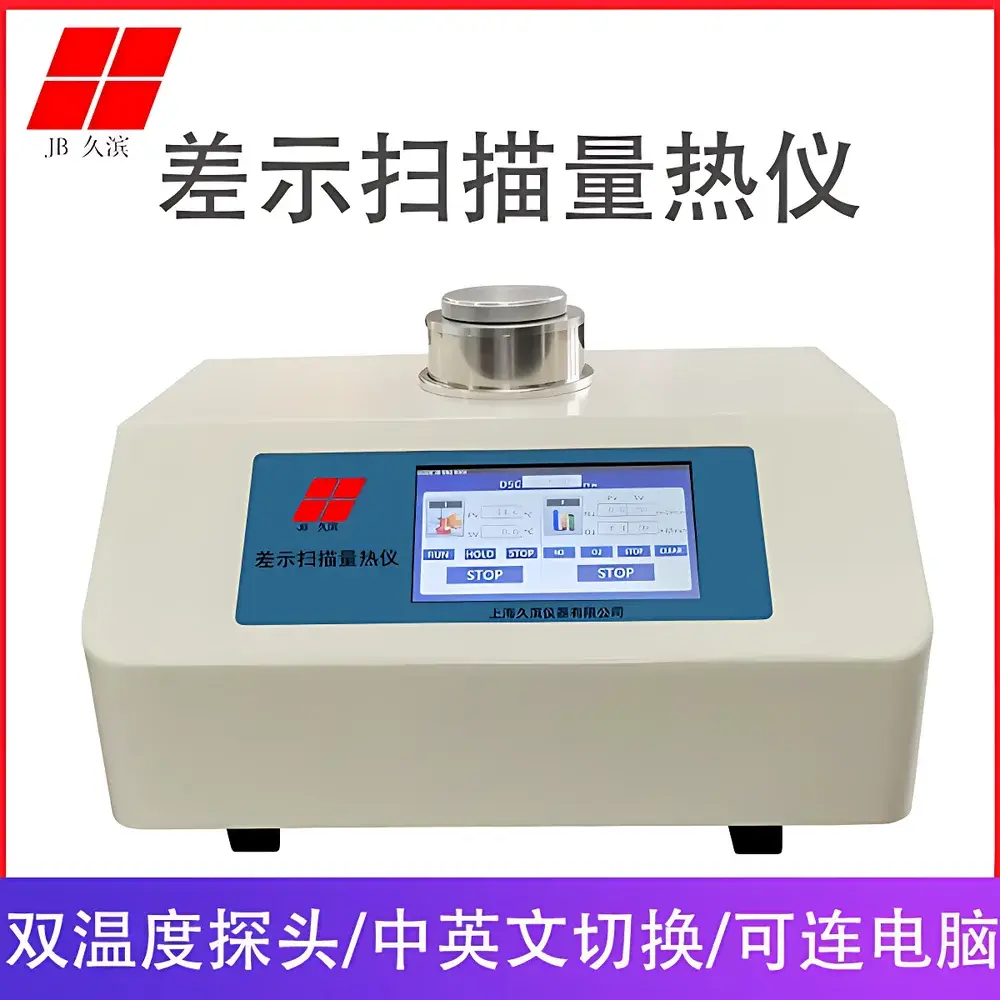
JB-DSC-500 Differential Scanning Calorimeter (DSC) by Jiubin Instruments
| Brand | Jiubin Instruments |
|---|---|
| Origin | Shanghai, China |
| Model | JB-DSC-500 |
| Temperature Range | Ambient to 500 °C |
| Temperature Accuracy | ±0.1 °C |
| Heating/Cooling Rate | 0.1–50 K/min |
| DSC Heat Flow Range | ±500 mW |
| DSC Noise Level | 0.01 μW |
| Thermal Resolution | 0.01 μW |
| Temperature Resolution | 0.1 °C |
| Repeatability (Temperature) | ±0.1 °C |
| Baseline Stability | <0.05 μW over 30 min |
| Gas Flow Control | Digital Mass Flow Controller |
| Interface | 7-inch 24-bit LCD Touchscreen + USB Data Export |
| Calibration Standard | Certified Tin Reference Material (Sn, mp = 231.928 °C) |
Overview
The JB-DSC-500 is a high-stability, microprocessor-controlled differential scanning calorimeter engineered for precise thermal transition analysis of pharmaceuticals, polymers, and advanced materials. Operating on the heat-flux DSC principle, it measures the difference in heat flow between a sample and an inert reference as both are subjected to identical, programmable temperature profiles under controlled atmosphere. This enables quantitative determination of endothermic and exothermic events—including glass transition temperature (Tg) of ethyl cellulose, melting point (Tm) of active pharmaceutical ingredients (APIs), cold crystallization, solid-solid phase transitions, oxidative induction time (OIT), and enthalpy of fusion or reaction. Designed for compliance with ISO 11357, ASTM E794, and USP , the JB-DSC-500 delivers traceable, reproducible data essential for formulation development, stability studies, and regulatory submissions in GMP environments.
Key Features
- Optimized furnace architecture with dual-sensor symmetry and low-thermal-mass alumina sensor plates, ensuring superior baseline flatness (<0.05 μW drift over 30 min) and enhanced signal-to-noise ratio.
- Digital mass flow controller (MFC) for precise, logged gas flow regulation (N2, air, or synthetic air); switching between purge and protective atmospheres is fully automated and synchronized with thermal programs.
- Independent dual-control operation: real-time adjustment via integrated 7-inch capacitive touchscreen interface or remote configuration and data acquisition via PC-based software with full audit trail capability.
- High-resolution thermal detection system with 0.01 μW sensitivity and 0.1 °C temperature resolution, validated using certified Sn reference material per ISO 17025-compliant calibration protocols.
- Programmable linear heating/cooling rates from 0.1 to 50 K/min, supporting both dynamic scans and isothermal holds—critical for kinetic modeling of polymer curing or degradation kinetics.
Sample Compatibility & Compliance
The JB-DSC-500 accommodates standard aluminum crucibles (hermetic or vented), gold-plated pans for high-temperature stability, and specialized high-pressure cells for volatile or reactive samples. It supports routine analysis of small-mass pharmaceutical solids (1–10 mg), amorphous dispersions, excipients (e.g., ethyl cellulose, HPMC, PVP), and lyophilized formulations. All thermal protocols comply with ICH Q5C (stability testing), Q1A(R2) (accelerated conditions), and FDA guidance on thermal characterization of drug substances. Data integrity meets ALCOA+ principles; instrument firmware supports electronic signatures and 21 CFR Part 11–compliant user access control when operated with validated software modules.
Software & Data Management
The proprietary DSC Analysis Suite provides full GLP/GMP-ready functionality: automatic peak identification (onset, peak, endset), baseline correction (tangent, step, or polynomial), enthalpy integration, Tg calculation via midpoint or inflection methods, and multi-curve overlay with statistical comparison. Raw data (.dsc binary format) and processed reports (.pdf/.xlsx) are exportable via USB 2.0. Audit trails record all parameter modifications, calibration events, and user logins with timestamps. Software validation documentation (IQ/OQ/PQ templates) and raw data archiving protocols are provided to support laboratory accreditation (ISO/IEC 17025) and regulatory inspections.
Applications
- Pharmaceutical R&D: Quantification of Tg for amorphous solid dispersions containing ethyl cellulose; detection of polymorphic transitions in APIs; assessment of excipient compatibility via binary mixture scans.
- Quality Control: Release testing of melting point and purity (van’t Hoff analysis) per USP ; verification of thermal history in lyophilized products.
- Material Science: Curing kinetics of epoxy resins; oxidative stability evaluation (OIT) of packaging polymers; cold crystallization behavior in semi-crystalline thermoplastics.
- Regulatory Support: Generation of thermal data packages for ANDA, NDA, and CMC sections; alignment with WHO TRS 1019 Annex 5 requirements for thermal analytical method validation.
FAQ
What thermal events can the JB-DSC-500 detect in pharmaceutical formulations?
It detects glass transitions (Tg), melting (Tm), recrystallization, desolvation, decomposition onset, and oxidative induction time—enabling comprehensive solid-state characterization.
Is the instrument suitable for GLP-compliant laboratories?
Yes—when used with validated software and documented procedures, it supports full audit trail generation, electronic signatures, and 21 CFR Part 11 compliance for regulated environments.
How is temperature accuracy verified?
Using certified tin (Sn) reference material with a defined melting point of 231.928 °C; users perform routine calibration following ISO 11357-1 Annex A protocols.
Can the JB-DSC-500 operate under inert and oxidative atmospheres?
Yes—automated gas switching between N2 (purge) and synthetic air (oxidative) is programmable within each thermal cycle.
What is the minimum sample mass required for reliable Tg measurement of ethyl cellulose?
Typical recommended mass is 3–5 mg in a standard 40 μL aluminum pan; lower masses may be used with optimized baseline subtraction algorithms.



