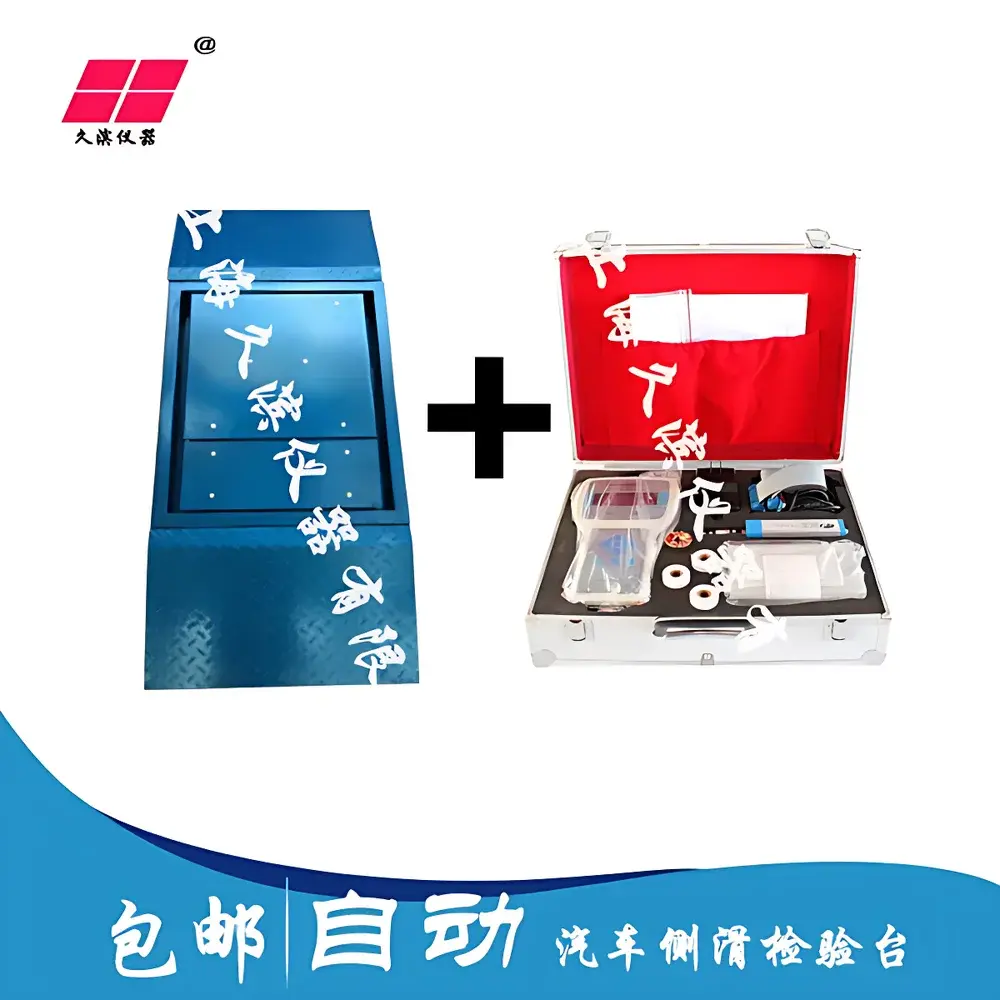
Jiubin JB-10 Single-Plate Automotive Side-Slip Test Bench
| Brand | Jiubin |
|---|---|
| Origin | Shanghai, China |
| Manufacturer Type | Authorized Distributor |
| Country of Origin | China |
| Model | JB-10 |
| Price | Upon Request |
| Load Capacity | 10 t |
| Measurement Range | ±10 m/km |
| Indication Error | ≤ ±0.2 m/km |
| Zero Offset Error | ±0.2 m/km |
| Sliding Plate Dimensions (L×W) | 500 × 700 mm |
| Overall Bench Dimensions (L×W×H) | 800 × 900 × 100 mm |
| Approach Ramp Dimensions | 800 × 500 mm |
| Compliance Standard | JT/T 507–2004 “Automotive Side-Slip Testing Benches” |
Overview
The Jiubin JB-10 Single-Plate Automotive Side-Slip Test Bench is an electromechanical measurement system engineered for precision evaluation of front-wheel alignment geometry in passenger vehicles and light commercial vehicles during routine safety inspections. It quantifies the lateral displacement—expressed as side-slip value in meters per kilometer (m/km)—generated when a vehicle traverses the bench at low speed (typically 3–5 km/h) under zero steering input. This displacement arises from the vectorial interaction between wheel camber angle and toe-in/toe-out setting, serving as a critical diagnostic indicator of dynamic straight-line stability and tire wear patterns. Unlike dual-plate systems that isolate left/right wheel contributions, the JB-10 employs a single free-floating sliding plate actuated by combined lateral forces from both front wheels, delivering a net resultant side-slip reading aligned with national regulatory inspection protocols.
Key Features
- Robust structural architecture with a load-bearing capacity of 10 metric tons, validated for repeated use in high-throughput workshop environments.
- High-stability sliding plate (500 mm × 700 mm) constructed from hardened steel with low-friction linear guidance, ensuring consistent mechanical response across operational life.
- Integrated strain-gauge-based displacement transducer with analog signal conditioning circuitry—featuring active filtering, programmable gain amplification, and 12-bit A/D conversion—to deliver measurement resolution compliant with JT/T 507–2004 requirements.
- DC 12 V control interface for enhanced electrical safety; all signal wiring conforms to IEC 61000-6-2 immunity standards for industrial electromagnetic environments.
- Modular approach ramp (800 mm × 500 mm) with anti-slip surface and precise leveling feet, enabling rapid installation and alignment verification using standard workshop spirit levels.
- Locking pin mechanism for secure immobilization of the sliding plate during non-operational periods or maintenance, preventing unintended drift or mechanical wear.
Sample Compatibility & Compliance
The JB-10 is designed for vehicles with front-axle gross weights up to 10 t, covering passenger cars, SUVs, vans, and light-duty trucks commonly serviced in certified automotive repair facilities. It does not support heavy-duty commercial vehicles or axle configurations exceeding its rated load envelope. The device complies fully with China’s national transportation industry standard JT/T 507–2004, which defines metrological performance criteria—including maximum permissible error (±0.2 m/km), repeatability limits, temperature sensitivity thresholds, and mechanical durability testing procedures—for side-slip test equipment used in statutory roadworthiness inspections. While not certified to ISO/IEC 17025 or EN 14301, its design principles align with internationally recognized alignment metrology practices for workshop-grade instrumentation.
Software & Data Management
The JB-10 operates as a standalone analog-digital hybrid instrument without embedded firmware or network connectivity. Readings are displayed on a local LED or LCD panel calibrated to show side-slip values directly in m/km units. For integration into digital inspection workflows, optional analog voltage output (0–5 V or 4–20 mA) is available via terminal block interface, enabling connection to third-party data acquisition modules or centralized inspection management systems. When interfaced with GLP/GMP-compliant recording platforms, the system supports audit-trail generation for calibration history, operator ID logging, and timestamped test records—facilitating traceability in regulated service environments. Calibration certificates issued by accredited metrology laboratories may be maintained alongside equipment logs to satisfy internal quality assurance requirements.
Applications
- Routine safety and emissions inspection stations performing mandatory annual or biennial vehicle certification per Chinese MOT regulations.
- Automotive repair workshops conducting pre-alignment diagnostics prior to four-wheel geometry correction using laser or CCD-based alignment racks.
- Vocational training institutes teaching wheel alignment theory, including camber-toe interaction modeling and empirical side-slip interpretation.
- Fleet maintenance depots monitoring long-term suspension component degradation through trend analysis of side-slip deviation over successive inspection cycles.
- Aftermarket parts validation labs assessing the impact of replacement control arms, tie rods, or hub assemblies on front-end kinematic behavior.
FAQ
What is the maximum axle weight the JB-10 can safely accommodate?
The JB-10 is rated for front axle loads up to 10 metric tons. Vehicles exceeding this limit must not be tested to prevent mechanical overload and potential sensor damage.
Does the JB-10 require periodic recalibration, and what is the recommended interval?
Yes. Per JT/T 507–2004, calibration verification shall be performed before each shift or daily in continuous operation environments. Full recalibration by an accredited metrology provider is advised every six months or after any physical impact or maintenance event affecting the sliding mechanism.
Can the JB-10 distinguish between left and right wheel contributions to total side-slip?
No. As a single-plate configuration, it reports the net lateral force vector. Dual-plate systems are required for independent left/right wheel analysis.
Is the unit compatible with international inspection standards such as EU Directive 2014/45/EU?
It meets functional equivalence for side-slip assessment but lacks formal CE marking or type approval under EU regulatory frameworks. Local regulatory acceptance depends on national implementation authorities.
What environmental conditions must be maintained during operation?
Ambient temperature: 5–40 °C; relative humidity: ≤85% RH (non-condensing); floor surface must be level (≤0.1° tilt), clean, dry, and structurally stable—no water exposure or roof leakage permitted.