
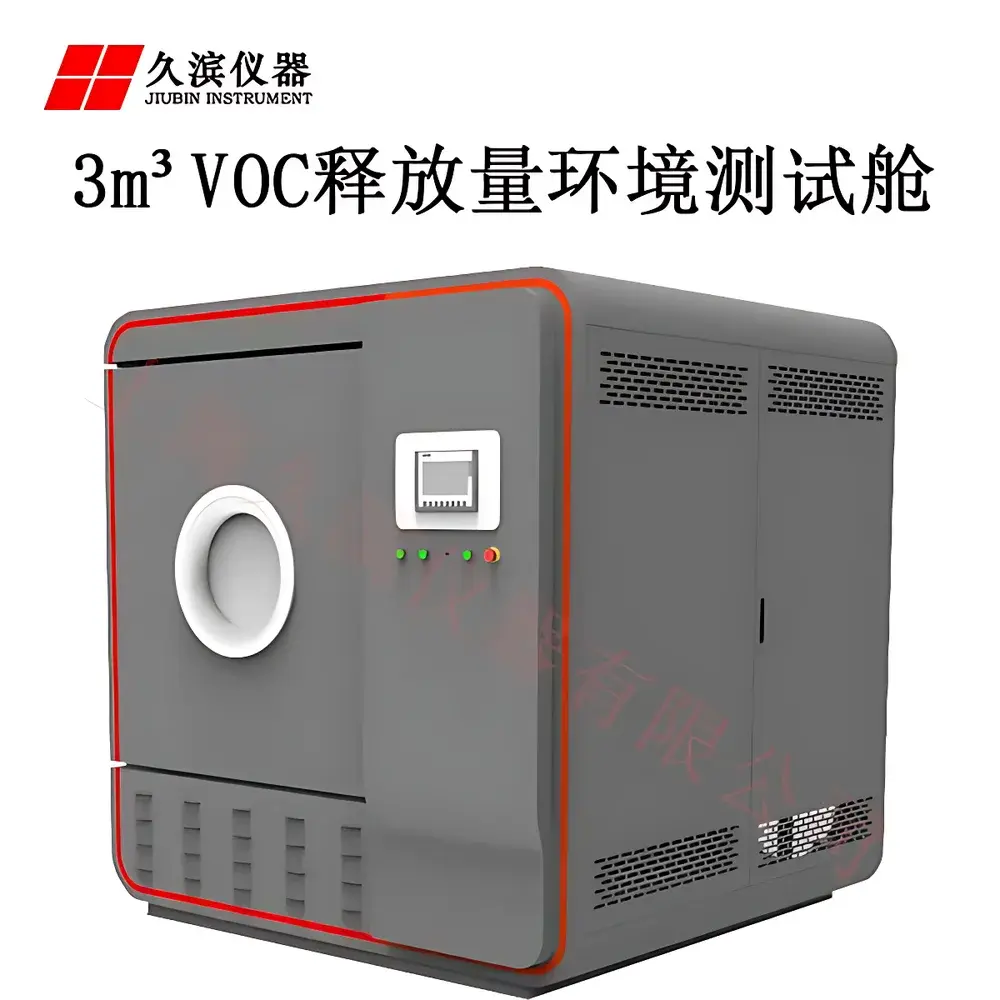
Jiubin JB-160-C 2–30 m³ Large-Volume Environmental Test Chamber for VOC and Formaldehyde Emission Testing
| Brand | Jiubin Instruments |
|---|---|
| Origin | Shanghai, China |
| Model | JB-160-C |
| Chamber Volume Range | 2–30 m³ |
| Application | Standardized VOC & Formaldehyde Emission Testing per ISO 16000, ASTM D6007, GB/T 18883, GB 50325 |
| Construction | Stainless Steel Inner Wall, Double-Glass Insulated View Window, PID-Controlled Temperature & Humidity System |
| Air Exchange Rate | Adjustable 0.1–2.0 h⁻¹ (±0.02 h⁻¹) |
| Temperature Control Range | 15–40 °C (±0.5 °C) |
| Relative Humidity Control Range | 30–70 %RH (±3 %RH) |
| Airflow Uniformity | ≥90 % across test zone |
| Internal Surface Emission | <0.5 µg/m²·h (TVOC), <0.1 µg/m²·h (Formaldehyde) |
| Compliance | Designed to meet ISO 16000-9, ISO 16000-11, ASTM D5116, JIS A 1901, GB/T 31106–2014 |
Overview
The Jiubin JB-160-C is a large-volume environmental test chamber engineered for standardized determination of volatile organic compound (VOC) and formaldehyde emissions from building materials, furniture, automotive interior components, and consumer products. Operating on the principle of dynamic chamber testing—where conditioned air continuously flows through a sealed test volume containing the specimen—the system enables quantitative analysis of emission rates under controlled temperature, relative humidity, and air exchange conditions. With an adjustable internal volume ranging from 2 to 30 m³, the JB-160-C accommodates full-scale or representative-size samples (e.g., floor coverings, wall panels, dashboards, upholstered seating), ensuring compliance with internationally recognized protocols including ISO 16000-9 (chamber method), ISO 16000-11 (emission rate calculation), ASTM D5116 (small-scale chamber), ASTM D6007 (wood-based panels), and Chinese national standards GB/T 31106–2014 and GB 50325. Its stainless steel interior, low-emission construction, and precision PID-controlled climate system minimize background interference and ensure measurement reproducibility essential for regulatory reporting and product certification.
Key Features
- Modular volume configuration: Interchangeable inner partitions allow flexible adjustment between 2 m³ (for small-sample screening) and 30 m³ (for full-scale product evaluation), maintaining uniform airflow distribution and thermal stability across all settings.
- High-fidelity climate control: Dual independent PID loops regulate temperature (15–40 °C ±0.5 °C) and relative humidity (30–70 %RH ±3 %RH); integrated pre-conditioning ductwork ensures stable inlet air parameters prior to chamber entry.
- Trace-level background integrity: Internal surfaces are electropolished stainless steel (AISI 316L) with welded seams and zero organic sealants; validated blank emission rates remain below 0.1 µg/m²·h for formaldehyde and 0.5 µg/m²·h for total VOCs.
- Precision air exchange management: Mass flow-controlled dilution system delivers calibrated air exchange rates from 0.1 to 2.0 h⁻¹ with accuracy better than ±0.02 h⁻¹—critical for kinetic emission profiling and steady-state rate derivation.
- Non-intrusive monitoring interface: Integrated sensor array (NDIR CO₂, electrochemical O₂, capacitive RH, Pt100 RTD) feeds real-time data to the central controller; all parameters logged at user-defined intervals with UTC timestamping.
Sample Compatibility & Compliance
The JB-160-C supports diverse sample geometries and material classes—including laminate flooring, particleboard, medium-density fiberboard (MDF), upholstered furniture, automotive trim composites, insulation foams, and coated metals—without requiring size reduction that may compromise emission kinetics. Sample loading follows ISO 16000-11 surface-area-to-volume ratio guidelines (typically 0.4–1.0 m²/m³). The chamber’s design conforms to Good Laboratory Practice (GLP) requirements for auditability: all calibration records, maintenance logs, and test reports are time-stamped and stored with immutable metadata. It serves as a primary emission testing platform in laboratories accredited to ISO/IEC 17025 and routinely referenced in submissions to China’s CCC certification body, EU Eco-label assessment bodies, and U.S. EPA Indoor Air Quality initiatives.
Software & Data Management
The embedded control software provides intuitive setup of test protocols (e.g., preconditioning, purge, equilibration, sampling phases), automatic generation of emission curves (µg/m²·h vs. time), and export of raw sensor data in CSV and XML formats compatible with LIMS integration. Audit-trail functionality meets FDA 21 CFR Part 11 requirements: all user actions, parameter changes, and report generations are logged with operator ID, timestamp, and reason-for-change fields. Optional add-ons include remote access via TLS-secured web interface and automated report templating aligned with GB/T 31106–2014 Annex B and ISO 16000-11 Annex C.
Applications
- Regulatory compliance testing for indoor air quality standards (GB/T 18883, GB 50325, California Section 01350, French A+ labeling).
- Emission profiling of low-VOC adhesives, water-based coatings, and bio-based composites during R&D.
- Validation of photocatalytic or adsorbent-based mitigation technologies under realistic loading conditions.
- Comparative evaluation of material substitutions in automotive OEM supply chains (e.g., dashboard substrates, headliner fabrics).
- Third-party verification for green building certifications (LEED IEQ Credit 4.3, WELL Building Standard W09).
FAQ
What standards does the JB-160-C support for formaldehyde emission testing?
It complies with ISO 16000-3, ISO 16000-9, GB/T 17657–2013 (Method 4.12), and JIS A 1901 for formaldehyde quantification using DNPH-HPLC or spectrophotometric analysis of chamber air samples.
Can the chamber be validated for ISO/IEC 17025 accreditation?
Yes—its metrological traceability, documented uncertainty budgets for temperature/humidity/airflow, and GLP-aligned software audit trail support full scope accreditation for emission testing.
Is external analytical instrumentation required?
Yes. The chamber itself performs controlled emission generation; downstream analysis requires certified GC-MS, TD-GC-MS, or HPLC systems for speciated VOCs and formaldehyde, per ISO 16000-6 and ISO 16000-3 protocols.
How is uniform airflow verified inside the chamber?
Air velocity mapping is conducted using calibrated hot-wire anemometers at ≥25 grid points; uniformity ≥90 % across the test zone is verified during factory acceptance testing and repeated annually per ISO 16000-9 Annex B.
Does the system support multi-day continuous operation?
Yes—designed for unattended 168-hour (7-day) emission tests with redundant power supply monitoring, alarm-triggered SMS/email notifications, and automatic data backup to network storage.







