
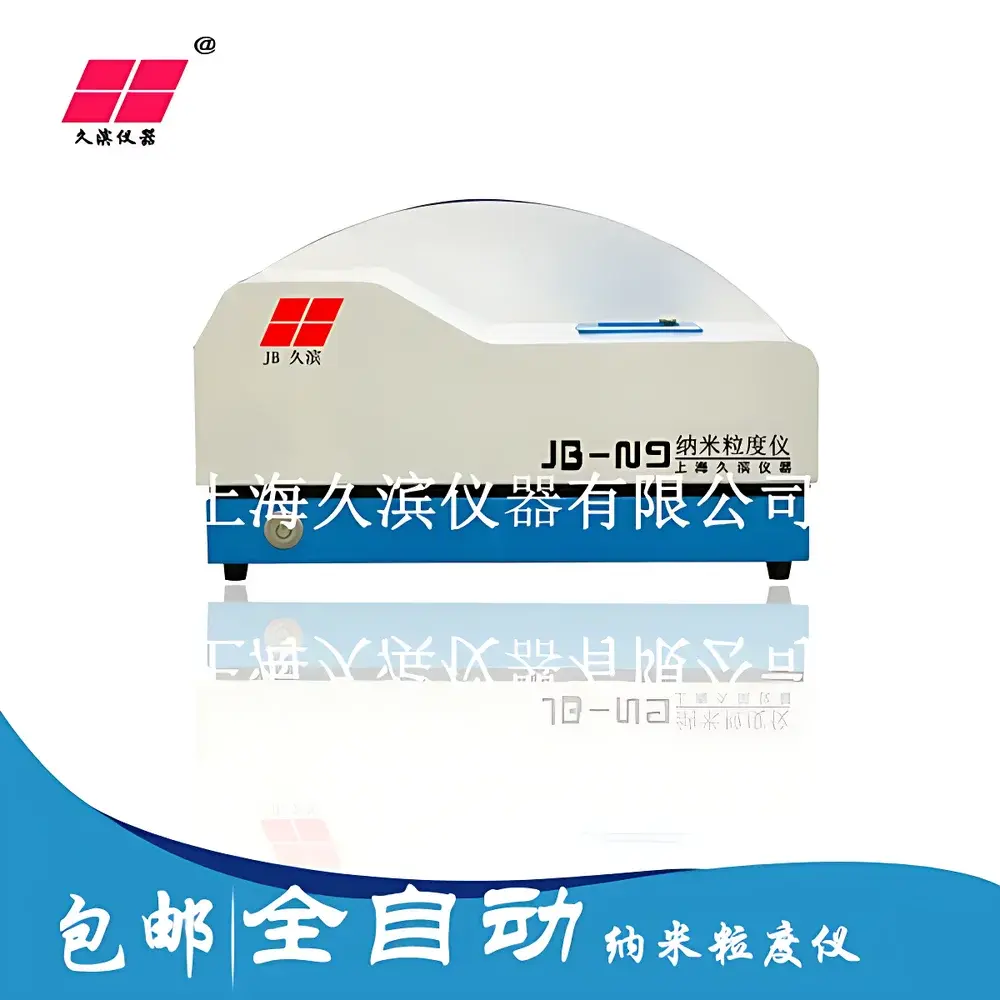
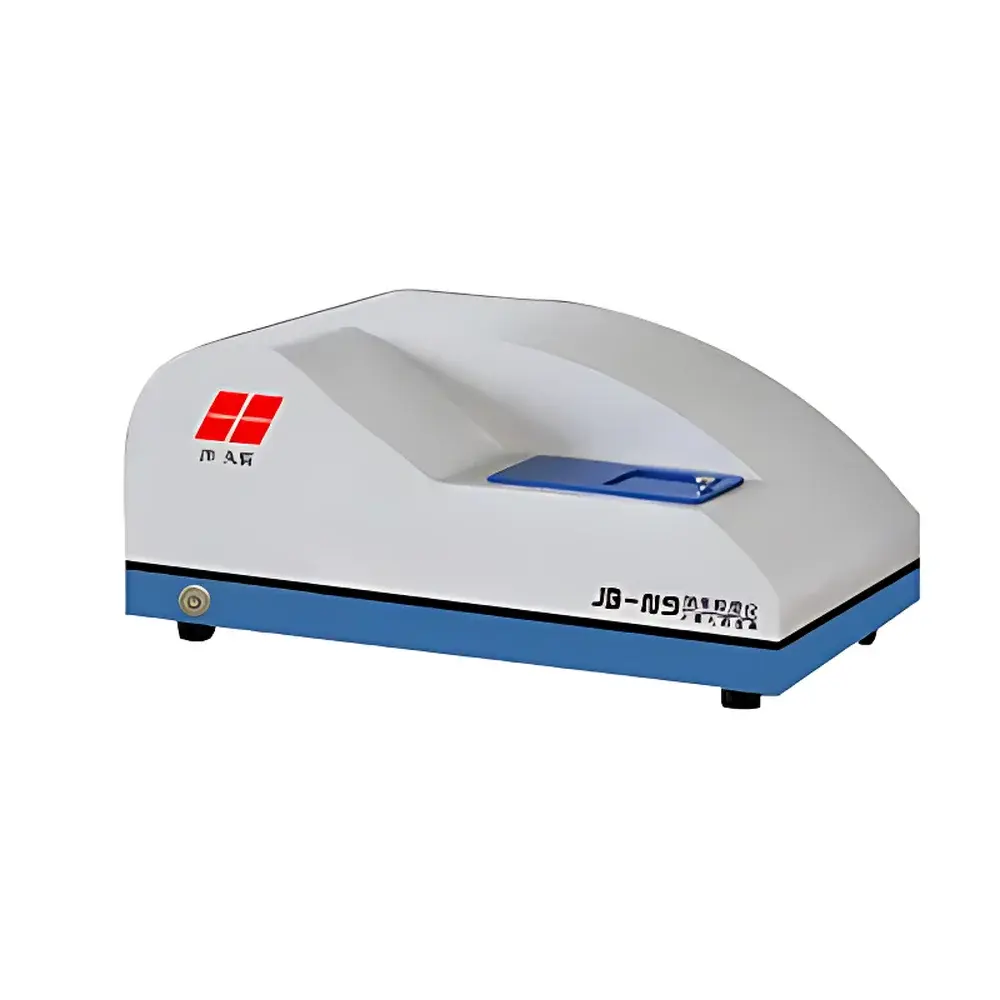
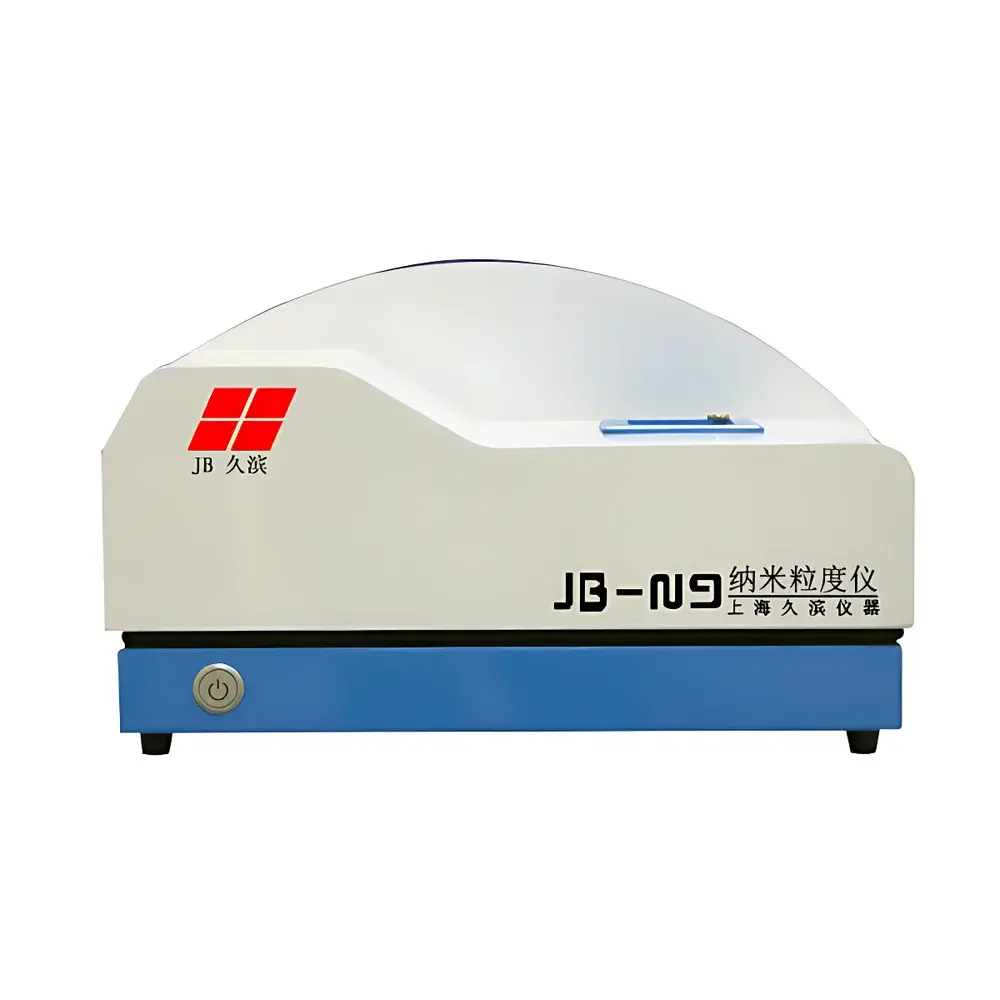
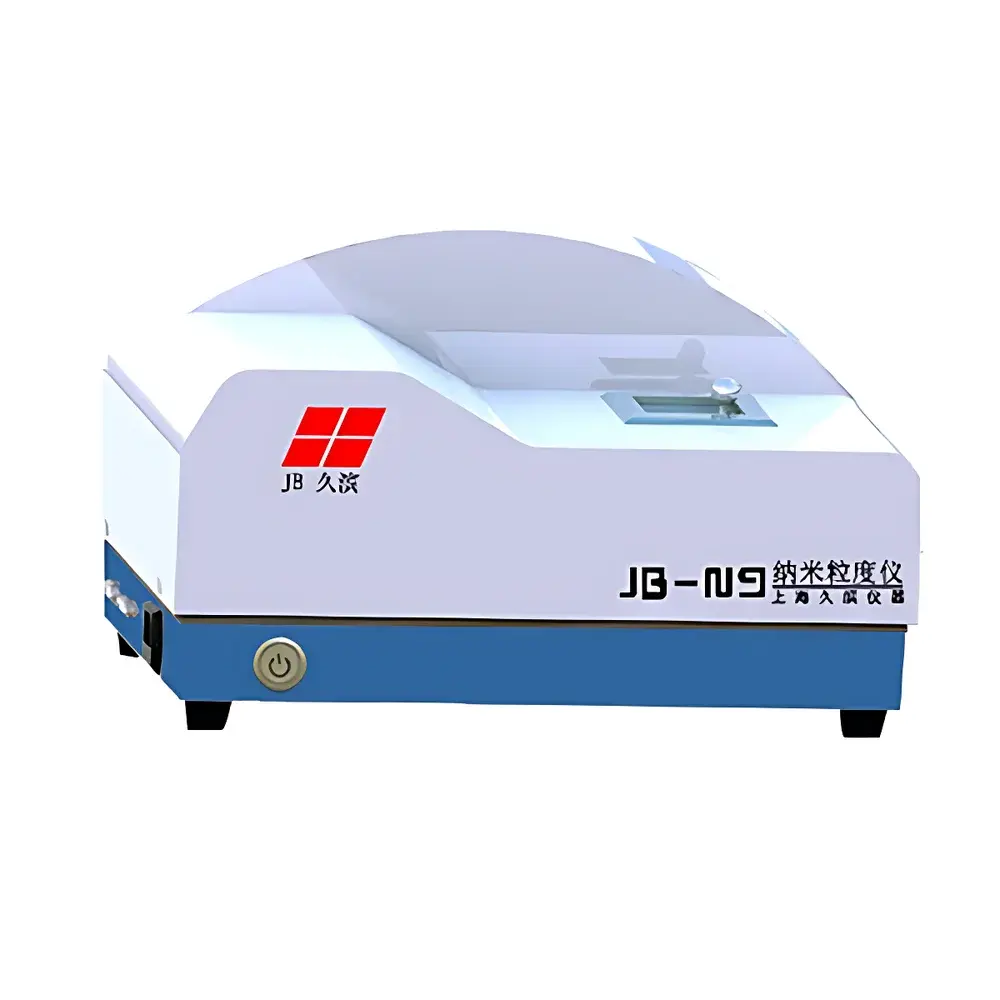
JB-N9 Nanoparticle Size Analyzer (Dynamic Light Scattering, DLS)
| Brand | Jiubin Instruments |
|---|---|
| Model | JB-N9 |
| Origin | Shanghai, China |
| Laser Wavelength | 532 nm (LD-pumped, temperature-stabilized) |
| Detection Angle | 90° |
| Detector | Hamamatsu Photomultiplier Tube (PMT) with Single-Mode Polarization-Maintaining Fiber |
| Sample Cell | 10 mm × 10 mm quartz cuvette, 4 mL capacity (temperature-controlled) |
| Measurement Range | 1–10,000 nm (sample-dependent) |
| Concentration Range | 0.1–100 mg/L |
| Accuracy | <1% (vs. NIST-traceable standard reference materials) |
| Repeatability | <1% (RSD of mean diameter) |
| Temperature Control Range | 8–45 °C (±0.1 °C stability) |
| Correlator | Custom ASIC-based high-speed photon correlator |
| Data Analysis | Cumulant method + regularized non-negative least-squares (NNLS) inversion |
| Output | Z-average diameter (d<sub>Z</sub>), polydispersity index (PDI), intensity-weighted size distribution, volume/mass distribution (derived), full exportable distribution tables and plots |
| Measurement Time | <60 s per run (excluding dispersion preparation) |
| Compliance | GB/T 29022–2012, ISO 22412:2008 |
| Dimensions | 390 × 255 × 240 mm |
| Power | AC 100–260 V, 50/60 Hz, max. 80 W |
| Operating Environment | 15–40 °C, 20–70% RH, non-condensing |
Overview
The JB-N9 Nanoparticle Size Analyzer is a laboratory-grade dynamic light scattering (DLS) instrument engineered for precise, reproducible hydrodynamic diameter measurement of colloidal nanoparticles in liquid suspension. Based on the physical principle of Brownian motion—where particle diffusion coefficients are inversely proportional to hydrodynamic size—the JB-N9 quantifies temporal fluctuations in scattered laser intensity (at 532 nm) via photon correlation spectroscopy (PCS). This enables robust determination of the Z-average diameter (dZ) and polydispersity index (PDI) in accordance with ISO 22412:2008 and GB/T 29022–2012. Its optomechanical architecture integrates a temperature-stabilized solid-state laser diode, a single-mode polarization-maintaining fiber-coupled Hamamatsu PMT detector, and a 90° orthogonal detection geometry optimized for signal-to-noise ratio and minimal multiple scattering artifacts. The system is calibrated using NIST-traceable polystyrene latex standards and validated against certified reference materials to ensure metrological traceability.
Key Features
- High-fidelity optical path: 532 nm LD-pumped laser with active thermal stabilization to maintain wavelength stability and beam pointing accuracy over extended operation.
- Ultra-low-noise detection: Hamamatsu R-series photomultiplier tube coupled via polarization-maintaining fiber, delivering high quantum efficiency (>25%) and dark current <50 counts/s at operating gain.
- Dedicated hardware correlator: Application-specific integrated circuit (ASIC) enables real-time autocorrelation computation at up to 100 MHz sampling rate with 4,096 channels and sub-microsecond resolution.
- Precision thermostatic sample chamber: Peltier-controlled cuvette holder (10 × 10 mm quartz cell, 4 mL volume) maintains temperature within ±0.1 °C across 8–45 °C range—critical for viscosity-dependent diffusion coefficient calculation.
- Intelligent data acquisition: Auto-optimization of count rate, acquisition time, and correlator delay settings ensures optimal signal fidelity without user intervention.
- Comprehensive analysis suite: Dual-algorithm processing—cumulant analysis for rapid dZ and PDI reporting, plus Tikhonov-regularized NNLS inversion for high-resolution intensity-weighted size distributions.
Sample Compatibility & Compliance
The JB-N9 supports aqueous and organic dispersions of metallic nanoparticles (e.g., Au, Ag), metal oxides (TiO2, SiO2), polymeric nanoparticles (PLGA, PS), liposomes, protein aggregates, and virus-like particles—provided samples fall within the operational concentration window (0.1–100 mg/L) and exhibit sufficient scattering contrast. It complies fully with ISO 22412:2008 (‘Particle size analysis — Dynamic light scattering’) and its Chinese national equivalent GB/T 29022–2012. All calibration and verification procedures align with ISO/IEC 17025 requirements for testing laboratories. While not inherently 21 CFR Part 11 compliant out-of-the-box, audit trails, electronic signatures, and data integrity controls can be implemented via optional software modules meeting GLP/GMP documentation standards.
Software & Data Management
The proprietary JB-DLS software (Windows 10/11 compatible) provides intuitive workflow-driven operation: automated alignment validation, one-click measurement initiation, real-time correlation curve visualization, and post-acquisition batch processing. Raw intensity autocorrelation functions (ACFs), fitted residuals, and regularization parameter selection are fully inspectable. Export formats include CSV (distribution tables), PNG/SVG (publication-ready plots), and XML (for LIMS integration). All measurement metadata—including instrument parameters, environmental logs, and operator ID—are embedded in each data file. Version-controlled software updates follow ICH Q5A and ISO 13485-aligned change management protocols.
Applications
- Quality control of nanomedicine formulations (liposomal doxorubicin, mRNA-LNPs) during development and manufacturing.
- Stability assessment of colloidal dispersions under thermal stress or long-term storage (via time-resolved DLS).
- Verification of nanoparticle synthesis consistency (e.g., citrate-reduced gold colloid batch-to-batch comparability).
- Aggregation kinetics monitoring in biopharmaceuticals (monoclonal antibodies, fusion proteins) under varying pH or ionic strength conditions.
- Supporting regulatory submissions where particle size distribution is a critical quality attribute (CQA), per ICH Q5A and USP <729>.
- Academic research in soft matter physics, polymer science, and environmental nanotoxicology requiring statistically robust ensemble-averaged sizing.
FAQ
What is the minimum detectable particle size under optimal conditions?
The theoretical lower limit is ~1 nm for monodisperse, highly scattering particles (e.g., 5 nm gold colloids) in low-viscosity solvents at ideal concentration (1–10 mg/L); practical resolution depends on signal-to-noise ratio and sample purity.
Can the JB-N9 measure zeta potential?
No—zeta potential requires electrophoretic light scattering (ELS), which is not supported by this DLS-only platform. A separate zeta potential analyzer is required for surface charge characterization.
Is the software validated for regulated environments (e.g., pharmaceutical QC labs)?
The base software meets functional requirements for routine sizing but requires site-specific validation (IQ/OQ/PQ) and configuration control to satisfy FDA 21 CFR Part 11 or EU Annex 11 compliance; optional GxP-ready modules are available upon request.
How does temperature control impact measurement accuracy?
Temperature directly affects solvent viscosity and thus the Stokes-Einstein relationship used to convert diffusion coefficient to size; ±0.1 °C stability ensures dZ uncertainty remains below ±0.5% for particles >10 nm.
Does the system support multi-angle DLS or depolarized detection?
No—it operates exclusively at fixed 90° scattering geometry and uses vertically polarized incident light with co-polarized detection, consistent with ISO 22412 recommendations for routine monomodal analysis.



