
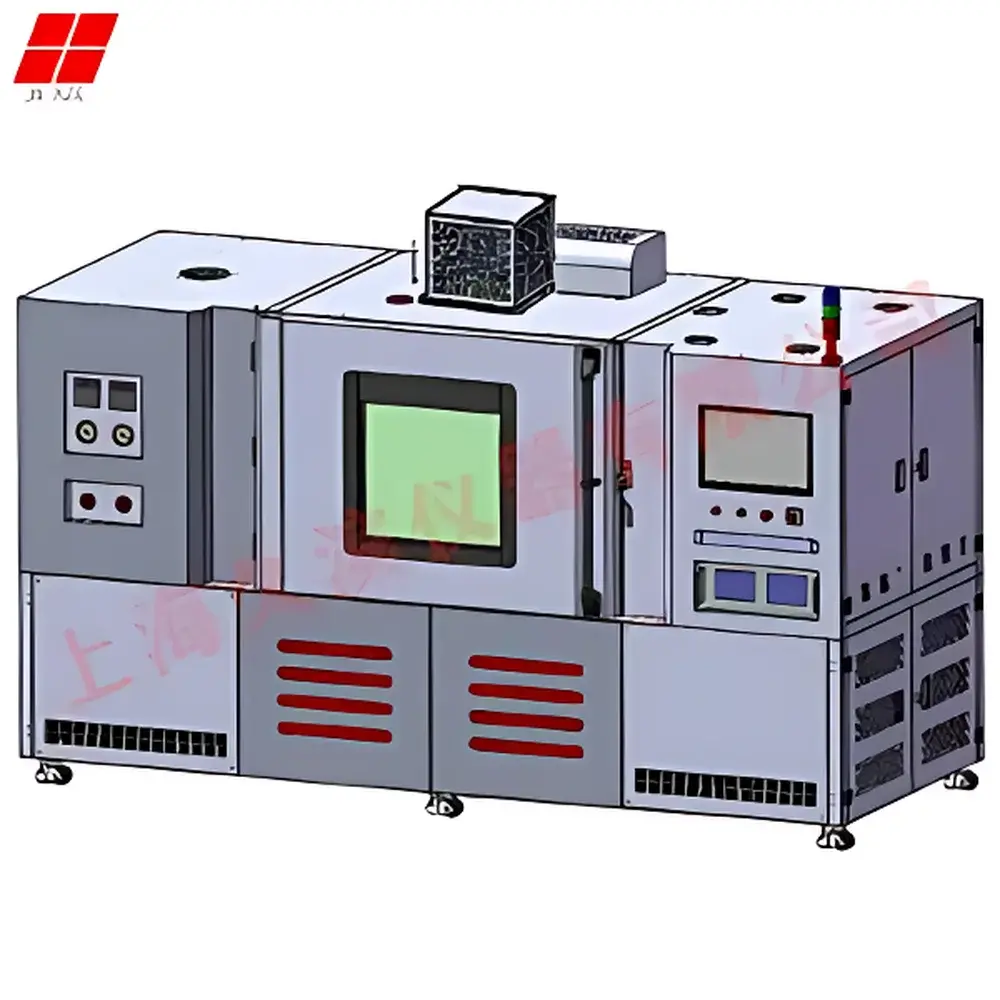
JB-Bin JB-99 Pressure Pulse Fatigue Testing System
| Brand | JB-Bin |
|---|---|
| Origin | Shanghai, China |
| Model | JB-99 |
| Pressure Range | 0–40 MPa (pulse), 0–500 MPa (burst) |
| Frequency Range | 0–5 Hz |
| Waveform Options | Square, Trapezoidal, Triangular, Sinusoidal |
| Medium Temperature | −60 °C to 200 °C |
| Ambient Temperature Range | −70 °C to 155 °C |
| Cycle Life Capacity | ≥2 million cycles |
| Test Medium | Water, Oil, Ethylene Glycol Mixtures, Compressed Air, Vacuum |
| Compliance | Configurable for ISO 6803, ISO 6772, SAE J1401, GB/T 20462, ASTM D3078 |
Overview
The JB-Bin JB-99 Pressure Pulse Fatigue Testing System is an engineered platform for evaluating the structural integrity and long-term durability of pressure-containing components under dynamic cyclic loading. It operates on the principle of controlled hydraulic or pneumatic pressure pulsation—applying repeatable, programmable waveforms to simulate real-world service conditions such as thermal-mechanical stress cycling, start-stop operation, and transient overpressure events. Designed for rigorous industrial validation, the system supports static pressure hold, burst testing, leak detection, thermal cycling, and combined environmental–mechanical fatigue protocols. Its modular architecture integrates pressure generation, thermal conditioning, and digital control subsystems into a single coordinated test environment, enabling reproducible qualification per international design verification standards.
Key Features
- Multi-mode pressure actuation: Independent hydraulic (liquid) and pneumatic (gas/vacuum) circuits with high-fidelity pulse generation up to 40 MPa at frequencies from 0.01 to 5 Hz
- Dual thermal control system: Simultaneous regulation of test medium temperature (−60 °C to 200 °C) and ambient chamber temperature (−70 °C to 155 °C), supporting coupled thermo-mechanical fatigue testing
- Waveform flexibility: Programmable pressure profiles—including square, trapezoidal, triangular, and sinusoidal—as well as user-defined custom waveforms via digital signal synthesis
- Modular integration capability: Native interface for coupling with environmental chambers and electrodynamic vibration shakers, enabling combined pressure–temperature–vibration (P–T–V) test sequences
- Robust mechanical construction: Stainless steel internal chamber lining, powder-coated steel enclosure, and sealed hydraulic manifold design for long-term reliability in laboratory and production QA environments
- Fail-safe monitoring: Real-time pressure transducer feedback, overpressure cut-off, thermal interlocks, and automated fault logging compliant with functional safety principles (IEC 61508)
Sample Compatibility & Compliance
The JB-99 accommodates a broad range of tubular, assembled, and welded pressure components—including heat exchangers, condensers, automotive HVAC cores, hydraulic hose assemblies, brake lines, powertrain fluid conduits, and pressurized reservoirs. Fixturing is configurable for standardized test ports (e.g., SAE J1401 quick-connect interfaces) and custom adapters. The system supports test execution and documentation traceability aligned with ISO 6803 (rubber hoses), ISO 6772 (metallic tubes), SAE J1401 (automotive coolant hoses), GB/T 20462 (Chinese national standard for hydraulic components), and ASTM D3078 (leak integrity testing). Audit-ready data capture meets GLP and GMP requirements, including electronic signatures, time-stamped event logs, and 21 CFR Part 11–compliant report generation when paired with validated software configurations.
Software & Data Management
Control and acquisition are managed through a dedicated Windows-based application with deterministic real-time I/O handling. The software provides synchronized sampling of pressure waveform (≥10 kHz effective sampling rate), cycle count, frequency, medium temperature, ambient temperature, and elapsed test time. All parameters are logged in IEEE-compliant binary format with metadata embedding (test ID, operator, calibration status, environmental setpoints). Reporting modules generate PDF/CSV outputs with statistical summaries (mean pressure amplitude, standard deviation per 10,000 cycles, failure onset timing), trend charts, and pass/fail annotations against preloaded acceptance criteria. Optional database integration supports SQL Server or PostgreSQL backends for enterprise-level test data archiving and cross-system traceability.
Applications
- Qualification testing of automotive cooling and braking systems per OEM engineering specifications (e.g., Ford WSS-M97B44-D, GM GMW14872)
- Design validation of aerospace fluid manifolds and fuel delivery lines under combined thermal and pressure cycling
- Regulatory compliance testing for medical device fluid circuits (ISO 14971 risk analysis support)
- Accelerated life assessment of industrial heat exchanger tube sheets and gasketed joints
- Material development studies on elastomeric composites, thermoplastic hoses, and metal–polymer hybrid assemblies
- Root cause analysis of field failures involving pressure-induced fatigue cracking, delamination, or seal extrusion
FAQ
What pressure media are supported by the JB-99 system?
Water, mineral oil, ethylene glycol–water mixtures, compressed air, nitrogen, and vacuum—all selectable via configurable fluid path valving and material-compatible wetted components.
Can the system perform simultaneous pressure pulsing and thermal cycling?
Yes. The dual-zone thermal control enables independent regulation of internal medium temperature and external chamber temperature, allowing fully synchronized P–T profiles per test protocol.
Is the JB-99 suitable for regulatory submission testing?
When operated with calibrated transducers, validated software, and documented procedures, it supports data packages for FDA 510(k), CE marking, and IATF 16949-certified production part approval processes.
What is the maximum number of test cycles the system can execute without maintenance?
Rated for ≥2 million uninterrupted cycles under nominal 20 MPa pulsation at 2 Hz; scheduled maintenance intervals are defined in the operator manual based on cumulative operating hours and fluid contamination metrics.
Does the system include hardware for vibration integration?
Vibration shaker coupling is optional and requires mechanical interface plates, signal synchronization modules, and extended software licensing—available as JB-99-VIB add-on package.



